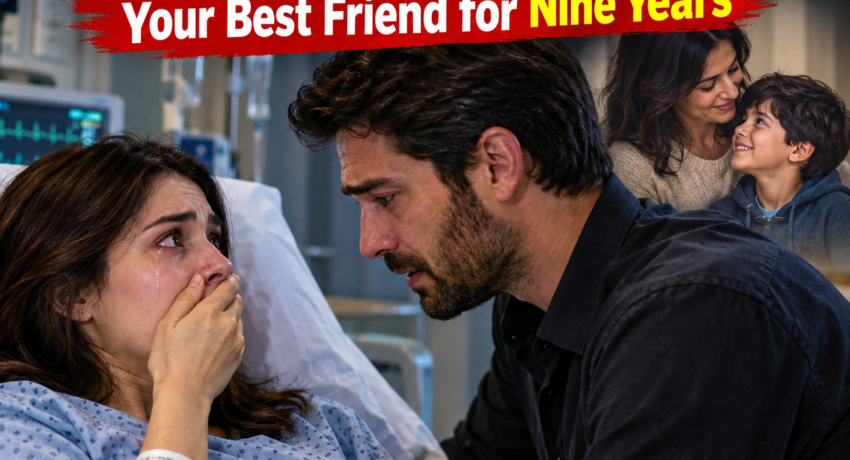
Two hours before they wheeled me into brain surgery, my husband set divorce papers on my hospital sheet and told me to sign before I lost consciousness — or my memory. “I’ve been with your best friend for nine years,” he said. “We have a son.” I didn’t cry. I didn’t argue. I picked up the pen, signed exactly where his finger was pointing, and closed my eyes for surgery already knowing exactly what I’d do the moment I woke up. He thought he was walking away with everything. He had no idea whose name was actually on the deed to the life he was so proud of.
PART 1
“Sign the divorce papers before they open up your skull. If you don’t wake up, at least Claudia and I can get married without any red tape.”
Those were my husband’s exact words, two hours before I was scheduled for brain tumor surgery.
My name is Camila Vance. I’m forty-five, and for fifteen years I believed I was married to a flawed but fundamentally decent man. That morning, lying in a private Chicago hospital room with an IV taped to my wrist, I expected Alejandro to walk in, hold my hand, and tell me everything would be fine.
Instead he arrived in a brand-new tailored suit, smelling of expensive cologne, carrying a leather portfolio like he was closing a deal.
“Why are you dressed like that?” I asked. My voice came out raspy.
“I have an important business lunch,” he said smoothly.
He slid several pages out of the folder and set them directly on my hospital sheet.
“Claudia and I want to start our life together. Her son just turned one. My son. I’ve waited long enough.”
The heart monitor beside me started beeping faster.
Claudia wasn’t some stranger he’d met at the office. She had been my best friend since high school. When doctors found my tumor six months earlier, she was the first person to hug me and promise she’d help take care of Alejandro while I went through treatment.
Now I understood exactly what kind of “help” she’d been giving him.
“Nine years,” he said, almost proud of it. “I know that’s a lot to take in right now.”
Nine years. He had been living an entire second life for nearly a decade, and Claudia had only decided to make it official once she finally had something to show for it — a baby, and a story where I was the obstacle instead of the wife.
He kept talking, calm in a way that scared me more than shouting would have.
“Look, Camila, I don’t want to be cruel, but you could never give me children. Now you’re sick. Claudia is young, healthy, and she gave me a boy. I deserve a real family too.”
“How long have you two actually been together?”
“That doesn’t matter anymore.”
“And the baby?”
He smiled, proud of himself.
“He’s mine. And as your best friend, Claudia thinks you should be happy for us.”
Then he leaned over the bed.
“Let’s be realistic. If something goes wrong in there, I don’t want to be stuck fighting through probate and hospital bureaucracy for months. And if you wake up fine, we both know this is happening anyway. Either way, just sign now and save us both the mess later.”
Fifteen years of marriage, reduced to a signature, minutes before I was wheeled into an operating room.
I looked at him. And then, strangely, my fear disappeared. In its place came a very cold, very clear kind of calm.
“Okay.”
Alejandro blinked. “What?”
“I’ll sign.”
With the IV still taped to my wrist, I took the pen in my trembling hand and signed the bottom line.
He grabbed the papers immediately, smiling like a man who’d just closed his biggest deal of the year.
“I knew you’d understand in the end. Good luck with the operation.”
He walked out without kissing me, without touching my shoulder, without looking back once.
I didn’t cry. Because Alejandro had no idea about one fundamental truth sitting underneath our entire marriage.
The luxury high-rise condo downtown where he planned to move Claudia hadn’t been paid for by him. The platinum cards funding his tailored suits, his watches, his restaurants and vacations weren’t supported by his modest salary. And the monthly wire that had been quietly keeping his parents’ struggling carpentry workshop in Indiana afloat for years didn’t come from his “investments.”
Every cent of it came from me.
My late father had spent forty years building a commercial real estate empire. When he died, I inherited properties, holdings, and an independent trust that had always been kept legally separate from marital assets. I had never once flaunted that to Alejandro. I told myself protecting his fragile pride was an act of love.
That had been my greatest mistake.
When the surgical team came in to prep me, I closed my eyes and made one promise to myself.
If I wake up, the lie is over.
The surgery lasted seven hours.
PART 2
When I opened my eyes in recovery, my neurosurgeon was smiling down at me.
“Camila, it went brilliantly. We resected the tumor completely, no complications.”
I hadn’t just survived. I had come back in time to watch Alejandro discover exactly who had been financing the luxurious life he loved claiming as his own.
I didn’t say a word to him about it yet. I let him believe he’d gotten away clean.
A week later, once I could walk steadily down the hospital corridor on my own, I called Richard Calloway, my family’s longtime estate attorney. He had managed our holdings since long before Alejandro ever entered my life.
I told him everything.
Silence on the line. Then:
“Camila, I need your formal authorization for three things,” Richard said, crisp and businesslike, like I’d asked him to review a lease instead of end a marriage. “Freeze the voluntary monthly allowance to your in-laws. Remove Alejandro as an authorized user on every primary credit account. Separate the joint operational funds, effective immediately.”
“Do it today.”
“And the downtown condo?”
“Protect my assets,” I said. “No illegal lockout. We do this by the book, every step.”
He didn’t ask if I was sure. He already knew I was.
At nine the next morning, Alejandro learned that his platinum card couldn’t buy a cup of coffee.
He called me screaming.
“What did you do to my accounts?!”
“Your accounts, Alejandro?”
“Don’t play dumb with me! I’m at a dealership right now trying to buy Claudia a new SUV, and the card just got declined in front of everybody!”
“Maybe try your own salary,” I said softly, and hung up.
He was still shouting into a dead line when Claudia walked into my hospital room two hours later.
PART 3
She was wearing a hot-pink designer dress and carrying a bag that cost more than most people’s monthly rent. No flowers. She didn’t bring flowers.
“Well, look at you — you actually survived,” she said, her voice syrupy with fake sweetness. “How awkward.”
She dropped into the armchair like she owned the room.
“Alejandro told me you signed the papers. Thank you, Camila. We can finally be a real family.”
She pulled out her phone and held it up to my face. A photo of her, Alejandro, and the toddler at a Miami resort. Alejandro was wearing the gold watch I’d given him for our tenth anniversary.
“Look at him,” she gloated. “He was never truly happy with you. You were a burden. Now he has a real woman and a son.”
I let her keep going without changing my expression, and she kept going, because people like Claudia can’t stop themselves once they think they’ve won.
“Alejandro makes incredible money. He’s getting promoted to vice president next month. We’re already planning our permanent move into your — well, his — downtown condo.”
Then, right before she left, she added one more thing, almost as an afterthought.
“By the way, this weekend Alejandro and I are taking the baby to visit your parents’ memorial plot. He wants to introduce us as his new family. At their headstone.”
That landed somewhere deeper than anything else she’d said.
My parents were the one thing I hadn’t let anyone touch. Not once, in fifteen years, had I allowed Alejandro to turn them into a prop for anything.
The idea of him standing at their grave with Claudia and that baby, performing a family photo op on the ground where my mother and father were buried, made my blood go cold in a way the frozen credit cards never had.
As soon as Claudia left, I called Father Thomas, an old family friend who oversaw the parish beside the cemetery where my parents rested. I told him what was planned.
He didn’t hesitate. “No one is turning that ground into a stage, Camila. Not while I’m there.”
I thought that would be the worst of my day.
I was wrong. Alejandro called that same afternoon — on video this time — and what I saw on the screen behind him was so much worse than anything Claudia had said out loud.
PART 4
My downtown living room looked like a demolition site.
My clothes were stuffed into black trash bags, lined up against the wall like they were waiting for a garbage truck. My antique books had been swept off the shelves and left scattered across the floor. Claudia stood in front of my mirror, trying on one of my tailored cashmere coats, turning side to side to admire herself. Beside her stood my in-laws.
“We’re finally clearing out your junk,” Alejandro said into the camera, grinning. “This place needs a younger, more vibrant woman living in it.”
My mother-in-law leaned in close to the screen.
“Camila, you aren’t family anymore. Claudia actually gave us a grandson.”
Then Alejandro picked something up off the floor — a small wooden keepsake box. My parents’ photo albums were inside it. So was my late father’s vintage pocket watch, the one he’d worn every day of his working life.
“This junk is going straight to the dumpster,” he laughed, weighing it in his hand like garbage.
“Don’t you dare touch those,” I said, my voice quiet and even.
All four of them laughed.
Then the screen went black.
My hands were still shaking ten minutes later when Richard walked into my room carrying a folder thicker than any he’d ever brought me before.
“We have several developments, Camila,” he said, setting it on my lap. “This morning, Alejandro attempted to present himself as the sole owner of one of your commercial properties in order to secure an unauthorized business loan. His firm’s compliance department has already opened an internal investigation into his conduct.”
“How could he be that reckless?”
“Because he’s spent fifteen years convincing himself that everything he touched was his,” Richard said. “But that isn’t the most important thing in this folder.”
He pulled out a certified legal document.
“Since Claudia is now a party to the contested asset dispute, we ran a standard background check on her. It surfaced an active paternity and child-support case, filed in Cook County eight months ago. There’s a certified DNA report in the court record — public record, anyone with the case number can pull it.”
A chill moved through me.
“For the baby?”
Richard nodded once.
“Yes.”
“And Alejandro?”
He looked at me without a trace of emotion.
“Alejandro is not the biological father.”
PART 5
Two days later, my doctor approved a four-hour leave from the step-down unit. He objected at first, then agreed, on the condition there’d be no physical exertion — only, as I told him, “a critical legal disclosure that can’t wait.”
At nine that morning, a private car dropped me outside a glass skyscraper in downtown Chicago. The tower housed Alejandro’s corporate headquarters. What he had never bothered to look into, in all his years of bragging about his office view, was that the entire building belonged to a real estate holding company controlled by my family’s foundation. His CEO, Stephen Miller, had been a close associate of my father for decades, and the Vance family trust held a major investment stake in the firm itself.
I heard Alejandro before I saw him.
He’d brought Claudia, the baby, and his parents into the office to show them off to his colleagues.
“I want everyone to meet my real family!” he was announcing to a group of visibly uncomfortable managers. “I finally cut ties with a sick, helpless wife who was living off my hard work.”
Claudia stood proudly beside him, designer bag on her arm. His parents stood nearby, looking far more panicked than proud.
“Alejandro,” his mother said, her voice trembling. “The bank just froze our workshop’s line of credit in Indiana. They said the monthly subsidy wire was canceled. You promised us that money was secure!”
He waved her off. “Calm down, Mom. Camila just locked the secondary accounts because she’s bitter. I’ll have my lawyers sort it out.”
“We owe over a hundred thousand dollars on new industrial saws!” his father said. “We took out those equipment loans because you swore those monthly transfers were your executive bonuses!”
Alejandro glanced around the lobby, suddenly aware of who might be listening.
“Once my promotion to VP goes through this week, that debt will be pocket change.”
That was the exact moment the executive elevator opened behind them.
Stephen Miller, Richard Calloway, and I stepped onto the marble floor.
The lobby went completely silent.PART 6
Alejandro turned, saw me in my silk blouse and tailored trousers, and laughed — that condescending laugh I’d heard a thousand times over fifteen years.
“Did you seriously follow me to my office to beg me to come back, Camila?”
I said nothing.
“Look at you,” he said, stepping toward me. “It’s over. Even if you got on your knees right now, I’m not leaving Claudia. Stop acting childish and unlock my credit cards. You’re playing with money that isn’t yours.”
Stephen stepped directly between us.
“Mr. Vance. Stop talking. Now.”
Alejandro laughed toward his colleagues. “Stephen, with respect, this is a private domestic matter between my wife and me.”
“No,” Stephen said, ice in his voice. “It became a corporate matter the moment you submitted forged ownership documents on this building to secure an unauthorized line of credit.”
Alejandro’s expression faltered.
“What are you talking about?”
Stephen gestured up at the glass tower rising above them.
“This building is owned by Sterling Real Estate Holdings — a firm managed exclusively by the family trust of Mrs. Camila Vance.”
Alejandro laughed, but it came out thin. “That’s impossible. She doesn’t own buildings.”
“The Vance Family Trust,” Stephen continued, “is also one of our primary institutional investors. The woman you just called a helpless parasite in front of your entire staff isn’t only your landlord. Her family’s capital funded this firm’s expansion.”
A collective gasp moved through the lobby.
Alejandro stared at me. “You — you don’t have that kind of money.”
Richard stepped forward and opened his portfolio.
“Certified deeds, corporate charters, financial ledgers,” he said, loud enough for the whole lobby to hear. “The downtown condo was purchased entirely with pre-marital inheritance assets and sits inside a sole-proprietorship trust. Your platinum cards were secondary authorized cards paid directly from Mrs. Vance’s estate. And the monthly wires to your parents’ workshop in Indiana were voluntary personal gifts, extended by Camila from her private funds.”
Alejandro’s mother covered her mouth.
“You — you paid off our equipment mortgage five years ago?”
“Yes,” I said quietly.
“And the three thousand dollars every month?” his father stammered.
“Also me.”
Alejandro sank onto a lobby bench and put his face in his hands.
I thought about a dinner at their Indiana house three years earlier. His mother had pointed her fork at me and told the whole table I was a useless, unemployed wife who couldn’t even give her son an heir. Alejandro had laughed and agreed with her.
“Mom’s right,” he’d said. “Without my salary, Camila wouldn’t even know how to pay the electric bill.”
I hadn’t said a word that night. The next morning, money from my private account had gone out again to keep his father’s business alive, like it did every month.
“The monthly wires are permanently terminated,” I said now, looking straight at my in-laws. “Not out of malice. Because you made it very clear I wasn’t family. I won’t keep funding people who treat my generosity as weakness.”
My mother-in-law reached for me. “Camila, sweetie, we were just upset. You know how stress gets to us.”
“I know exactly who you are now,” I said.
Alejandro’s new suit was already soaked through with sweat.
“Okay — I made mistakes. But we’re still legally married, Camila. Half of that trust is marital property!”
Richard almost smiled.
“Incorrect, Mr. Vance. You personally filed an expedited dissolution petition, with an explicit waiver of spousal support and asset claims, which you signed and handed to my client in her hospital bed. The court has already accepted the filing. And pre-marital inheritance is excluded under state law regardless.”
Panic broke across Alejandro’s face.
“She tricked me. She let me believe I was paying for everything!”
“No,” I said, stepping closer. “I let you keep your pride. You’re the one who turned that pride into cruelty.”
That was when Claudia — silent in the corner until now — grabbed his arm.
“You told me you were a multi-millionaire. You said you owned the condo.”
“I am! I mean — I thought—”
“They just proved you don’t own a single thing!” she shrieked.
I looked at her, calm.
“And you haven’t been entirely honest either, Claudia.”
PART 7
Richard opened the grey folder again.
Alejandro turned sharply. “What is that.”
Richard explained it the way he’d explained everything else that morning — flatly, and loud enough that no one in the lobby could pretend not to hear. A background review tied to the divorce had turned up an active child-support and paternity case Claudia had filed in Cook County eight months earlier, against another man. Attached to the filing was a certified DNA report.
Claudia went white.
“That’s a private record.”
“It’s a public court record,” Richard corrected. “And the certified genetic analysis confirms that Alejandro has zero biological relation to the child.”
The lobby went completely silent.
Alejandro looked down at the toddler in Claudia’s arms, then back at her.
“Tell me he’s lying.”
She wouldn’t meet his eyes.
“Tell me!” His voice cracked across the marble.
“Lower your voice,” she snapped back. “You’re making a scene.”
“A year! I spent an entire year telling everyone he was my son!”
“Because you were desperate to believe it,” she said. “You wanted an heir so badly, just to spite your wife, that you swallowed everything I told you without asking a single question.”
Before Alejandro could answer, the glass doors opened. A man walked in flanked by two private investigators.
His name was Marcus Reyes — a nightclub owner from North Chicago, and the respondent named in Claudia’s original child-support filing. When Richard’s team had pulled the case for background review, Marcus’s contact information came with it, along with the DNA results he’d been chasing for months. Someone had finally told him where to find the woman who’d disappeared on him.
Claudia closed her eyes.
Marcus hadn’t come to make a scene. His attorney simply handed Richard formal documents laying out what had actually happened: Claudia had been involved with Marcus, pursued child support from him while his nightclub was thriving, then vanished the moment his business came under a state audit. Months later she resurfaced online with Alejandro — claiming her son was his — because by then she’d decided Alejandro was the wealthier man.
The whole ugly picture finally made sense.
Claudia had never fallen in love with Alejandro. She had fallen in love with the version of him he’d spent years selling at family reunions — the self-made tycoon, the luxury condo, the man one deal away from buying out his own firm. She’d watched our life from the outside — the vacations, the restaurants, the watches, the condo — and decided I was a sick, powerless heiress whose fortune was really controlled by her husband.
So she decided to take my place in it.
“You told me you had millions!” she screamed at Alejandro, no longer caring who was watching. “You told me Camila was a penniless leech!”
“I believed it was my money!” he screamed back.
“Then you’re even dumber than I thought.”
Stephen’s voice cut through the shouting. “Mr. Vance. One final matter.”
He held out a formal termination letter.
“You’re terminated for cause, effective immediately. Our internal audit uncovered unauthorized expense claims, altered corporate invoices, and an attempted use of company assets to secure a personal line of credit. We’ve already turned the file over to the State’s Attorney.”
Alejandro turned the color of ash. His knees buckled.
The investigation hadn’t started because of me. It had already been underway for weeks — his attempt to use my building as collateral had simply handed investigators the last piece they needed.
PART 8
“Camila.” He stepped toward me, and for the first time since the hospital, he said my name without a trace of contempt in it. “Please. Tell Stephen to drop the charges. We can fix this. Claudia means nothing to me. The baby isn’t even mine. Fifteen years, Camila. Please.”
I looked down at him from my wheelchair.
“Three days ago, you stood over my hospital bed and asked me to sign divorce papers because you thought I might die on the table,” I said, steady. “You called me defective. You threatened to throw my parents’ photo albums in a dumpster.”
“I was confused. I was stressed.”
“You meant every word.”
He lowered his head and started sobbing against the polished floor.
“Forgive me. Please.”
“No,” I said. “Forgiveness doesn’t mean handing you the keys back to my life.”
His parents started in too. “Camila, think of us. We’re old. We’ll lose the workshop.”
“I was never your daughter when you called me barren and unemployed and a burden,” I told them. “I wish you no harm. But your debts were always your own.”
Claudia was already inching toward the door with the baby, hoping to slip out before anyone noticed. She didn’t make it far. Marcus’s legal team caught up with her on the sidewalk and served her with fraud and custody paperwork right there, in front of the building.
Over the following months, the two of them — who had once planned a perfect stolen life together — spent most of it in courtrooms, turned against each other.
Back in the lobby, two plainclothes financial-crimes detectives arrived with a warrant tied to Alejandro’s corporate fraud case. As they took him by the arms, he finally panicked.
“Camila! I’m your husband! Do something!”
Richard closed his briefcase.
“You were in a tremendous hurry to stop being her husband, Mr. Vance. Enjoy the consequences.”
They walked him out through the revolving doors, past the same colleagues he’d tried to impress an hour earlier. Nothing was left of the man who’d strolled into my hospital room a week before in a brand-new suit, demanding a divorce before I even reached the operating table.
He finally understood. The money had never been his. The condo had never been his. The child had never been his. And the power he’d spent years performing had been financed, every dollar of it, by the woman he’d tried to throw away.
PART 9
Six months later.
Summer light fell across the quiet grounds of the memorial park on Chicago’s north side. I stood in front of a polished granite headstone with two names carved into it — Arthur and Eleanor Vance — and set down fresh white lilies before sitting on the stone bench nearby.
Father Thomas walked up the gravel path and smiled.
“He never came back, Camila. After that Saturday we turned them away at the gate, neither Alejandro nor that woman ever set foot on these grounds again.”
“Thank you, Father,” I said. “For protecting their peace.”
“They would be so proud of you,” he said gently, and squeezed my hand before heading back toward the chapel.
I stayed there a long while, listening to the wind move through the oak trees. For the first time since my diagnosis, I let myself cry.
Not for Alejandro.
For the woman I’d been for fifteen years — the one who confused love with protecting a man’s fragile ego. The one who quietly paid other people’s debts, absorbed her in-laws’ insults, and mistook endless generosity for the glue that holds a marriage together.
My father used to tell me, “Camila, helping someone you love is a virtue. Handing them the keys to your dignity is a tragedy.”
It took a brain tumor and a brutal betrayal for me to finally understand what he meant.
Alejandro mistook my quietness for helplessness. Claudia mistook my illness for an opportunity. My in-laws mistook my patience for an obligation. Every one of them confused kindness with weakness — and I let them make that mistake for far too long.
I reached up and touched the thin surgical scar fading beneath my hairline. It didn’t feel shameful anymore. It felt like proof that I’d survived two operations, not one.
The first removed a tumor from my brain.
The second removed a toxic life I’d spent fifteen years building on someone else’s lies.
I stood up, pulled my coat closer against the breeze, and walked back toward my car. Losing a fake family hadn’t left me broken, and it hadn’t left me alone. It had simply made room — finally — for me to find the one person I’d abandoned for fifteen years while I was so busy keeping everyone else happy.
Myself.