PART 1
“There’s something Nathan should have told you himself,” Eric said. “Instead, he asked me to carry it.”
I heard the words. I didn’t understand what they meant. Not yet.
The conference room was too cold, the kind of cold that comes from air conditioning nobody bothers to adjust because the people who work there never sit still long enough to feel it. A wooden box sat on the table between us, and the lawyer who’d called me here — a tired man named Eric — was watching my face the way you watch someone standing too close to a ledge.
“Just say it,” I told him.
He didn’t. Not right away. He reached for the wooden box instead, like whatever was inside it needed something solid to lean on before the words could come out at all.
I didn’t know yet what was waiting inside that box. I only knew that six weeks of coffee and crossword puzzles and a dying man’s hand around mine were about to mean something entirely different than I thought they did. I only knew that my chair scraped hard against the floor when I stood, and that the sound of it was the only thing in the room that felt real.
To understand how I got there, you have to go back three months, to the night I first walked into a hospice I had no reason to be in.
My mother died two years before that, and I still hadn’t figured out what to do with the quiet she left behind. Grief doesn’t announce when it’s finished with you. Mine hadn’t finished. I couldn’t sit in our old apartment without hearing her voice in rooms she’d never spoken in, so I signed up to volunteer at a small hospice outside town, and I told everyone, including myself, that I wanted to help people. The truth was smaller and more selfish than that. I needed somewhere my grief could exist without anyone asking when I planned to be done with it.
That was where I met Nathan Cole.
He was fifty-nine years old, sharp-eyed in a way that made the nurses nervous, and irritated by almost everything within reach. He hated weak coffee. He hated daytime television, loudly, at volumes that got him complaints from the room next door. He hated when anyone called him brave, and he told them so.
Most of the patients on that floor had flowers on their windowsills, photographs taped to the wall, relatives who came in carrying takeout containers and stayed too long. Nathan had one leather bag zipped shut in the corner of his room and no emergency contact listed on his chart. Not one name. I remember thinking that was the loneliest detail I’d ever read on a clipboard.
On my second shift, I brought him a coffee from the café across the street, the good kind, with real cream, because something about his face told me the hospital coffee was one more small cruelty in a life that had probably collected a lot of them. He took one sip and looked at me like I’d done something suspicious.
“You remembered cream in my coffee.”
“You complained about it for twenty minutes.”
“Complaining does not guarantee anyone listens.”
“It does when you’re impossible to ignore.”
That earned me the first smile I ever saw cross his face, and it changed something in the shape of the room. A few days later, the volunteer coordinator stopped me in the hallway, clipboard against her chest, and told me something that should have made me ask more questions than I did.
“Nathan requested you,” she said.
“Why?”
“He said you remind him of someone.”
I let it go. I told myself old men say strange things when they’re dying and it doesn’t always mean anything. I had no idea I’d just been handed the first thread of something that had been pulling toward me for longer than I could imagine.
PART 2
I started visiting him before I signed out for the night, and then before my shift even officially started, until the visits stopped being part of the job and became something else I didn’t have a name for yet.
Nathan told stories in pieces, the way people do when they’re deciding, moment to moment, how much of themselves they’re willing to hand over. He’d washed dishes for a living once. He’d driven delivery trucks up and down the coast. Most of his life, he told me, had been spent running a diner, though he never said which one, or where. Whenever I asked if he had children, his eyes would go somewhere else, somewhere I wasn’t invited, and he’d change the subject so smoothly I almost didn’t notice he’d done it. Almost.
One afternoon I was working through a crossword in the chair beside his bed when a man in a dark suit filled the doorway. Nathan’s whole face changed before the man said a word — jaw tight, eyes flat, a wariness I hadn’t seen in him before.
“What do you want?” Nathan asked.
“Your signature.”
The man crossed the room and set a folder in front of Nathan without so much as a glance in my direction — except for one glance, quick and sharp, that flicked from my coffee cup to the crossword book between us and back again. For just a second, something hard moved across his face. I felt it before I understood it. I didn’t know yet that I was looking at the one person in the world who already knew exactly who I was.
“This is Eric,” Nathan said, not looking up from the papers. “He handles my paperwork.”
Eric gave me a nod so restrained it barely qualified as one. Nathan dismissed him a moment later without another word, the way you’d wave off an employee who’d overstayed a welcome he’d never really been given. I remember thinking that was a strange way to talk about your own lawyer. I didn’t ask. There was so much about Nathan I’d learned not to ask.
Weeks passed in small rituals. I brought him coffee. He saved crossword clues for the days I’d come, the way some people save the last piece of good news for someone they want to see smile. I pushed his wheelchair through the hospice garden while he criticized flowers he had, by his own admission, never planted a single one of in his life.
Then one rainy evening, with the window fogged gray and the light gone soft, Nathan reached over and took my hand. His grip was weaker than it had been even a week before, and something in that weakness made my chest go tight before he even spoke.
“I have one last wish,” he said.
“That sounds dangerous,” I told him, trying to keep it light, the way you do when you’re afraid of what’s coming.
He didn’t laugh this time. He just looked at me, and for the first time since I’d met him, Nathan Cole looked like a man who was finally about to tell the truth.
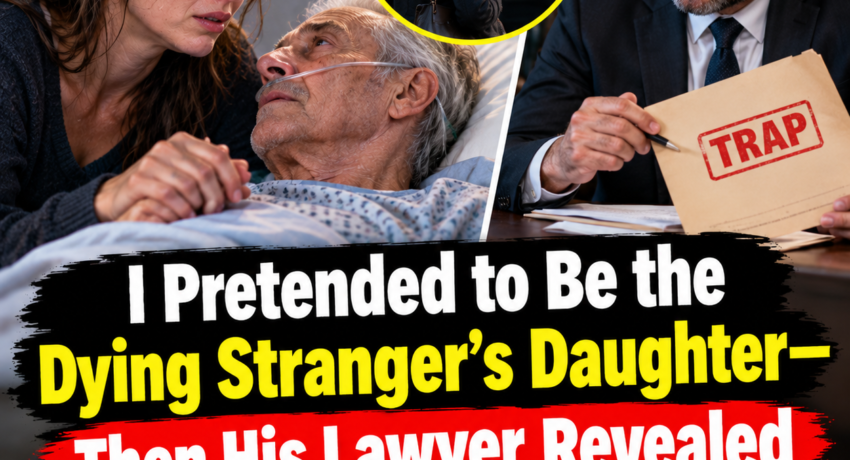
“Pretend you are my daughter,” he said, “until I am gone.”
PART 3
I stared at him. Somewhere outside, rain moved sideways against the glass, and Nathan turned his face toward the window like he couldn’t watch me hear it.
“Life separated me from my little girl before she was even born,” he said. “I never got to know her.”
I sat with that sentence longer than I probably should have. My own mother had raised me alone, and never once, not on her deathbed, not in any unguarded moment across twenty-some years, had she told me my father’s name. After she died, I searched every drawer and shoebox in our apartment for a photograph, a letter, anything with his handwriting on it. There was nothing. All she’d ever given me was one sentence, delivered like a door closing: he chose fear over us.
Nathan’s request should have unsettled me. A dying stranger asking me to play a role in the last chapter of a story I had no part in — I should have stood up, thanked him for the compliment, and gone back to the coffee cart. Instead, his words found the oldest wound I owned and pressed directly on it. I forced a smile onto my face before I’d even decided to.
“Well then,” I said. “Hello, Dad.”
Nathan laughed until it turned into a cough that scared me enough to reach for the call button, my hand already moving before my mind caught up.
“Do not ruin my first minute as a father,” he said, waving me off between coughs.
“You’re already demanding.”
“I have lost time to make up for.”
I didn’t know, not then, how literally he meant that sentence.
For six weeks after that night, we built something small and entirely borrowed. I brought him coffee every visit, cream, no sugar, the way he’d trained me to remember. He saved his best crossword clues for the days he knew I’d come. I wheeled him through the garden and listened to him list every reason the hospice’s roses were an embarrassment to the concept of roses. It should have felt like a performance. Most days, it didn’t feel like one at all, and that was the part that frightened me most, quietly, in the hours after I left him and drove home to an apartment that still didn’t sound right without my mother in it.
The hospice cleared two outings after Nathan signed the medical releases himself, his hand shaking over the signature line in a way he refused to let me help with. The first stop was a place called Millie’s Diner, tucked between a laundromat and a shuttered pharmacy on a street that looked like it hadn’t changed in thirty years. The manager greeted him by name before we’d even crossed the threshold.
“Good to see you, Nate.”
Nathan just shrugged when I looked at him, sliding into the corner booth like it had been carved to fit him. “I used to work here,” he said, and nothing more, though the way the waitress brought him coffee without asking — cream, no sugar, exactly how I made it — told me there was a whole history in that booth I wasn’t being let into.
He ordered two slices of apple pie before I’d even opened the menu.
“Expecting company?” I asked.
“I dislike making decisions,” he said, and looked at the empty seat across from us just a half-second too long for it to mean nothing.
PART 4
The second outing was to the ocean, forty minutes north, on a day so bright it made his skin look almost the color it must have been decades earlier. I helped him across the sand slower than either of us wanted to admit was necessary. He pulled off his shoes without asking me to help, pressed his bare feet into the cold, and closed his eyes like he was trying to memorize the feeling.
“Worth it?” I asked.
“Ask me when I can’t stand,” he said, and didn’t open his eyes.
People on the boardwalk assumed things about us — that I was his daughter, that we’d always belonged to each other the way families are supposed to. Nathan never let me correct them. Every single time, he answered before I could open my mouth.
“She is.”
Two words, and every time he said them, warmth moved through my chest followed almost instantly by guilt, a current running two directions at once. I knew what we were doing. I knew it was pretend, agreed to in a hospice room on a rainy night for reasons that were really about him and not about me at all. And still — after years of caring for a mother who was too proud to need me and too sick to say so, after a lifetime of being useful to everyone and chosen by no one — I liked being picked. I liked it more than I wanted to admit, even to myself, even now.
Nathan weakened faster than either of us had let ourselves prepare for. By my final visit, he could barely keep his eyes open long enough to finish a sentence.
“Was I convincing?” he asked, his voice down to almost nothing.
“As a father?”
“As someone worth remembering.”
I held his hand, the same hand that had reached for mine on that rainy night, and it felt lighter now, like something in him had already started to leave.
“You were difficult,” I told him.
“That sounds honest.”
“And I will remember you.”
He died the following morning, before the sun was fully up, while I was still twenty minutes from the hospice with a coffee going cold in the cupholder.
At his funeral, I recognized half the room without knowing their names — hospice nurses in their off-duty clothes, the diner manager standing near the back with his hands folded, a silver-haired waitress dabbing at her eyes with a paper napkin she must have brought from home out of habit. And there, alone near the very back wall, arms crossed, was Eric. He watched me place a single flower on Nathan’s casket. He didn’t come closer. He didn’t say a word. He just watched, and something about the stillness in him should have told me he was carrying more weight than a lawyer usually carries to his client’s funeral.
The following afternoon, my phone rang. It was him.
“My name is Eric Cole,” he said. “I handled Nathan’s estate. I need to tell you something he should have told you himself.”
PART 5
We met in a conference room at his office two days later, the kind of room with a long table built for meetings that never seem to need that much space. A wooden box sat between us, and Eric looked like a man who hadn’t slept, hollow around the eyes in a way I recognized because I’d worn that same look myself, less than a week earlier.
“Nathan was your biological father,” he said.
For several long seconds, the words didn’t land anywhere. They just hung in the cold air of that room, foreign, unassembled, refusing to arrange themselves into something I could hold. Then my chest tightened so fast it felt like something physically closing.
“No,” I said.
It was the only word I had.
Eric slid a file across the table, and I made myself open it because some part of me needed proof before I’d let the sentence become real. Inside was a signed acknowledgment of paternity, dated years before I was born. Copies of letters, returned to sender, unopened, in my mother’s handwriting on the front and someone else’s on the back. And a printout from a genealogy database — a recent match, run against a DNA sample I’d submitted years earlier while trying to find any trace of relatives on my mother’s side. I remembered spitting into that little tube at my kitchen table, half as a joke, half out of a loneliness I didn’t examine too closely.
Nathan had found me through that same database. He’d known who I was before I ever walked into that hospice.
“He confirmed your identity,” Eric said, “and found out where you volunteered. He chose that hospice because of you.”
My stomach dropped somewhere I couldn’t locate.
“He arranged everything,” I said.
“Yes.”
I stood up so fast my chair struck the wall behind me.
“You knew?”
“Yes.”
“For all six weeks?”
“Yes.”
“You let me pretend he was a stranger.”
“I did.”
“Why?”
“Nathan believed you would refuse to see him if you knew who he was.”
“That was my choice to make.”
“I know.”
“Stop saying that you know.”
Eric lowered his eyes to the table. “He threatened to refuse treatment. He said he’d remove me from every medical decision if I told you the truth. I told myself he was dying anyway. I told myself six weeks of comfort would hurt you less than six weeks of the truth would.” His voice cracked somewhere in the middle of that sentence. “I was wrong.”
I wanted him to defend himself. It would have been so much easier to hate him cleanly if he had.
Instead, he reached for the wooden box and opened it. Inside were two bundles of letters, tied with string gone soft with age. One bundle carried my name on the top envelope. The other carried his. Beneath them, folded flat, were documents naming us joint owners of a small diner on a street I’d only visited twice, once for pie, once to bury the man who’d owned it.
I looked up at him.
“Who are you to Nathan?”
Eric’s jaw tightened until I could see the muscle move beneath his skin.
“His son,” he said.
That landed somewhere different than the first confession had. Somewhere deeper, and colder.
PART 6
Eric explained it slowly, like a man setting down something breakable. Nathan had married years after leaving my mother, back when she was pregnant and he was young and terrified in a way he’d apparently never stopped being terrified, deep down, for the rest of his life. He’d left town. He’d come back months later, saying he wanted to help, but by then my mother wanted nothing that carried his name on it. She’d returned his letters unopened, year after year, a stack of them thick enough to fill half a box, because his second attempt didn’t undo the first choice he’d made. He had still left. Nothing that came after could unwrite that.
Eric had grown up in Nathan’s house and rarely, if ever, felt anything close to warmth from the man who raised him.
“He paid the bills,” Eric said, staring at some fixed point past my shoulder. “He showed up to school meetings. He never once asked how I felt about anything, unless the answer might affect my grades.”
“And you still protected him,” I said. “For six weeks. From me.”
Eric looked toward the window, where afternoon light was cutting a hard line across the carpet. “He had never trusted me with anything that mattered to him emotionally. Not once, in thirty-some years. When he told me about you, I actually thought — for the first time in my life — that he was finally treating me like a son.” He swallowed hard. “Then you walked in with coffee, and he became someone I had wanted my entire life to have as a father. And he wasn’t giving that version of himself to me. He was giving it to you.”
“You resented me.”
“Yes.”
“I didn’t take him from you,” I said, and I meant it as a plain fact, not a plea.
“I know.”
I glared at him anyway, waiting for him to argue, to soften it, to make himself smaller so the moment would be easier to survive. He didn’t.
“No,” he said quietly. “You didn’t.”
That night I sat at my kitchen table and opened Nathan’s letter, the one from the bundle with my name on it. He admitted, in his own slanted handwriting, that he had failed both of us in different ways. He had abandoned me before I was even born. He had raised Eric without ever once giving him softness. He wrote that he’d arranged our meeting because he wanted to find out whether I could love him before I learned exactly what he’d done to earn the opposite. His regret, even on paper, had become one more demand dressed up as an apology.
Then I reached the final page.
He had asked me, on that last morning, whether he’d been convincing.
The answer made me physically sick when I finally understood it. He hadn’t been pretending to be my father. For six weeks, in every small and ordinary way, he had been pretending not to be. Nathan wrote that he hoped Eric and I might someday give each other what he had denied us both.
I called Eric the next morning before I’d even had coffee.
“We are not required to become a family because a dying man wanted a clean ending for himself,” I said.
“I agree,” Eric said.
“And I am not forgiving you. Not today, and maybe not ever.”
There was a long pause on the line before he answered.
“I understand,” he said.
I didn’t know yet that the diner sitting between us — half mine, half his, tangled up in debt and history neither of us had asked for — was about to force us into the same room, week after week, whether either of us wanted it or not.
PART 7
We communicated through separate attorneys for the better part of a month, careful and clipped, the way people talk when they’re afraid of what might slip out if they let a sentence run too long. Millie’s couldn’t be sold without both of our signatures, which meant Eric and I were legally chained to a diner we’d never asked to inherit, a business built on top of a lie neither of us had chosen to tell.
The building itself was worth something. The business, buried under debt, was not. Eric wanted to sell the property, settle what was owed, and split whatever was left between us like two strangers dividing an estate sale. I agreed, on paper, right up until the day we actually walked through the door.
The silver-haired waitress from the funeral recognized me before I’d made it past the register.
“You came with Nathan,” she said.
“Yes.”
“I’m Rosa.”
She led us to the corner booth without asking, the same booth where he’d ordered two slices of pie for a chair he never let me sit in. “Nathan started here as a dishwasher,” she said, running her hand along the edge of the table like she was greeting an old friend. “He bought the building years later.” Her fingers stopped moving. “Every year, on your birthday, he ordered two slices of pie. Every single year, before you ever knew he existed.”
I folded my arms because I needed something to do with them. “Missing someone isn’t the same as finding them,” I said.
“No,” Rosa agreed quietly. “It isn’t.”
Six employees depended on that diner staying open, six people with names and mortgages and kids in braces, and Eric, true to the version of himself he’d shown me from the start, stayed relentlessly practical about all of it.
“We can’t keep a failing business alive out of the goodness of our hearts,” he said.
“And selling it solves everything?”
“It pays the debt.”
“It also erases six incomes,” I said. “Cleanly. On paper. The way you like things.”
Paul, the manager, overheard us from behind the counter and came around with a rag still in his hand. He looked at Eric with something between grief and accusation.
“Your father told us he was finally trying to make things right,” Paul said.
Eric went completely still.
Then he did something I hadn’t expected from him, not once, in the weeks I’d known him.
“He lied to her,” he said.
Paul frowned, confused, his eyes moving between the two of us.
Eric kept going, his voice steadier than I thought it would be. “She didn’t know Nathan was her father. I did. I helped him hide it from her until the day he died.”
The room went quiet in a way that had nothing gentle in it. Rosa stared at him, the rag in Paul’s hand forgotten mid-air. Eric’s face went red, but for the first time since I’d met him, he didn’t look away from what he’d done.
“I chose his wishes over her right to know the truth,” he said. “Whatever happens to this diner, don’t blame her for how long this is taking. Blame me.”
That was the first time Eric stopped protecting Nathan’s image, even at his own expense. I stood there in the middle of that quiet, sunlit diner, and something in my chest that had been clenched since the conference room finally, slightly, loosened.
PART 8
Three days later, an envelope arrived at my apartment. Inside was a written apology from Eric, longer than anything he’d said to me out loud, and an offer to withdraw entirely as the estate’s representative, paying out of his own pocket for an independent lawyer to review every document Nathan had ever signed. That was the first thing he’d done that actually cost him something real.
I agreed to look at the diner’s accounts. Not because I’d forgiven him — I want to be honest about that — but because six people’s paychecks were harder to walk away from than my own anger, and because some stubborn part of me refused to let Nathan’s last manipulation be the reason good people lost their jobs.
For four months, Eric and I met twice a week in that same corner booth, arguing over spreadsheets and staffing schedules and whether saving that diner counted as loyalty or just guilt wearing a nicer coat. We found a way to keep it open — selling an unused lot behind the building, trimming hours until the debt stopped growing faster than we could pay it down. The details of the ledger mattered less, in the end, than the four months themselves.
Eric told me his mistakes before I ever had to find them myself. I defended him, once, when Paul tried to pin every one of Nathan’s choices on him like Eric had been the one holding the pen. I learned, somewhere in those months, that he’d spent most of his own savings on Nathan’s treatment near the end. He learned that I’d worked two jobs for years while caring for my mother alone. Neither fact erased what had happened in that hospice room. But both of them changed the shape of the anger I was still carrying, softened its edges just enough that I could hold it without it cutting me every time.
The hospice and the diner entered a quiet partnership that none of us had planned. Once a month, Millie’s served free breakfast to hospice families, the same booths filling with people who understood, better than most, what it meant to lose someone slowly. We didn’t rename the place after Nathan. Nobody suggested it, and I think we both understood why. We left the corner booth exactly as it was.
Trust, when it came, arrived in pieces too small to notice individually. Eric called when he said he would call. I stopped assuming every practical suggestion out of his mouth was cold calculation instead of just how he was built. We argued. We apologized. We came back the next week anyway.
PART 9
On my birthday, I arrived at the diner before the doors opened. Eric was already there, sitting in the corner booth with two slices of apple pie set out in front of him, the way Nathan had ordered them every single year I never knew about.
“I suppose he finally got his table for two,” Eric said.
I looked at the one empty seat across from him, and for a moment I let myself feel everything at once. Nathan had manipulated me into loving him under false pretenses. He had taken from me the one thing I might have actually wanted, which was the chance to decide, with full knowledge, whether I wanted him in my life at all. Missing me for years, ordering pie in silence on a birthday I never knew he was marking, didn’t undo what he’d done. But the six weeks had also been real, every bit of it, the coffee and the crosswords and the ocean and the two words — she is — that had made something in me feel chosen for the first time in longer than I could remember. Love didn’t cancel the anger. The anger didn’t make the love a lie.
I pulled a third chair up to the table.
“No,” I said. “He doesn’t get to decide who belongs at this table.”
Eric looked at that empty chair for a long moment. Then he slid over and sat down beside me instead of across from me, and before the doors opened, he reached into his coat and set an envelope on the table between us — Nathan’s letter to him, still sealed.
“I still haven’t read it,” he said.
“Why not?”
“Because I already know what he’s going to ask me to forgive.”
I looked at the envelope for a while. “Maybe he won’t ask for that.”
“He always wanted the ending handed to him,” Eric said, “before he’d done any of the work to earn it.”
That sounded so exactly like my own anger that I almost laughed out loud, right there in the empty diner. I pushed the letter back toward him instead.
“You don’t have to read it today.”
He studied me for a second. “Did you read yours all at once?”
“No. I stopped three times.”
“Did stopping help?”
“It hurt differently each time. I’m not sure that’s the same thing as help.”
He nodded slowly and slid the letter into his coat pocket instead of the briefcase beside him. It was a small thing, barely worth mentioning, but I noticed it anyway. For once, neither of us let Nathan set the pace of anything.
We sat there quietly until Rosa flipped on the lights behind the counter, and the front windows caught the glow and threw back a reflection of three chairs pulled up to one table.
Rosa unlocked the door. Families from the hospice began filing in for their free breakfast, tired and grateful in the particular way people are when grief has become a regular part of their week instead of a single unbearable day. We left Nathan’s slice of pie sitting untouched in the middle of the table. Rosa looked at the three chairs for a long moment, said nothing, and disappeared into the kitchen.
She came back a minute later carrying one more fork.