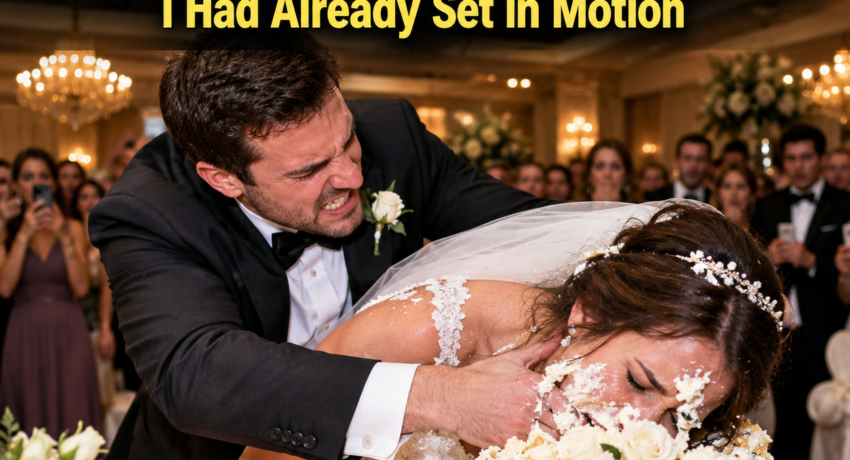
The first thing my husband did after we cut the cake was grab the back of my neck and shove my face into it. The second was laugh. “Smile, Claire—” no. “Smile, Nora,” he whispered, “don’t embarrass me.” He didn’t know about the recorder sewn into my dress. He didn’t know what was in my best friend’s purse. Two hundred guests watched him humiliate me. None of them knew I’d already decided how this day would end.
PART 1
“You ruined her makeup, Marcus!”
That was the first thing anyone said. Not “are you okay.” Not “what just happened.” His mother, Diane, said it laughing, delighted, like her son had pulled off a clever party trick instead of shoving his new wife’s face into three tiers of buttercream and vanilla sponge.
I stayed still for three seconds. I counted them.
Frosting clogged my nose. Champagne-fueled laughter rolled across the ballroom like a wave. My cheek throbbed where it had hit the wooden cake stand underneath all that sugar and sweetness. Somewhere behind me, a string quartet kept playing, because nobody had told them to stop.
Marcus’s hand was still on the back of my neck.
“Smile, Nora,” he said, close to my ear, so only I could hear it. “Don’t embarrass me.”
I raised my head slowly. White frosting coated my hair, my lashes, the bodice of the silk gown I’d tried on four times before choosing. A thin line of blood ran from my nostril, mixing into the sugar.
The laughter faltered.
My maid of honor, Sophie, had gone the color of the tablecloths. She wasn’t laughing. She was staring at Marcus’s hand on my neck like she wanted to break every finger of it.
Marcus saw the blood and rolled his eyes.
“Jesus, Nora. It was a joke.”
That sentence scared me more than the shove had.
Because I’d heard versions of it for almost two years. When he’d put his fist through the drywall six inches from my head during an argument about seating charts, that was “losing his temper.” When he’d gripped my wrist hard enough to leave four finger-shaped bruises because I’d taken too long to answer a text, that was because I was “too sensitive.” When he’d taken my phone out of my hand mid-sentence because I hadn’t picked up fast enough, that was because “married people don’t keep secrets.”
And three nights before the wedding, lying next to me in the dark, he’d said, “Once we’re married, you’ll stop acting like you can just walk away whenever you want.”
I hadn’t slept that night, understanding exactly what kind of man I was about to marry — and exactly why he wanted to marry me so badly.
It had never really been me.
It started three months earlier, with a folder left open on his laptop while he was in the shower. A folder labeled, with almost insulting simplicity, “N. Assets.”
I didn’t cry at my own wedding reception. I wiped the frosting out of my eyes instead, watched my new husband raise his champagne glass to toast “his beautiful wife” to scattered, uncertain applause, and I thought about that folder, and the four weeks of quiet work that had followed it, and I smiled.
Not because he’d won.
Because underneath a small pearl button sewn into the neckline of my dress, there was a recorder no bigger than a shirt stud. And in Sophie’s clutch purse, six feet away near the service doors, was a sealed envelope holding four months of financial statements, two signed affidavits, and a marriage contract clause his own attorney had once laughed about, calling it “a formality nobody ever actually uses.”
Marcus thought he had just humiliated his new wife in front of two hundred people.
He had actually just handed me two hundred witnesses.
PART 2
To understand why I was still standing there smiling with blood on my face, you have to understand what I’d built before Marcus Callahan ever said my name.
I was thirty-four. For twelve years before I met him, I’d run a health-data software company with my college roommate, Priya — the two of us living on instant noodles and hope in a two-bedroom apartment until the product finally worked, and then for six more years after that, building it into something a larger firm wanted badly enough to pay for. When we sold our controlling stake, I kept enough equity and cash to never need anyone else’s money again.
I met Marcus four months after the sale closed, at a fundraiser I almost hadn’t attended. He was handsome in the specific, expensive way that photographs well. He asked good questions. He listened — or performed listening so convincingly that for over a year, I couldn’t tell the difference.
I told him what my company had sold for. Not the exact number, but enough that he understood the number was large. That was, I now believe, the moment he decided to marry me.
The warning signs came slowly enough that each one felt survivable alone. The hole in the wall. The bruised wrist. The phone snatched from my hand. Any single incident, I could explain away — stress, a bad week, a man who loved me too much and expressed it clumsily. It was only when I lined them up like photographs on a corkboard that I saw the pattern instead of the excuses.
Then came the folder.
“N. Assets” contained scanned copies of documents from our wedding-planning file — documents with my signature on them, documents that referenced my premarital accounts — alongside an unfinished application for a line of credit. Two million dollars, requested against assets that belonged solely to me, using paperwork Marcus had no legal right to submit.
His mother was in on it. I found that out four days later, when his email account, still logged in on our shared laptop, showed me a thread between the two of them that made my stomach drop straight through the floor.
Once you’re married, she won’t fight it, Diane had written. Make sure she signs before the honeymoon. After Europe, we can deal with the house.
The house — a Craftsman bungalow I’d bought with cash two years before I ever met Marcus — belonged to me. So did the investment account Marcus had apparently already promised, in writing, would fund his mother’s retirement.
I didn’t scream. I closed the laptop quietly and made three calls the next morning: to my attorney, to my bank’s fraud department, and to Priya, who still had a friend at the firm that had audited our company for years.
Do not tip him off, my attorney told me. Let us document the pattern first. A single incident is a misunderstanding. A pattern is a case.
So I smiled through cake tastings. I smiled through Diane’s opinions about my dress. I smiled while, underneath the smiling, four different professionals quietly built a file with my name at the top of it and Marcus’s underneath.
Today was supposed to be the last day I pretended not to know.
Marcus had simply moved the timeline forward himself, three tiers of buttercream at a time.
PART 3
The plan had never been to let it get as far as a wedding cake in my hair. That part, I want to be honest, was not in anyone’s script.
The plan, six weeks earlier, had been quieter and slower. My attorney, Angela Reyes, had one rule above all others: verified evidence, gathered before confrontation, or none of it would hold up when it mattered.
So Sophie and I built a file.
She scanned every bruise I let her see, dated and time-stamped, the week they happened, in case I ever needed to prove a “pattern” instead of a “story.” I forwarded her the “N. Assets” folder the same day I found it, before Marcus could think to delete it. When the two-million-dollar credit application actually hit my bank’s fraud queue three weeks later — flagged automatically, because my accounts had a fraud-alert set on them since the folder — Angela had copies within the hour.
The recorder came from Angela’s office, not a spy shop — a slim disc no bigger than a coat button, battery good for eleven hours. My seamstress sewed it beneath a pearl at my request, “for good luck,” and didn’t ask twice.
We rehearsed nothing about the wedding itself. We rehearsed everything around it. Sophie knew three exits from the venue. She knew that if I ever texted her a single word — Proceed — it meant calling the number saved under “Emergency Contact 2,” which was actually Angela’s cell, not a relative’s.
Two nights before the wedding, Marcus told me I’d stop acting like I could walk away. I lay awake afterward, not frightened exactly — past frightened, into something colder and steadier — and I texted Angela at two in the morning.
He’s escalating. I don’t think we have until the honeymoon anymore.
Her answer came back within minutes, because apparently she wasn’t sleeping either.
The fraud team confirms the application is still pending, not yet funded. If he pushes it through before the wedding, we may actually be in a stronger position, not a weaker one — a fraudulent application filed against a married woman’s assets, on the eve of the marriage, is worse for him, not better. Stay calm. Let him make the next move. We’ll be ready for it.
I didn’t know, that night, that his “next move” would be his hand on the back of my neck in front of two hundred people.
What I did know, walking down the aisle the next afternoon in a dress that weighed more than I did with a recorder sewn under a pearl button, was that I was no longer the only person in that ballroom keeping score.
I just didn’t expect the scorecard to change so fast, or in a direction none of us had planned for.
Because three hours before the ceremony, Sophie had pulled me aside in the bridal suite, her face unusually serious for someone about to be a maid of honor.
“There’s a woman outside asking for you,” she said. “She says her name is Brooke. She says it’s important, and she says you’ll want to hear this before you say ‘I do.’”
PART 4
I didn’t have time to see Brooke. That’s the part I regretted most, afterward — not marrying Marcus, but not listening to a stranger who’d driven two hours to warn me about him.
Sophie had gone out to talk to her instead, while I was zipped into a dress I could no longer take off without help. She came back four minutes later with her phone in her hand and a look on her face I’d never seen before.
“She says her name is Brooke Ellery,” Sophie said. “She says she was engaged to Marcus. Before you. She says there was a credit application then, too.”
I remember staring at myself in the mirror, half a bride, half something else entirely.
“Did you get her number?”
“I got everything,” Sophie said. “She left a card. She said, and I’m quoting her exactly — ‘Tell her it’s not new. Tell her to ask his mother about the guesthouse.’”
I didn’t understand the guesthouse part yet. I filed it away, the way you file away a strange noise in your house at night, promising yourself you’ll investigate it later, when there’s time, when it’s safe.
There wasn’t time. The wedding planner was already knocking, telling me the processional was starting in six minutes.
So I walked down the aisle carrying a stranger’s warning I hadn’t fully unpacked, alongside four months of evidence I understood completely, and I said “I do” to a man I already knew was going to try to take everything I owned.
I want to be clear about why. It wasn’t naivety. It wasn’t hope that he’d change. Angela had been explicit: once we were legally married, the misconduct clause in our prenuptial agreement — the one Marcus’s own attorney had negotiated and apparently never expected to matter — would activate. One verified incident of assault after the marriage would trigger immediate financial separation, eliminate any claim Marcus had to my premarital assets, and protect the company shares I still held.
Before the marriage, I was just an ex-girlfriend with hurt feelings and some bruises no one else had seen.
After it, with the fraud already in motion and a recorder sewn into my dress, I was something else. A wife with a paper trail.
Marcus needed the marriage to happen exactly as much as I needed it to.
Neither of us said that part out loud, obviously, standing at the altar holding hands in front of a minister neither of us had met before that week. We said the version everyone else wanted to hear. For better or worse. In sickness and in health.
I meant my vows to myself more than I meant them to him. I promised myself, standing there, that I would not spend the rest of my life being someone’s asset.
Three hours later, he shoved my face into the cake, and Diane called it a joke.
And somewhere in a parking lot outside, Brooke Ellery was probably driving home, wondering if the woman she’d tried to warn had even listened.
She had. She just hadn’t had time to ask the one question that would have changed everything: what, exactly, was hiding in that guesthouse.
PART 5
I found out about the guesthouse forty minutes later, locked in the bridal suite with Sophie and a laptop between us, frosting drying stiff in my hair.
“We can leave through the kitchen,” Sophie said, the second the door clicked shut. “Right now. Nobody has to know anything else today.”
“Not yet,” I said.
Her eyes went wide. “Nora—”
“I need them to believe I’m still staying. Let me clean up. Give me ten minutes to think.”
While I washed frosting out of my hair over the suite’s small sink, Sophie pulled up Angela’s latest email on her laptop — the one that had come in an hour before the ceremony, the one neither of us had opened yet, because there hadn’t been time.
The subject line was four words: Confirmed. Please call immediately.
Angela’s fraud contact had done more than flag the credit application. She’d pulled the account history behind it, going back three years — long before Marcus and I had ever met.
Two years and eight months ago, a nearly identical application had been submitted under a different name, requesting a credit line against assets belonging to a woman named Brooke Ellery. The application had been withdrawn before it funded, quietly, after Brooke’s family lawyer intervened. No charges were ever filed. Brooke had simply broken the engagement and disappeared from that circle of people entirely — until, apparently, today.
And the guesthouse. Marcus’s parents’ guesthouse, the one Diane and Walter had lived in “temporarily” for six years, wasn’t in their name. It never had been. Public records showed it belonged to a holding company registered to Marcus, funded — according to a wire transfer Angela’s team had located — by the settlement Brooke’s family had quietly paid two years ago to make the whole ugly situation disappear without a lawsuit.
I sat down on the edge of a couch that cost more than most people’s cars, in a dress stained pink with someone else’s blood, and I understood, finally, completely, what kind of family I had actually married into.
This wasn’t a man who’d made one bad decision under financial pressure. This was a family business. Diane found the women. Marcus courted them. The guesthouse was paid for by the last woman who’d almost lost everything to them.
I was not his first attempt. I was simply the one who’d found out in time.
“Nora.” Sophie’s voice was very quiet. “What do you want to do?”
I looked at the folder in my lap — the recordings, the affidavits, the prenup, and now this. I thought about Brooke Ellery, driving two hours to warn a stranger, only to be turned away at a door.
“I want everyone in that ballroom to understand exactly what they’re clapping for,” I said. “And I want it to happen before Marcus has time to hide a single dollar.”
A fist hit the bridal suite door hard enough to rattle the frame.
“Nora! Open the damn door!”
Marcus.
I looked at Sophie. She was already opening a new text thread to Angela.
I picked up my own phone and typed one word.
Proceed.
PART 6
“Open the door, Nora.” Another fist against the wood, harder this time. “We’re doing speeches. Guests are waiting.”
I didn’t answer.
“This is ridiculous,” Diane’s voice, muffled through the door, sharp with irritation instead of concern. “Everyone paid attention to that little scene already. Enough.”
I started recording on my own phone, in case the pearl-button recorder somehow failed. Sophie stood beside me, silent, watching the door like it might come off its hinges.
Then Marcus said something to his mother that he clearly believed I couldn’t hear.
“If she thinks she can ruin today,” he said, low and flat, “remind her whose house she’s coming home to tonight.”
Diane laughed.
My stomach dropped through the floor a second time that afternoon.
They think the house is his, I thought. After everything I found — the folder, the guesthouse, Brooke Ellery driving two hours to warn me — they genuinely believed the Craftsman bungalow I’d bought two years before I ever met him was somehow, now, Marcus’s to threaten me with.
Sophie mouthed the words at me: They think everything is his.
I typed a second message to Angela, forwarding the audio.
Her reply came back in under a minute.
Security and two officers are positioned outside the ballroom. Bank confirmed the fraudulent application was submitted yesterday morning, timestamped before the ceremony. Do not leave that room alone. We’re ready when you are.
I exhaled — the first full breath I’d taken since the cake.
Then I opened the door.
Marcus stood there, furious, Diane a step behind him with her arms crossed like a woman waiting for an apology.
“You done performing?” Marcus asked.
“Yes,” I said. “I am.”
I walked past both of them, back toward the ballroom. Marcus grabbed my wrist — the same wrist, I noted distantly, that already had a two-week-old bruise fading beneath my sleeve from an argument about seating charts.
This time, I didn’t pull away. I wanted people to see it.
“Where do you think you’re going?” he asked.
“Back to our guests,” I said. “You wanted speeches.”
Something in his face eased. He thought I’d surrendered. Diane’s mouth curved into something close to a smile.
“That’s better,” she said.
I let them believe it the entire walk back across the ballroom floor. I let Marcus settle into his chair at the head table, satisfied, raising his champagne glass toward me like a man toasting a problem he’d already solved.
“Finally,” he said, loudly enough for the closest tables to hear.
I picked up the microphone instead of my own glass.
The DJ, watching me, slowly faded the music down to nothing.
Two hundred faces turned toward me.
“Actually,” I said, “I have one more announcement.”
Marcus smiled, lazy and certain. “Make it quick.”
I looked directly at my husband of two hours.
“My husband thinks what happened with the cake was funny,” I said. “I’d like everyone to hear what happened right after.”
PART 7
Sophie connected her phone to the sound system before Marcus fully understood what was happening.
“What are you doing?” He was already on his feet.
His own recorded voice answered him, echoing off the ballroom’s high ceiling before I could say another word.
Smile, Nora. Don’t embarrass me.
A pause. Then, colder:
Good girl.
Then the hallway recording, the one from four minutes earlier, unmistakably his voice, unmistakably recent.
If she thinks she can ruin today, remind her whose house she’s coming home to tonight.
No one laughed this time.
Diane’s face drained white, the exact color of the tablecloths. Marcus’s father, Walter, slowly lowered his whiskey glass without drinking from it, staring at his son like he was seeing a stranger wearing his son’s suit.
Marcus lunged toward the DJ booth. “Turn that off. Turn it off right now.”
He didn’t reach it.
Two uniformed officers came through the ballroom’s main doors first. Behind them, moving with the calm pace of someone who’d been waiting for this exact cue, was a woman in a gray suit I recognized instantly from four months of phone calls.
Angela Reyes.
Marcus stopped where he stood. The room — two hundred people who’d been laughing forty minutes earlier — went completely silent.
Angela crossed to me first. “Are you all right?”
“I am now,” I said.
Marcus’s eyes moved between the two of us, calculating, still trying to find an angle. “What the hell is this?”
Angela turned to him, opening a slim folder she’d clearly been carrying for exactly this moment.
“Mr. Callahan, your wife contacted my office regarding suspected financial fraud and ongoing domestic violence several weeks ago.”
Diane’s voice cracked across the silence like a whip. “Financial fraud? That’s absurd. This family has spent thousands of dollars on this wedding.”
“I know,” I said. “You spent my deposit.”
She actually froze at that, as if I’d slapped her.
“The venue, the catering, the flowers, the honeymoon flights, and your jewelry for tonight,” I continued, “were all charged to an account my financial team froze this morning.”
“You can’t freeze our money,” Marcus said.
“It was never our money,” I said.
I reached under the table and pulled out the second folder Angela had prepared for me — copies, not originals, because the originals were already with the fraud department and a district attorney’s office by then.
“The house is held in my trust,” I said. “The investment account is mine alone. My company shares are separate property. And the prenuptial agreement you signed,” I looked at Marcus directly, “contains a misconduct clause your own attorney negotiated. Verified assault, after marriage, voids your claim to everything you thought you were marrying into.”
His face went gray in a way I hadn’t seen a person’s face do before, not even in the worst arguments of the last two years.
“You wouldn’t actually enforce that,” he said.
“You put my face in a cake in front of two hundred witnesses,” I said. “I have three separate recordings and a nosebleed on video. I would.”
One of the officers stepped closer. “Sir, we need to speak with you regarding a reported assault and a fraudulent credit application filed yesterday morning.”
Marcus looked around the ballroom like someone might step forward to save him.
No one moved. Not even his father.
That was when Marcus made the mistake that ended whatever was left of the evening for him.
He grabbed the microphone out of my hand.
PART 8
“You ungrateful—”
He didn’t finish the sentence. The officer closest to him had already closed a hand around his wrist.
Marcus jerked backward, hard enough to knock two champagne glasses off the head table. They shattered against the parquet floor, a small, bright sound in a room that had gone dead silent otherwise.
“Get off me,” he said, and then he was face-down against the table, hands secured behind his back, while Diane screamed somewhere behind me.
“This is her fault! She did this!”
I turned to look at her.
“No, Diane. This is what consequences look like.”
She started toward me. Sophie stepped between us before I had to move at all — a hundred and thirty pounds of maid of honor who clearly had no intention of letting a mother-in-law get within arm’s reach of me that day, or possibly ever again.
Angela stepped in with a second document, holding it out to Diane instead of me.
“You should read this,” Angela said.
“What is it?”
“Notice to vacate.”
Diane blinked at her, uncomprehending. I answered before Angela had to.
“The guesthouse you and Walter have been living in rent-free for six years belongs to my trust as of this morning,” I said. “It always has. Marcus’s holding company transferred it in as loan collateral eighteen months ago — the same collateral he was trying to use to secure the two-million-dollar credit line against my accounts.”
Diane’s mouth opened. Nothing came out.
I hadn’t planned to say the next part in front of two hundred people. It came out anyway, because by then I was done protecting anyone in that family from the truth.
“There’s a woman named Brooke Ellery,” I said, loud enough to carry. “Some of you might remember her. Two years and eight months ago, this family tried the exact same thing to her — a credit application against her assets, timed right before a wedding that never happened. She came here today to warn me. I didn’t have time to listen to her before the ceremony.”
I looked at Diane directly.
“I had plenty of time to listen to her after it.”
For the first time since I had met that family, not one of them had anything left to say. Walter set his whiskey glass down on the table, untouched, and didn’t pick it back up.
The marriage was annulled six weeks later, on grounds that made Angela’s job considerably easier than a divorce would have been. Marcus eventually pleaded guilty to misdemeanor assault and attempted financial fraud, once investigators had matched his family’s emails to the Brooke Ellery case file that had never technically been closed. He received probation, mandatory counseling, restitution, and a criminal record that ended his career at the investment firm he’d been so proud of.
Diane avoided criminal charges. She lost the guesthouse, the leased luxury car I’d unknowingly been subsidizing for over a year, and the version of her life that had depended entirely on her son marrying well and never getting caught.
I never spoke to either of them again.
PART 9
The weeks after the wedding were not glamorous, whatever the story might sound like from the outside. They were mostly paperwork.
I sat across from Angela’s desk more than anywhere else that month, signing affidavits, reviewing the fraud timeline, answering an investigator’s careful questions about bruises I’d photographed myself in a locked bathroom.
A locksmith changed every lock on the Craftsman bungalow within four days, even though it had always legally been mine. I wanted the feeling of it to be mine too.
Sophie stayed at my place for the first two weeks. We didn’t talk much about the wedding itself. We talked about ordinary things — a show she wanted me to watch, a recipe she’d ruined, whether my hydrangeas were dying or just resting. I understood, later, that this was its own kind of care. Not every act of loyalty needs to be dramatic. Sometimes it’s someone making you dinner so you don’t have to decide anything else that day.
Priya called from three time zones away the morning the story made it into a small industry newsletter, of all places, because Marcus’s firm quietly let him go the same week and someone had connected the dots. “You okay?” she asked, and I told her the truth: mostly. Getting there.
I never heard from Brooke Ellery again after that day, though Angela passed along a message once, secondhand, through Brooke’s own attorney. She’d wanted to know if the warning had mattered. I asked Angela to tell her yes. It had mattered enormously. It just hadn’t arrived in time to stop the wedding — only in time to make sure the wedding didn’t end the way Marcus and his mother had planned.
I sold the Craftsman bungalow eventually. Not because anything was wrong with it, but because every room in it still held some memory of the four weeks I’d spent there pretending not to know what I knew. I wanted a house with no memories in it yet.
I kept my company shares, my investment account, and — after eight months of Angela’s patient, meticulous work — every dollar Marcus and Diane had tried to route through a fraudulent credit line that never actually funded.
I did not, in the end, get an apology from any of them. I stopped expecting one somewhere around week three.
PART 10
Eight months later, I stood on the small back deck of a house overlooking the Pacific, coffee going cold in my hands, watching the tide come in.
It wasn’t a mansion. It wasn’t a statement to anyone. It was just mine, bought outright, with a mortgage broker who’d never heard the name Marcus Callahan and didn’t need to.
Sophie visited that weekend, the way she did most weekends now, and she brought a small, slightly lopsided cake from a bakery two blocks from her apartment.
She set it on the kitchen counter without a word.
We both looked at it for a long moment.
Then she grinned. “Too soon?”
I laughed until my eyes watered, for the first time in longer than I could remember laughing at anything.
Then I cut two slices, and we ate them standing up at the counter, and nobody’s hand was anywhere near the back of my neck.
People still ask me sometimes whether I regret the wedding — the dress, the ceremony, the vows I meant more to myself than to him. I don’t, not really. What I regret is the eighteen months before it, the small warnings I explained away one at a time instead of lining them up where I could see the whole pattern sooner.
But I don’t regret what came after the cake. Not one part of it.
Because I’ve come to believe that the most important promise anyone makes on their wedding day isn’t always to the person standing beside them.
Sometimes it’s the one you make to yourself, quietly, on a night three days before, when you finally understand exactly who you’re about to marry — and you decide, calmly and completely, that you are not going to disappear.
The moment Marcus pushed my face into that cake in front of two hundred people, I finally kept the promise I’d made to myself.
I left.
I built something new, on my own name, in my own house, on my own terms.
And I never once looked back.