Part 1 — Three Weeks That Became Seven
When my daughter Megan called and asked if she, her husband Chris, and their two children could stay with me while their kitchen and downstairs bathroom were being renovated, I didn’t hesitate.
“How long are we talking?” I asked.
“Three weeks,” Megan said confidently.
Chris, standing behind her, gave a tired little laugh.
“Four, maybe.”
Megan shot him a look.
“The contractor said three.”
“The contractor also said demolition would be ‘basically dust-free,’” Chris replied.
That settled it.
I told them to bring their bags.
My house wasn’t huge, but it was comfortable, and I was secretly happy to have the extra noise around. My granddaughter Emma filled the dining table with homework, markers, and half-finished craft projects. My grandson Noah somehow managed to leave toy cars in every room.
There was only one practical problem.
My driveway was barely wide enough for one vehicle.
With two children to get in and out of the car, groceries to unload, and construction chaos waiting for them back home, it made sense for Megan and Chris to use it.
“I’ll park on the street,” I told them.
“Mom, you don’t have to,” Megan said.
“I’ve lived here for years. Street parking is public. I’ll survive.”
At the time, it felt like the most ordinary sentence in the world.
I had no idea how important those words were about to become.
For the first few evenings, I parked wherever I found an open spot. Sometimes it was in front of my own house. Sometimes it was a few doors down.
Nobody cared.
At least, nobody except Linda.
Linda lived next door.
And if there was one thing Linda believed in, it was that everything within eyesight of her living room window somehow fell under her personal authority.
One evening, I came home and found a perfectly legal parking space along the curb directly in front of her house.
No driveway.
No fire hydrant.
No signs.
No restrictions.
So I parked my old Honda there, went inside, ate dinner with my family, helped Emma with her homework, and completely forgot about it.
The next morning, around seven, someone knocked on my door.
I opened it.
Linda stood on my porch holding a coffee mug.
She smiled, but there was nothing friendly about it.
“If you park that car in front of my house again,” she said, “you’re going to regret it.”
For a moment, I honestly thought she was joking.
“Good morning to you too.”
“I’m serious.”
“About what?”
She pointed toward the street.
“Your car.”
“My Honda?”
“That ugly green thing.”
I looked over her shoulder.
“It’s gray.”
Linda narrowed her eyes.
“With all that rust, it’s difficult to tell.”
“It has one rust spot.”
“It’s the first thing I see every time I look out my front window.”
I waited.
Surely there was more.
There wasn’t.
“Okay,” I finally said.
Linda frowned.
“Okay?”
“I’m just trying to understand what response you want from me.”
“I want you to move it.”
I took a slow breath.
“Megan and Chris are staying with me temporarily, so they’re using my driveway.”
“That isn’t my problem.”
“It isn’t your problem at all.”
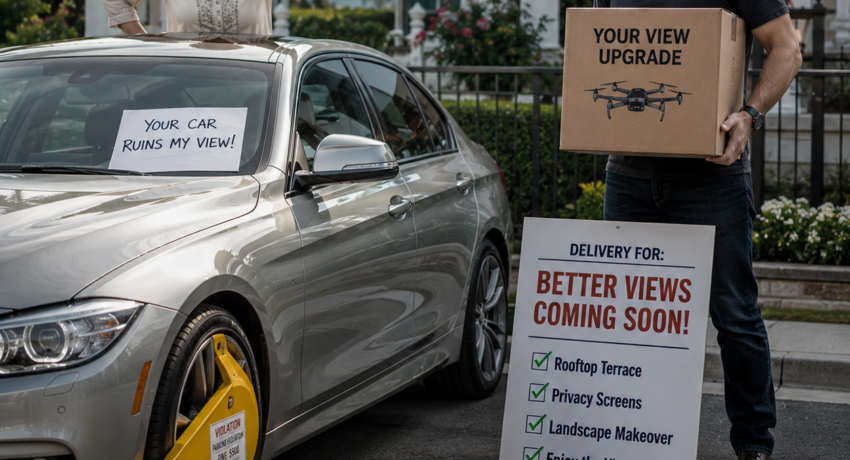
“It ruins my view.”
I glanced across the street.
There was a hedge.
A mailbox.
Another house.
I looked back at her.
“Your view of what, exactly?”
Linda actually turned around as if the scenery might suddenly provide evidence for her case.
Then she faced me again.
“This is my neighborhood.”
“It’s our neighborhood,” I corrected. “And that’s a public street.”
“I don’t care.”
Then she lifted her chin.
“You’ve been warned.”
And off she went.
That was Linda.
She had once moved another neighbor’s flowerpots because she thought they looked “cheap.”
Another time, I caught her dragging Emma’s pink bicycle toward her trash bins because Emma had left it lying sideways on my lawn.
“What are you doing?” I’d asked.
“It looks abandoned.”
“It’s pink, has streamers hanging from the handlebars, and is lying in front of my house.”
“Exactly.”
I rescued it before the garbage truck arrived.
So Linda’s behavior wasn’t entirely new.
Usually, the easiest way to deal with her was simply not to react.
Linda loved control.
But I suspected she loved getting a reaction even more.
I had no intention of giving her one.
At least, not yet.
Part 2 — The Yellow Boot
I didn’t want to start a feud over something as silly as a parking space.
So that evening, I parked two houses away.
The following day, I found another space farther down.
But on the third evening, I came home tired, carrying groceries, and the only nearby legal parking space was once again directly in front of Linda’s house.
I remembered her warning.
Then I remembered that she didn’t own the street.
So I parked.
The next morning, I was already running late for work when I hurried outside.
I made it halfway down the walkway before I stopped.
Something bright yellow was attached to the front wheel of my Honda.
I stared at it.
A wheel boot.
For several seconds, my brain refused to accept what I was looking at.
Then Linda’s front door flew open.
She hurried outside wearing a robe and slippers.
She was laughing before she even reached me.
“I told you.”
I slowly turned toward her.
“You put a boot on my car?”
“I warned you not to park here.”
I crouched down and inspected it.
This wasn’t anything issued by the city.
It was a private wheel clamp, the sort of thing anyone could buy online.
I stood again.
“Linda, you cannot immobilize someone else’s car because you don’t enjoy looking at it.”
She folded her arms.
“My property, my rules.”
“The street is not your property.”
“It’s in front of my property.”
“That doesn’t make it yours.”
Linda shrugged.
“Then call someone.”
I reached for my phone.
That was exactly what I planned to do.
But then I looked at Linda.
Then at my Honda.
Then at her enormous living room window—the window whose precious “view” my car had supposedly destroyed.
And suddenly, an entirely different idea came to me.
I lowered my phone.
Linda smiled triumphantly.
“Finally understand?”
I smiled back.
“Oh, I understand perfectly.”
I still intended to deal with the boot properly.
But before I did, I decided Linda deserved something special to look at.
I borrowed Megan’s car and drove to work.
During my lunch break, I returned long enough to photograph everything—the Honda, the wheel boot, the curb, and the surrounding area.
Then I called the city’s nonemergency number.
I explained that a neighbor had placed a private clamp on my legally parked vehicle.
They told me someone could come by the next morning.
Perfect.
Then I made another phone call.
This one was much more fun.
A woman at a local sign and printing shop answered.
“What size were you thinking?” she asked.
“About six feet wide.”
Silence.
“Six feet?”
“Roughly life-size.”
“Life-size picture of a person?”
“No.”
I paused.
“A Honda.”
Another silence.
Then she laughed.
“You have my attention.”
I explained what I wanted.
A large cardboard printout of my old Honda.
A side view.
As close to life-size as they could reasonably make it.
They couldn’t produce a polished retail display on such short notice, but they could print the image on heavy cardboard and have it ready that afternoon.
“Can you fold it flat?” I asked.
“Yes.”
“And package it like a large delivery?”
“Absolutely.”
“Can you deliver it to my neighbor?”
Now she was laughing again.
“I think we can arrange that.”
I emailed them a photograph.
Before sending it, I added a message in huge black letters across the windshield:
FOR DAYS WHEN THE REAL ONE IS PARKED SOMEWHERE ELSE.
Then I gave them Linda’s address.
Part 3 — Special Delivery
Around four that afternoon, a delivery van pulled up outside Linda’s house.
Megan had been watching for it.
The second the driver stepped out carrying an enormous flat package, she grabbed her phone and started recording from our front window.
Linda opened her door.
Even from across the street, she looked suspicious.
She signed for the package.
The driver left.
Then Linda stared at the enormous delivery lying across her porch.
She hesitated before opening it.
Slowly, she tore away the wrapping.
Then she unfolded the cardboard.
My Honda appeared.
Life-size.
Rust spot and all.
Megan’s video became nearly impossible to watch because she was laughing so hard that the camera kept shaking.
Linda froze.
She read the message across the fake windshield.
FOR DAYS WHEN THE REAL ONE IS PARKED SOMEWHERE ELSE.
Then she turned her head.
Very slowly.
Straight toward my house.
Her expression told me everything I needed to know.
The gift had been received.
When I returned from work that evening, Linda was waiting for me.
She marched across my lawn, dragging the folded cardboard Honda behind her.
“Did you do this?”
I glanced at the giant cardboard car.
“Do what?”
“THIS.”
“Oh.”
I nodded.
“You said you were concerned about losing your view. I thought I’d help.”
Her face turned red.
“Are you insane?”
“I thought it was thoughtful.”
“This is harassment!”
I pointed toward my still-booted Honda.
“You put a wheel clamp on my car.”
“Because you ignored me!”
“I parked legally.”
“You knew I didn’t want it there.”
“I didn’t realize your personal preferences had become traffic law.”
Linda opened her mouth.
Closed it.
Then opened it again.
Finally, she shoved the cardboard toward me.
“Take your garbage.”
“Thanks.”
“I don’t want it on my property.”
I carried it to the side of my garage.
Then I unfolded it again.
Linda stared in disbelief.
“You’re putting that thing there?”
I smiled.
“It’s on my property.”
For once, Linda had absolutely nothing to say.
At least for several seconds.
“Take it down.”
“No.”
She spun around and stormed home.
Linda had promised I would regret parking in front of her house.
That evening, judging from how frequently her curtains moved, I had a feeling regret had changed addresses.
I assumed that was the end of my little joke.
It wasn’t.
Because Emma found the cardboard Honda.
Part 4 — The Car Nobody Expected to Love
“Grandma!”
Emma came running into the house.
“This is AMAZING!”
She dragged me outside and pointed toward the cardboard Honda as though I had somehow overlooked its existence.
“It was supposed to annoy Linda,” I explained.
Emma stared at it thoughtfully.
“Can I color it?”
Before I had time to give a real answer, she had already disappeared inside.
She returned carrying markers.
Within minutes, flowers appeared across both doors.
Then Noah joined her.
He decided the car needed flames.
Naturally.
Chris came outside, studied their work, and said, “This thing needs actual windows.”
Twenty minutes later, he had carefully cut openings where the windshield and side windows had been printed.
The children climbed inside.
Emma grabbed an imaginary steering wheel.
Noah made engine noises so loudly that Megan came outside to see what was happening.
By the next afternoon, three neighborhood children had joined them.
Within two days, the cardboard Honda looked nothing like the one I’d ordered.
It had flowers.
Stars.
Lightning bolts.
Handprints.
Children’s names.
Colorful scribbles.
And a cardboard steering wheel Chris had made from an old pizza box.
Kids started lining up for turns behind the wheel.
They pretended to drive to school.
To the beach.
To the moon.
One afternoon Noah announced they were going to “California and then probably dinosaurs.”
Nobody questioned the route.
The strange part was how quickly the fake Honda changed the atmosphere of our little stretch of street.
The object Linda had hated became the brightest thing on the block.
Children laughed around it almost every afternoon.
Parents stopped to talk.
People walking dogs smiled when they passed.
And Linda?
Linda watched from behind her curtains.
The next morning, the city parking officer finally arrived.
He inspected my Honda.
He inspected the curb.
Then he looked at the yellow boot.
Linda came outside almost immediately.
“It obstructs my view,” she told him.
The officer blinked.
“Your view?”
“Yes.”
“Of what?”
“The street.”
Then she tried another approach.
“My property frontage.”
He looked at her for a long moment.
“Ma’am, the vehicle is legally parked on a public street.”
“I pay taxes.”
“So does your neighbor.”
“I don’t want her car there.”
The officer sighed.
“Well, I don’t particularly want to be here settling an argument over a completely legal parking space, but here we are.”
Then his tone became firmer.
“You cannot clamp another person’s legally parked vehicle.”
Linda’s face tightened.
“You need to remove it.”
And that was it.
No dramatic speech.
No shouting.
No victory dance.
Linda simply crouched beside my Honda and unlocked the clamp.
Watching that yellow boot come off felt better than any argument could have.
I thought the message had finally gotten through.
A few days later, I learned I had been overly optimistic.
Part 5 — Linda Changes Tactics
I came home one afternoon and saw something strange along the curb.
Two recycling bins.
And a garden chair.
They had been arranged exactly where I normally parked.
I didn’t need to ask who had done it.
Linda was standing behind her front window.
Watching.
I calmly got out of the car.
I took a photograph.
Then I moved the bins and chair back onto Linda’s lawn.
After that, I parked.
Legally.
Before going inside, I looked toward her window.
Linda was still there.
So I waved.
The curtain snapped shut.
That was the moment I decided I was done treating the situation like a competition.
I didn’t want to spend my days wondering what Linda might do next.
If another nearby space was available, I used it.
If not, I parked where I was legally permitted to park.
No drama.
No arguments.
The cardboard Honda, however, stayed beside my garage.
And strangely enough, that silly thing eventually did more to change our relationship than every argument about parking ever could.
One Saturday afternoon, I noticed a little girl standing near the edge of our yard.
She looked about seven.
She was watching Emma, Noah, and two neighborhood children climb in and out of the cardboard Honda.
She clearly wanted to join them.
Then Linda’s voice came from next door.
“Sophie.”
The little girl turned.
“Come back here.”
“But Grandma, they’re playing.”
“I can see that.”
“Can I go play too?”
“No.”
Sophie looked back toward the children.
“Why?”
Linda hesitated.
“Because I said so.”
Sophie slowly returned to her grandmother’s porch.
That was when I realized she was Linda’s granddaughter.
Later, I saw Sophie sitting by herself while the other children laughed inside the cardboard car.
Something about it bothered me.
This ridiculous dispute had started between two adults.
A child shouldn’t have to sit alone because of it.
So I walked toward Linda’s house.
She came outside before I even reached the porch.
“What?”
“Can Sophie come over and play?”
Linda immediately looked suspicious.
“Why?”
“Because she’s a kid.”
Linda said nothing.
“They’re pretending to drive a cardboard Honda, Linda. It’s not exactly an organized conspiracy.”
She studied my face.
“This isn’t some kind of trick?”
Before I could respond, Sophie appeared behind her.
“Please, Grandma?”
Linda sighed.
“Twenty minutes.”
Sophie sprinted across the lawn before Linda had finished speaking.
Within five minutes, she and Emma were arguing over who got to be the driver.
By the time Linda came over to collect her, all three children were drawing a license plate on the back.
Sophie looked up.
“Can I come back tomorrow?”
Linda looked at me.
I deliberately said nothing.
After a long pause, she replied,
“Maybe.”
That “maybe” was the first crack in the wall.
Part 6 — Cookies and Quiet
The following weekend, Sophie came back.
This time, she didn’t wait near the sidewalk.
She ran straight toward our yard.
Linda followed several steps behind carrying a plastic container.
“I made cookies,” she said.
I smiled.
“For us?”
“They’re for Sophie.”
“Of course.”
There were two folding chairs near the garage.
Linda sat in one.
After a moment, I sat in the other.
For several minutes, neither of us spoke.
We simply watched the children.
Emma was adding another flower to the cardboard door.
Noah was explaining an extremely complicated imaginary repair involving the “engine.”
Sophie was decorating the pizza-box steering wheel.
Eventually, Linda glanced toward the real Honda parked on the street.
Then she looked at the cardboard one.
She sighed.
“You’re never getting rid of that thing, are you?”
I turned toward her.
“The cardboard one or the real one?”
Linda gave me a tired look.
“Either.”
I smiled.
“Probably not.”
She shook her head.
But this time there was something almost amused in her expression.
After that afternoon, the recycling bins stopped appearing in parking spaces.
So did the garden chair.
Linda never apologized for the boot.
I didn’t expect her to.
Some people would rather carry a six-foot cardboard Honda down the street than say, “I was wrong.”
But things became quieter.
And honestly?
Quiet was enough.
Several weeks later, Megan and Chris finally moved back home.
Their “three-week renovation” had lasted seven.
The night before they left, Chris looked at me and said, “Technically, I was closer.”
“Don’t encourage yourself,” Megan replied.
Once they were gone, my driveway belonged to me again.
The real Honda returned to its usual spot.
And I decided the cardboard version had probably reached the end of its life.
It was bent.
Covered in marker.
One side had started sagging.
There were fingerprints everywhere.
I started carrying it toward the recycling pile.
Emma saw me.
Her expression changed instantly.
“Grandma!”
“What?”
“You can’t throw that away!”
“It’s falling apart.”
“It’s our car!”
“It’s cardboard.”
She folded her arms.
“It’s family cardboard.”
I stared at her.
There are certain arguments grandmothers know they are never going to win.
So the cardboard Honda moved into my garage.
Part 7 — The View Finally Changed
A few Saturdays later, someone knocked on my door.
When I opened it, Linda stood there.
Sophie was beside her, practically bouncing with excitement.
“Can we play with the car?” Sophie asked.
I pointed toward the garage.
“Keys are in it.”
She laughed and ran past me.
Linda followed much more slowly.
As she crossed the driveway, she passed my real Honda.
Then she stopped.
I watched as she looked at the car that had started this entire ridiculous battle.
The same old Honda.
The same rust spot.
The same supposedly neighborhood-destroying appearance.
Linda reached out.
Without looking at me, she gave the roof one small pat.
“Still ruins the neighborhood.”
I smiled.
“Nice to see you too, Linda.”
She rolled her eyes and continued toward the garage.
A few seconds later, Sophie’s laughter echoed from inside.
Emma joined her soon after.
And standing there, listening to them argue over who was driving the cardboard Honda this time, I realized something.
I had spent weeks thinking the whole dispute was about a parking space.
Then I thought it was about Linda wanting control.
Maybe some of it was.
But in the end, none of that mattered nearly as much as what happened afterward.
The ugly old car Linda hated looking at had somehow brought a group of children together.
The ridiculous cardboard copy had turned into a neighborhood toy.
And two neighbors who had once been locked in a petty battle had learned how to sit beside each other in folding chairs without fighting.
Linda never apologized.
I never demanded one.
Because eventually, I got something better.
Peace.
And apparently, shared custody of a six-foot cardboard Honda.
As for Linda’s precious view?
It still included my house.
My driveway.
My slightly rusty Honda.
And, every now and then, a group of laughing children racing absolutely nowhere in a cardboard car.
Personally, I think the view improved.