Part 1 — The Empty Key Ring
The little metal keychain tapped softly against the side of my coffee mug when I placed it on the kitchen table.
Lily had no idea I had found it.
It had belonged to her father, Michael, and for nearly four years it had been forgotten in the back of our junk drawer, buried beneath dead batteries, old takeout menus, loose screws, and pens that had long since stopped working.
Attached to the ring was a small rectangular tag engraved with one simple word:
HOME.
Michael had carried that keychain everywhere until the day we lost him.
That Saturday morning, I had polished it with a dish towel until the metal caught the light again.
The ring itself was empty.
But I had imagined that, by lunchtime, Lily’s first car key would be hanging from it.
She had worked almost every day that summer to make that moment possible.
I heard her bedroom door open upstairs.
“Ready?” I called.
Silence.
I smiled to myself and picked up the keychain, giving it a playful shake.
“Lily, if you make us late, somebody else is going to buy that car before we get there.”
A few seconds passed.
Then her voice came from the hallway.
“Mom?”
Something about the way she said it made my smile disappear.
I lowered the keychain.
Lily stepped into the kitchen wearing jeans and the faded café T-shirt she’d practically lived in all summer. Her hair was still messy, and she wasn’t carrying her purse.
She didn’t look like a girl about to buy her first car.
She looked like a girl preparing to confess something.
She sat across from me and didn’t even glance at the printed car listing lying on the table.
I studied her face.
“What’s going on, sweetheart?”
Her thumb moved nervously along the edge of the table.
“We can’t go.”
I immediately assumed the seller had changed his mind.
“Did he cancel?”
Lily shook her head.
“No.”
“Then what happened?”
She swallowed.
“I don’t have the money anymore.”
For a moment, I thought I had misunderstood her.
“What money?”
She finally raised her eyes.
“The car money.”
I gave a short laugh, mostly because the alternative was too ridiculous to process.
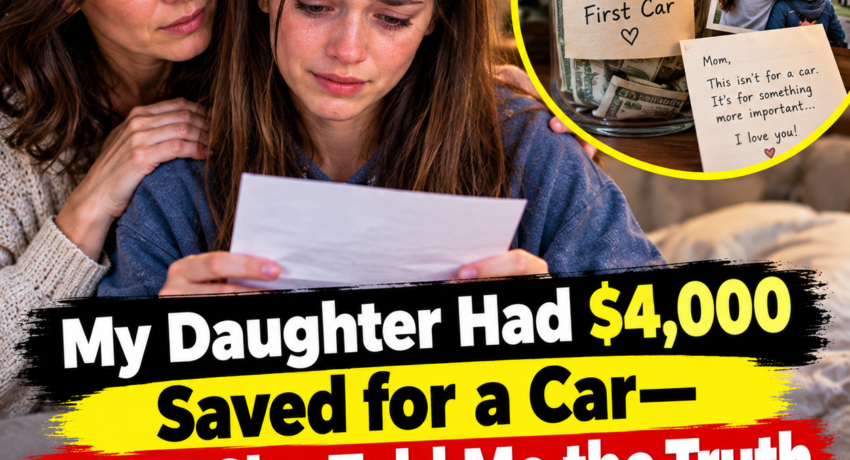
“You have four thousand and eighty-six dollars.”
Her expression didn’t change.
“I had four thousand and eighty-six dollars.”
That one word—had—made my stomach tighten.
“Lily.”
“I’m sorry, Mom.”
“Where is the money?”
She looked away.
I moved to the chair beside her.
“Did someone get access to your account?”
“No.”
“Did you spend it on something?”
“No.”
“Did somebody online convince you to send them money?”
“No, Mom.”
I tried to keep my voice under control.
“Then where did more than four thousand dollars go?”
Her eyes began to shine.
“I gave it away.”
I stared at her.
For three months, I had watched my daughter earn every one of those dollars.
While her friends went swimming or spent weekends hanging out together, Lily carried plates of pancakes, refilled coffee mugs, wiped tables, and smiled politely at customers who sometimes left syrup in places syrup should never have reached.
She came home smelling like fried food and coffee.
Night after night, she emptied her pockets at our kitchen table and counted her tips.
She skipped movies because she had an early shift.
She turned down invitations because she was determined to save enough.
One Saturday, after working eleven exhausting hours, she had collapsed onto the couch and declared:
“If I ever own a restaurant, I’m banning chairs.”
She had wanted that car more than almost anything.
Not because she wanted to impress anyone.
For Lily, a car meant independence.
She could drive herself to school.
She could get to work without borrowing mine.
She wouldn’t have to depend on friends for rides.
And beneath all of that was something neither of us talked about much.
Driving was another milestone her father should have been there to see.
When Lily was nine, Michael had once let her sit behind the wheel of his parked truck.
I had walked outside carrying groceries and nearly dropped the bags.
“What exactly are you doing?”
Michael had grinned.
“Starting early.”
“You absolutely are not.”
Lily had looked at me proudly.
“Dad said I could.”
Michael immediately lifted both hands.
“Dad has officially reconsidered.”
Lily still laughed whenever she remembered that day.
Now she was sixteen.
And the money she had spent an entire summer earning was gone.
“All of it?” I asked.
She nodded.
“More than four thousand dollars?”
Another nod.
I forced myself not to raise my voice.
If I shouted, I knew she would shut down.
So I asked quietly,
“Who did you give it to?”
She wiped beneath one eye.
“Mom, before I tell you, I need you to understand something.”
“No. First, I need to know who has your money.”
She hesitated.
Then she said something I hadn’t expected.
“It wasn’t one person.”
I frowned.
“What do you mean?”
“There were seventeen.”
I stared at her.
“Seventeen people?”
“Yes.”
“What seventeen people?”
Instead of answering, Lily stood.
“Come with me.”
“Lily, I’m not going anywhere until you explain this.”
She walked toward the counter, grabbed her café hoodie, and slipped it over her head.
“Please, Mom.”
I looked down at Michael’s empty key ring.
Then I looked at my daughter.
Twenty minutes later, we were walking toward the café where she had spent her entire summer working.
And with every step, my imagination became more frightening.
Had someone manipulated her?
Had an adult discovered how much money she had saved?
Had her coworkers pressured her?
Or had my very compassionate, very sixteen-year-old daughter decided she was responsible for solving everyone else’s problems?
Lily had always had a tender heart.
But at sixteen, kindness and recklessness can sometimes look dangerously similar.
Part 2 — The Card in the Café
When we reached the café, Mrs. Patel was unlocking the front door.
She had owned the place for almost twenty years and had hired Lily at the beginning of summer.
The moment she saw us together, her expression changed.
She looked directly at Lily.
“You told her?”
Lily nodded.
I stopped.
“You knew?”
Mrs. Patel slowly opened the door.
“Come inside, Rachel.”
The café wasn’t open yet.
The chairs were still upside down on the tables.
The glass pastry case was empty.
Everything was quiet except for the faint hum of the refrigerators.
Mrs. Patel led us behind the counter and into the cramped office where Lily usually counted her tips after work.
She opened a metal cabinet.
“Before you get angry with me,” she said, “I should tell you I didn’t realize how far she intended to take this until recently.”
I folded my arms.
“That isn’t making me feel better.”
“I know.”
Mrs. Patel reached behind a box of receipt paper.
When her hand came back, she was holding an old index card.
Nothing about it looked important.
The corners were bent.
A brown coffee stain covered one edge.
But when she handed it to me, my breath caught.
Sixteen first names had been written down the front.
Beside them were dates.
And beside several names was the same handwritten word:
FRIDAY.
I knew that handwriting.
Even after four years, I knew every curve of it.
Michael.
I touched the ink with my thumb.
“No.”
Mrs. Patel said nothing.
I looked at Lily.
“Where did this come from?”
“I found it here in July.”
“What is it?”
Mrs. Patel pulled out the desk chair.
“You might want to sit.”
I remained standing.
She gave me a gentle look.
“Your husband used to come here often.”
“I know.”
Michael had loved diner coffee with unreasonable devotion.
He insisted it tasted better from those thick white mugs.
I always told him coffee was coffee.
He told me I had no culture.
But as far as I knew, Mrs. Patel had simply known him as a regular customer.
Then she pointed to the first name on the card.
“Do you remember George?”
I shook my head.
“About seven years ago,” she began, “Michael came in early one morning and saw a man washing his face in the restroom.”
I looked down at the name again.
“Why was he doing that?”
“Because he had been sleeping in his car.”
Lily sat quietly beside me.
Mrs. Patel continued.
“George had a job interview that morning. Michael noticed him trying to smooth the wrinkles out of a shirt that clearly hadn’t come off his back in a while.”
A faint smile touched Mrs. Patel’s face.
“Michael asked whether he had an interview. George told him, ‘I’m fine.’”
Before she even continued, I could hear Michael’s response in my head.
Mrs. Patel smiled.
“He looked at him and said, ‘I didn’t ask if you were fine.’”
My eyes closed for a moment.
Of course he had.
That was exactly Michael.
If he asked whether your ankle hurt and you answered, I’m okay, he would get irritated because you hadn’t actually answered the question.
“What happened next?” I asked.
“He bought George breakfast. Then he took him to a discount store and bought him a clean shirt. After that, he gave him enough money for transportation.”
Mrs. Patel tapped the date beside George’s name.
“He got the job.”
I exhaled slowly.
“So that’s what this list is?”
“Partly.”
She folded her arms.
“George nearly lost that job three days later.”
“Why?”
“His first paycheck wasn’t coming until Friday. He didn’t have enough money to travel to work for the rest of the week.”
Michael discovered what was happening and stepped in again.
He didn’t pay George’s rent.
He didn’t try to fix his entire life.
He simply covered the small gap between unemployment and a first paycheck.
Bus fare.
Laundry.
A few lunches.
Just enough to get him through the week.
Just enough to get him to Friday.
Part 3 — Getting People to Friday
Mrs. Patel told me George wasn’t the last person Michael helped.
After that, he began noticing similar situations everywhere.
People who had already found an opportunity but couldn’t afford the final few steps needed to reach it.
A woman had been offered a kitchen job but couldn’t afford the nonslip shoes required for her first shift.
A young father finally found warehouse work but needed childcare for three days before his first paycheck arrived.
Another person only needed twenty dollars of phone service so a potential employer could call back.
They weren’t enormous problems.
That was the point.
Sometimes someone’s entire future was being blocked by something surprisingly small.
A pair of shoes.
A bus pass.
A phone bill.
Lunch money.
Three days of childcare.
Michael didn’t consider himself a hero.
He just hated seeing someone get within a few feet of stability and then lose everything because of one small obstacle.
Lily finally spoke.
“What did Dad call it?”
From her expression, I could tell she already knew the answer.
Mrs. Patel smiled.
“He called it getting somebody to Friday.”
That was when I finally sat down.
Not because my anger over Lily’s money had disappeared.
It hadn’t.
But because I suddenly felt as though someone had opened a door into a part of my husband’s life I’d never known existed.
I had been married to Michael for fourteen years.
I knew he couldn’t sleep with socks on.
I knew exactly how he liked his coffee.
I knew the look on his face when he was worried but didn’t want me to know.
I knew which jokes he used when he was uncomfortable.
I knew he sang the wrong lyrics to almost every song he liked and would stubbornly continue singing them even after I corrected him.
I thought I knew everything important.
And yet I had never heard a word about this.
I looked at the card.
“Sixteen people?”
Mrs. Patel nodded.
“Those are the ones I knew about.”
“Why write them down?”
She laughed softly.
“Because your husband was ridiculous.”
Despite myself, I almost smiled.
That sounded like him.
“Every few months, he’d walk in here and ask, ‘How many Fridays are we up to?’ Eventually I started keeping track because apparently being an adult wasn’t enough for him. He needed a scoreboard.”
Lily’s mouth twitched.
“He wasn’t trying to beat anyone,” Mrs. Patel added.
I shook my head.
“No. Michael only competed with himself.”
“Exactly.”
I turned the card over.
And my heart stopped again.
The handwriting on the back was different.
Newer.
Seventeen numbers had been written there.
One through seventeen.
I slowly looked at Lily.
“You wrote this?”
She nodded.
“This summer?”
“Yes.”
“Seventeen people?”
Another nod.
And then I understood.
She hadn’t added her name beside her father’s sixteen.
She hadn’t tried to continue his list.
She had started her own.
Mrs. Patel glanced at Lily, then at me.
“One of them is working today.”
I stood.
“One of who?”
Lily pushed her hands into the pockets of her hoodie.
“Mom, there’s something else you need to understand.”
I waited.
Her eyes filled again.
“The seventeen names aren’t just names.”
Mrs. Patel picked up her keys.
“Come on.”
Part 4 — The Girl at the Repair Shop
Mrs. Patel drove us to the other side of town.
The place Lily wanted me to see was an auto-repair shop.
Inside, a nineteen-year-old girl named Tara was halfway through her first week as an apprentice.
The second Lily walked through the door, Tara’s face lit up.
“Hey! Isn’t today car day?”
Lily stopped.
“Not anymore.”
Tara’s smile disappeared.
She looked at me.
Then back at Lily.
“No.”
Lily stared at the floor.
Tara stepped toward her.
“Tell me you didn’t spend your car money.”
Lily didn’t answer.
And suddenly Tara began to cry.
The story came out piece by piece.
Tara had recently been accepted into an apprenticeship at the repair shop.
It was exactly the opportunity she needed.
There was only one problem.
Her shifts began at six in the morning.
Public transportation from the temporary room where she had been staying didn’t start early enough.
If Tara arrived late or missed several shifts, she could lose the apprenticeship before receiving her first paycheck.
She also needed proper work boots.
And a way to get from where she was staying to the shop.
Lily had spent a little over eleven hundred dollars helping Tara.
Required boots.
A used bicycle.
And a short-term room close enough to the repair shop for Tara to make it to work every morning.
Tara had received the largest amount.
The remaining money had been divided among sixteen other people.
Bus passes.
Work clothes.
Phone service.
Meals.
Small expenses that didn’t look life-changing on paper.
Except to someone whose future depended on them.
Seventeen people.
Seventeen Fridays.
Tara wiped her cheeks.
“I’ll pay you back.”
Lily immediately shook her head.
“No.”
“Lily, I mean it.”
“Don’t pay me back.”
Tara looked confused.
My daughter took a breath.
“Help somebody else get to Friday.”
I turned away.
For most of that morning, I had been trying to decide how angry I was allowed to be.
My sixteen-year-old daughter had secretly given away more than four thousand dollars.
Money she had earned herself.
Money she desperately wanted to spend on her first car.
Part of me wanted to lecture her about financial responsibility until graduation.
But standing in that repair shop, watching Tara cry because someone had believed her first week of work was worth protecting, I couldn’t find the words.
All I could think about was Michael.
And the sixteen names on the front of that card.
And the seventeen on the back.
Part 5 — “Because Dad Couldn’t Anymore”
On the drive home, the silence between Lily and me felt different.
I wasn’t furious anymore.
But I wasn’t ready to pretend everything she had done was perfectly reasonable either.
Eventually, I asked the question that had been troubling me most.
“Why didn’t you tell me?”
Lily watched the houses pass outside the window.
“Because you would’ve helped.”
I glanced at her.
“Of course I would’ve helped.”
“I know.”
She finally turned toward me.
“That’s why I didn’t tell you.”
I frowned.
“That doesn’t make any sense.”
“It does to me.”
She looked down at her hands.
“If I’d told you, you would’ve given me money. Or helped those people yourself. And then I wouldn’t have known if I could really do it.”
“Do what?”
Her voice became quieter.
“Do it on my own.”
“Why was that so important?”
For a few seconds, she said nothing.
Then came the answer that broke whatever argument I had left.
“Because Dad can’t do it anymore.”
My hands tightened slightly around the steering wheel.
Neither of us spoke.
Then Lily whispered,
“I just wanted to do one thing he’d recognize.”
I had to blink hard before the road blurred in front of me.
There she was.
My sixteen-year-old daughter.
Still grieving her father in ways I hadn’t fully understood.
She wasn’t trying to replace him.
She wasn’t trying to prove she was exactly like him.
She simply wanted to believe that somewhere, somehow, if Michael could see what she had done, he would know exactly what it meant.
I reached one hand toward her across the console.
Then I stopped.
Because loving what she had done didn’t mean pretending there was nothing to learn from it.
She had made a generous decision.
She had also hidden something enormous from me.
Both things could be true at once.
“What you did matters,” I told her. “A lot.”
Lily stayed quiet.
“But giving away every dollar you worked all summer to earn and telling me afterward? We are not making that a family tradition.”
She nodded.
“I know.”
“Your father had a habit of helping people quietly too.”
A small smile appeared on her face.
“So apparently you inherited that part.”
She looked at me.
I continued.
“The three thousand dollars I promised toward your car is staying in savings.”
Her eyes widened slightly.
“When you earn your portion again, we’ll start shopping.”
She nodded.
“Okay.”
“And from now on, if you’re about to buy somebody work boots, a bicycle, a bus pass, or possibly an entire building—”
Lily laughed.
“—you tell your mother first.”
“Deal.”
And somehow, hearing her laugh made the entire day feel lighter.
Part 6 — Seventeen Fridays
That evening, I walked into the kitchen and found Lily at the table.
Her phone was in front of her.
Used-car listings filled the screen again.
She had already started over.
Beside her phone sat Michael’s old keychain.
The metal tag caught the kitchen light.
HOME.
The ring was still empty.
I leaned against the counter.
“Already shopping again?”
“Yep.”
“Any regrets?”
Lily stared thoughtfully at the listings.
For a second, I thought she might give me some profound answer.
Instead she groaned.
“I regret that cars cost four thousand dollars.”
I burst out laughing.
She laughed too.
Then her expression softened.
She opened the photographs she had taken of Mrs. Patel’s old card.
Michael’s handwriting filled the front.
Sixteen names.
Sixteen Fridays.
Then Lily turned to the photograph of the back.
Her handwriting.
Seventeen.
She tapped the screen gently.
“I don’t regret those seventeen.”
I couldn’t answer immediately.
I looked at the empty keychain beside her.
That morning, I had imagined presenting it to Lily with the key to her first car.
I thought the important moment would be watching my daughter drive away on her own for the first time.
Instead, Michael’s keychain had led me somewhere completely different.
It had shown me a piece of my husband I had never known.
And a piece of my daughter I hadn’t fully seen yet.
I slid the keychain across the table toward her.
Lily picked it up.
She turned the little metal tag between her fingers.
HOME.
Then she placed it beside her phone and continued scrolling through used-car listings.
The key ring remained empty.
For now.
Eventually, there would be a car.
There would be another summer of work, more tips counted at the kitchen table, more saving, more searching, and probably plenty of complaining about used-car prices.
One day, a key would finally hang from that ring.
But as I watched my daughter that night, I realized something.
An empty key ring didn’t mean she had come home with nothing.
She had spent an entire summer trying to reach one destination.
Instead, she helped seventeen other people reach theirs.
And somewhere between those sixteen names written by her father and the seventeen written by his daughter, Michael’s quiet little tradition had found its way home.