Part 1 — The Bag on Grandma’s Wheelchair
“Not yet.”
My grandmother’s voice had grown so soft with age that sometimes you had to lean close to hear her. But when she spoke those two words, everyone around her seemed to stop.
Her thin hand rested over mine.
“Wait,” she whispered. “Not until everyone is here.”
I glanced around our garden.
The tables were crowded with plates, paper cups, and half-deflated balloons. Children were chasing each other across the grass. My husband, Mark, was standing beside the apple tree with our one-year-old daughter, Lily.
“I think everyone is here, Grandma.”
She gave the smallest shake of her head.
“Your mother.”
Mom was inside getting the cake ready.
My uncle went to find her.
Until that moment, I had assumed the mysterious bag tied to Grandma’s wheelchair contained a birthday gift—perhaps a toy, perhaps something she had asked my uncle to buy.
But the way Grandma was looking at me made my heart begin to pound.
At 101 years old, she rarely went anywhere anymore.
She could no longer walk. Even sitting upright for long periods exhausted her. Getting her from her house to ours meant lifting her into the car, arranging cushions around her, stopping once during the ninety-minute journey, and then transferring her back into the wheelchair.
Everyone had told her she didn’t have to come.
Mom had practically begged her to stay home.
Grandma’s answer had been simple.
“I’m going.”
And somehow, she had.
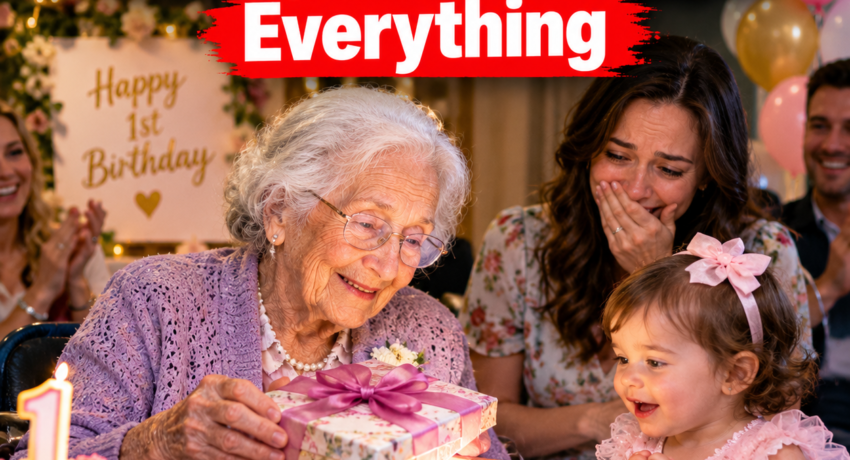
Now she sat beneath the apple tree with Lily perched carefully on her lap. Mark stood behind them, one hand lightly supporting Lily because Grandma’s arms were no longer strong enough to hold a wriggling toddler safely.
Grandma didn’t seem bothered by the help.
She was staring at Lily as if she were trying to memorize every inch of her.
“She has your ears,” she said.
I laughed.
“That’s not exactly a compliment.”
“They’re perfectly good ears.”
“They stick out.”
“So did yours.”
“That’s my point.”
Grandma smiled.
Then she gently brushed one finger across Lily’s cheek.
“Worth waiting for,” she murmured.
Four words.
That was all.
And suddenly I had to blink hard.
Because Grandma knew better than almost anyone what Lily’s arrival had meant to us.
Before I could answer, Mom stepped through the back door carrying the cake knife.
“What’s going on?”
Grandma pointed toward the bag.
“Sit.”
Mom frowned.
“Why?”
Grandma lifted one eyebrow.
“Because I’m 101 years old, and somehow you still haven’t learned to do what your mother tells you.”
My uncle burst out laughing.
Mom rolled her eyes but sat.
I untied the bag and pulled away the tissue paper.
Underneath was a wooden box.
Dark walnut.
Scratched at the corners.
A small brass clasp on the front.
I stared at it.
For a moment, I was a little girl again.
“Oh my God.”
Mom leaned forward.
“What is it?”
I ran my fingers across the lid.
“Grandma’s sewing box.”
That box had lived beside her chair for as long as I could remember.
When I was little, opening it felt like opening a treasure chest.
There were buttons in one section.
Needles in another.
Spools of thread arranged by color.
Bits of ribbon.
Tiny pieces of lace.
And, at the very bottom, something wrapped in brown paper that Grandma had never allowed me to touch.
I looked at her.
“You brought this all the way here?”
She nodded toward Lily.
“It’s hers.”
I laughed through the sudden tightness in my throat.
“Grandma, she’s one. She can’t sew.”
Grandma gave me the expression she used whenever I said something especially foolish.
“Neither could you when you were one.”
Fair enough.
I opened the clasp.
And that was when the birthday party stopped feeling like a birthday party.
It became something much bigger.
Something that had apparently begun decades before Lily was ever born.
Part 2 — Three Little Dresses
The top tray of the sewing box still looked exactly the way I remembered it.
Buttons filled several compartments.
Pearl ones.
Wooden ones.
Little red flower-shaped buttons.
Blue glass buttons that had fascinated me as a child.
Beneath them lay folded fabric.
I lifted the first bundle carefully.
A tiny white dress unfolded across my hands.
Yellow flowers had been embroidered around the collar.
My breath caught.
I knew that dress.
I had seen it hundreds of times.
Mom whispered, “No…”
For years, Grandma had kept a photograph beside her favorite chair.
In it, I was four years old, standing on the front step of Grandma’s house wearing that exact white dress with the yellow flowers.
I stared at her.
“You kept it?”
Grandma looked almost insulted.
“Of course I kept it.”
“For thirty-eight years?”
“Things don’t suddenly become worthless because people get old.”
Mom was already wiping tears from her face.
I laughed, but my own eyes were wet too.
Then I reached back into the box.
Under my dress was another one.
This one was smaller.
Pale blue.
The second Mom saw it, something changed in her face.
She reached out with both hands.
“My dress.”
I looked at her.
“Yours?”
Grandma nodded.
“Your mother wore that when she was two.”
Mom lifted the little dress as if it were made of glass.
It was more than sixty years old.
The bodice had been carefully smocked by hand. Tiny fabric-covered buttons ran down the back.
“You made this too?” I asked Grandma.
“Yes.”
Then she pointed into the sewing box.
“There’s more.”
Under Mom’s childhood dress was a bundle wrapped in tissue paper.
I peeled the paper back slowly.
Inside was a third dress.
Cream-colored linen.
Tiny green leaves had been embroidered around the hem.
At first, I thought it was simply unfinished because of age.
Then I looked closer.
One sleeve had been sewn on.
The other was still separate.
Pins held part of the collar in place.
A length of loose thread hung from the seam.
I looked up.
Grandma’s eyes were on Lily.
“That one belongs to her.”
The words seemed to knock the air from me.
“To Lily?”
Grandma nodded.
I stared at the half-finished dress.
“You made this?”
“Started it.”
“When?”
Instead of answering, she looked away.
Mom leaned forward.
“How long ago, Mom?”
Grandma ignored the question.
“Look in the pocket.”
“There isn’t a pocket.”
“There is.”
I turned the dress over.
After a moment, I noticed a narrow inner fold sewn near the waist.
Hidden inside was a small envelope.
My name was written across the front.
Grandma’s handwriting.
But not the strong, slanted handwriting I remembered from birthday cards when I was younger.
This writing trembled across the paper.
My fingers suddenly felt cold.
I opened the envelope.
The first line read:
For the baby I hope I live long enough to meet.
I stopped.
The words blurred.
I covered my mouth.
Mark immediately crouched beside me.
“You okay?”
I nodded.
I wasn’t.
Grandma watched me quietly.
“Read it.”
I looked at her.
“Out loud?”
“If you can.”
By then, conversations around the garden had faded.
Mom was crying openly.
My uncle had turned his head away and was pretending to be interested in something near the fence.
I took a breath.
Then I began.
Part 3 — Hope Needed Somewhere to Wait
“My darling girl,
“You once told me you were afraid motherhood might never happen for you.
“I wanted to comfort you, but sometimes there isn’t a sentence big enough to fix somebody else’s pain.
“So I went home and did the only useful thing I could think of.
“I began making a dress.”
I stopped reading.
Suddenly I remembered exactly when I had told her.
I had been thirty-four.
Mark and I had already been trying for two years.
We had gone through appointment after appointment, tests, waiting rooms, calendars, hopeful phone calls, disappointing phone calls.
Then our first fertility treatment failed.
Most people didn’t know.
I didn’t want advice.
I didn’t want people asking questions.
I didn’t want someone telling me that I was “thinking about it too much” or that motherhood would happen as soon as I relaxed.
But I told Grandma.
I can still remember sitting across from her at the kitchen table.
I had stared into my tea and finally said, “Maybe this is never going to happen for me.”
Grandma hadn’t tried to argue with me.
She hadn’t promised me a baby.
She hadn’t given me a speech about miracles.
She simply reached across the table, covered my hand with hers, and said:
“Maybe. But today isn’t every day.”
That was all.
At the time, I had no idea what she did after I left.
Apparently, she went to her sewing room.
And started making a dress for a child who did not exist.
I forced myself to continue reading.
“I did not make this dress because I was certain you would have a baby.
“I made it because hope sometimes needs somewhere to rest while it is waiting.
“And if no child ever wore it, your life would not have been less meaningful.
“You did not need motherhood to become enough.
“You were already enough.
“But if a child did arrive one day, I wanted that child to know that she had been loved before we even knew her name.”
My voice broke.
Mark found my hand and squeezed it.
Grandma sat silently beneath the tree, her small body almost disappearing into the wheelchair.
I looked at the dress.
At the missing sleeve.
At the little green leaves.
Then I read the next lines.
“I finished most of it when I was ninety-four.
“After that, my hands became less cooperative.
“So I left one sleeve unfinished.
“Maybe one day you can complete something I started.”
I laughed through my tears.
“I’m terrible at sewing.”
Grandma smiled immediately.
“I know.”
The whole garden laughed.
And somehow, that tiny interruption made it possible for me to keep going.
“The other dresses were made for your mother and for you.
“Three little girls.
“Three different times.
“If I am fortunate enough to meet yours, let her wear whichever one fits her.
“Do not protect them so carefully that nobody gets to enjoy them.
“Clothes are supposed to wrinkle.
“Children are supposed to spill things.
“Love does not become more valuable because you keep it untouched.”
I lowered the letter.
Those words hurt in a place Grandma could not possibly have known about.
Except, of course, she had known.
She always knew more than I thought she did.
Because I had spent nearly all of Lily’s first year afraid.
Not every minute.
But far too many of them.
Before Lily, I had lost a pregnancy at fourteen weeks.
Afterward, joy became difficult.
Even when I was happy, a part of me remained alert, as though happiness were something dangerous to trust too completely.
When Lily was finally born, I counted her breaths while she slept.
I checked the monitor constantly.
I woke Mark because I thought she felt hot.
Then another night because I thought she felt cold.
I searched online for every rash.
Every unusual noise.
Every change in her appetite.
Every strange diaper.
Every tiny thing became a possible disaster in my mind.
I had waited so long for Lily that sometimes I didn’t feel like I had been given a baby.
I felt like someone had handed me the most fragile object in the world and told me not to break it.
Grandma had noticed.
Of course she had.
I looked back at the letter.
There was more.
“And another thing.
“Stop looking terrified every time that child climbs onto something.
“You climbed everything you could find.
“Your mother was worse.”
Mom wiped her cheeks.
“That is absolutely not true.”
Grandma immediately turned toward her.
“You climbed onto the garage roof when you were eight.”
“I was getting my ball.”
“You climbed the drainpipe.”
“I was resourceful.”
Everyone laughed again.
I kept reading until I reached the final paragraph.
“If I am there when you open this, somebody put the baby in my arms.
“If I am gone by then, tell her I waited a very long time to meet her.
“And tell her I was very glad she came.”
I couldn’t manage the signature.
I folded the paper against my chest.
Then I crossed the grass on my knees and wrapped my arms around my grandmother.
Very carefully.
She felt so small.
That frightened me more than anything.
For most of my life, Grandma had seemed indestructible.
She carried laundry baskets.
Dragged furniture across rooms by herself.
Lifted me when I was already too big to be carried.
Now, at 101, she felt like bones, cotton, and warm skin beneath my hands.
I was afraid even my hug might hurt her.
She patted my back.
“You’re causing a scene.”
I laughed against her shoulder.
“You wrote the letter.”
“That was years ago.”
“That makes it worse.”
She chuckled.
Then Lily reached directly into the open sewing box.
Her fingers went toward one of the blue glass buttons.
“No!”
Grandma, Mom, and I shouted at the same time.
Three generations.
One voice.
Everyone burst into laughter.
Part 4 — “Finish the Sleeve”
We finally cut the birthday cake about twenty minutes later.
Grandma insisted she didn’t want a whole piece.
Then she ate half of mine.
She stayed for less than two hours.
That was all her body could manage.
When my uncle began pushing her wheelchair toward the gate, I walked beside them.
Her face had gone pale.
The excitement of the afternoon had drained what little energy she had.
I looked down at her.
“Was it really worth all this?”
She gave me a look.
“Obviously.”
“The drive almost killed you.”
“At 101, almost everything can kill you.”
“Grandma.”
She reached out and took my hand.
“I wasn’t going to sit at home just because coming here was difficult.”
“You could have gotten sick.”
“I can get sick sitting in my own chair too.”
I had no response to that.
At the car, Grandma turned her head toward the garden.
Lily was sitting on the grass, both hands buried in what remained of her birthday cake.
Pink frosting covered her cheeks.
Crumbs were stuck in her hair.
Grandma smiled.
“There.”
“What?”
“That’s what I wanted.”
I followed her gaze.
“What exactly?”
She lifted one weak finger toward Lily.
“One of yours.”
For a second, I didn’t understand.
Then I remembered the photograph beside Grandma’s chair.
Me.
Four years old.
Her front step.
The dress she had made.
“I thought you wanted a photograph of Lily on your front step.”
“I do.”
“But you just said this was what you wanted.”
Grandma looked almost annoyed.
“I’m allowed to want two things.”
Even at 101, she was negotiating.
Getting her into the car required both Mark and my uncle.
Just before my uncle shut the door, Grandma called my name.
I bent down.
“Yes?”
Her hand closed around mine.
“Finish that sleeve.”
I glanced back toward the house, where the sewing box waited.
“I’ll try.”
Her fingers tightened.
“No.”
I looked at her.
“Don’t try. Finish it.”
That was Grandma.
She never had much patience for vague intentions.
I watched the car disappear down the road.
Then I stood there crying long after it was gone.
Three days later, Mom and I visited Grandma.
The birthday party had exhausted her.
She wasn’t ill, exactly.
She was simply tired in the deep way people become tired when their bodies have carried them for more than a century.
She slept for much of that week.
Meanwhile, the sewing box had come home with me.
So had Lily’s unfinished dress.
And because Grandma had given me an instruction rather than a suggestion, I bought a beginner sewing kit.
It was humiliating.
I watched tutorials.
I paused them.
Rewound them.
Watched them again.
Then I called Mom.
Mom, unfortunately, was somehow even less useful than I was.
“I thought Grandma taught you to sew.”
“She tried.”
“What happened?”
“I hated it.”
“So did I.”
Apparently, generations of women in our family had happily enjoyed Grandma’s talent while collectively refusing to inherit it.
Eventually, my uncle found Grandma’s old sewing machine in a closet.
Her hands were too weak to operate it anymore.
Her ability to criticize, however, remained in perfect condition.
The first time I brought the dress to her, she inspected my attempt at attaching the sleeve.
Her mouth tightened.
“This seam is awful.”
“I know.”
“Take it out.”
“It took me two hours.”
“Good. Then the second time should take less.”
I stared at her.
She smiled sweetly.
And so I took the seam apart.
For six weeks, I worked on that dress.
Usually after Lily fell asleep.
Sometimes I worked for twenty minutes.
Sometimes until midnight.
I attached the sleeve twice before Grandma accepted it.
I redid the collar three times.
One night, after staring at a crooked line of stitches for nearly an hour, I seriously considered folding the whole dress, putting it back into the wooden box, and telling myself there was something poetic about leaving it unfinished.
Then I heard Grandma’s voice in my head.
Finish it.
So I did.
Part 5 — The Photograph
Lily was thirteen months old when we finally took her to Grandma’s house wearing the completed dress.
The cream linen fit almost perfectly.
The hem was slightly too long.
My sleeve wasn’t nearly as neat as Grandma’s.
Anyone who knew what they were doing could probably have identified my work from across the room.
But the sleeve was there.
Attached.
Finished.
We carried Lily outside toward Grandma’s front step.
The same step from the old photograph.
Grandma was waiting in the doorway in her wheelchair.
Mom stood beside her holding the picture of me at four years old.
We sat Lily on the step.
She immediately tried to crawl away.
“Of course,” I sighed.
Mom laughed.
“Put something interesting in front of her.”
Grandma said, “Give her a button.”
“No.”
“A large button.”
“No.”
Grandma sighed.
“You’re no fun anymore.”
Eventually, Mark stood behind the camera making the most ridiculous noises I had ever heard from a grown man.
Lily stopped.
She looked up.
For exactly one second, she sat still.
Click.
Mark checked the screen.
“We got it.”
And we had.
My mother at two years old in pale blue.
Me at four years old in white with yellow flowers.
Lily at thirteen months in cream linen embroidered with green leaves.
Three little girls.
Three dresses.
The same front step.
The same woman behind every stitch.
Grandma stared at the photograph on my phone for a very long time.
Then she handed it back.
“Print it.”
“I will.”
“People don’t print photographs anymore.”
“I print photographs.”
“You have eight thousand pictures on your phone.”
I blinked.
“How do you know that?”
“You told me.”
Fair enough.
I printed the photograph that afternoon.
A large copy.
I put it into a proper frame.
The next time I visited Grandma, the picture was sitting on the little table beside her chair.
The old photograph of me had been moved slightly to the left.
Just enough space had been made for Lily.
Grandma never said anything about it.
She didn’t have to.
Four months later, she died.
She was 101 years and seven months old.
She died quietly.
At home.
In her own bed.
Mom was there.
My uncle was there.
I arrived twenty minutes too late.
For a long time, those twenty minutes tormented me.
After everything, I wanted one final sentence.
One more instruction.
One more correction.
One more chance to roll my eyes when she told me I was doing something the wrong way.
I wanted to hear her voice one last time.
But grief has a way of slowly rearranging what you thought mattered.
Eventually, I understood something.
Grandma had not waited until her final day to say goodbye.
She had been saying goodbye in pieces.
The sewing box.
The old dresses.
The letter.
Lily’s birthday.
The unfinished sleeve.
The photograph.
She had once told us she would make it to the party.
And she had.
She made it to Lily’s first birthday.
She made it into the photograph on her little table.
She made it into the stitches around Lily’s dress.
She made it into the way Mom now looks at me whenever I hesitate to let Lily touch something old.
“Don’t save that,” Mom will say.
And we both know exactly who she sounds like.
Part 6 — Things Are Meant to Be Used
Before Grandma, I was very good at saving things.
The nice candles.
The expensive dishes.
The dress that was “too special” for an ordinary day.
Objects that carried memories.
Things I loved so much that I became afraid to use them.
Grandma changed that.
The cream dress she made for Lily already has a stain on it.
Strawberry, I think.
The white dress with the yellow flowers—the one I wore at four—now has a small repaired tear near the waist.
Lily wore it for family photographs last spring.
She caught it on a branch.
When I heard the fabric rip, I nearly cried.
For five full seconds, I felt devastated.
Then Grandma’s words returned.
Clothes are supposed to wrinkle.
Children are supposed to stain things.
So I repaired the tear.
Not beautifully.
But well enough.
The sewing box now lives in my house.
Sometimes Lily opens it while I sit beside her.
She is still too young to understand why I watch her hands so closely when she touches the wooden lid.
One day, she will understand.
One day, I will show her the photograph of her great-great-grandmother at 101 years old, sitting beneath an apple tree with a birthday girl balanced on her lap.
I will show her the letter.
I will explain that we waited six years for her.
Not all the details at once.
Some stories need to wait until children are old enough to carry them.
But someday I will tell her that long before anyone knew what color her eyes would be, or what her laugh would sound like, or whether she would even exist at all, an old woman sat down with a piece of cream linen and started making her something.
Not because Grandma knew Lily was coming.
But because she believed hope deserved a place to sit.
On Lily’s second birthday, we kept the celebration small.
Family.
Cake.
Too many balloons.
A paddling pool in the garden.
At one point, Lily escaped from us and tore across the grass wearing only a diaper and one of Grandma’s old necklaces.
Mom inhaled sharply.
“Careful with—”
Then she stopped.
I looked at her.
She looked at me.
We both knew.
Grandma would have been furious if we spent the afternoon chasing Lily around trying to preserve a necklace instead of letting her enjoy it.
Mom sighed.
“Fine.”
Lily ran away laughing.
And somehow, for a second, it felt like Grandma was there too.
Part 7 — The Crooked Leaf
Later that evening, after everyone had gone home, I sat alone in the garden.
The sky was beginning to darken.
Deflated balloons drifted near the fence.
There were crumbs beneath the table.
One abandoned plastic cup lay on its side in the grass.
The sewing box sat beside me.
I opened it.
I don’t even remember what I was looking for.
But beneath the dresses, all the way at the bottom, I found something I had somehow missed before.
A tiny scrap of cream fabric.
I almost threw it aside.
Then I noticed the embroidery.
Green leaves.
The same leaves Grandma had stitched around Lily’s dress.
But these looked different.
The first leaf was crooked.
The second looked worse.
The third was better.
By the fourth, the shape had become familiar.
I stared at the scrap for a long time.
Grandma had been sewing for nearly ninety years when she started Lily’s dress.
Ninety years.
And she had still practiced before stitching the real thing.
That small piece of cloth unsettled something in me.
All my life, I had looked at Grandma as someone who simply knew how to do things.
She knew how to mend a torn hem.
How to stretch dinner when unexpected guests arrived.
How to calm a crying child.
How to keep a house running.
How to survive losses.
How to age.
How to let go.
I had imagined that somewhere along the way she had stopped being uncertain.
That age had given her some secret confidence the rest of us didn’t have.
But the crooked leaf told me otherwise.
Grandma had still practiced.
She had still made mistakes.
She had still begun badly sometimes.
She had simply continued until the next stitch worked.
So I framed that scrap of fabric.
People sometimes ask me why.
To anyone else, it probably looks like nothing.
Three imperfect leaves on an old piece of linen.
To me, it may be the most important thing Grandma left behind.
Part 8 — The Work We Leave for Each Other
I think about that scrap whenever motherhood frightens me.
When Lily climbs too high.
When she gets a fever.
When she wakes in the night crying and I don’t immediately know why.
When that old panic creeps back and whispers that I should protect her from everything because I waited so long to have her.
I think of Grandma.
A 101-year-old woman sitting through a ninety-minute car ride when simply getting dressed had become exhausting.
Everyone told her she could stay home.
Everyone told her Lily would understand someday.
But Grandma had already lived long enough to know something the rest of us were still learning.
There are moments you cannot save for later.
So she came.
She sat beneath the apple tree.
She ate my cake.
She insulted my sewing before I had even begun.
She held Lily.
And she gave me an unfinished dress.
For a while, I thought the unfinished sleeve was simply the part Grandma had become too old to complete.
Now I think she gave me something far more important.
Permission to continue what someone else had begun.
Grandma did not have to finish everything herself.
She only had to leave enough behind for my hands to pick up where hers stopped.
Maybe that is what family really is.
Not a collection of perfect memories sealed carefully inside boxes.
Not heirlooms protected so fiercely that nobody is allowed to touch them.
Not people who always know what to do.
Maybe family is unfinished work.
One person begins something.
Another carries it forward.
Someone teaches you what they know.
Someone leaves you a mistake to correct.
Someone hands you a story whose ending they will never see.
And you do your best with it.
My stitches will never look exactly like Grandma’s.
Neither will my mother’s.
And someday, if Lily chooses to learn, hers will probably be different from all of ours.
That is all right.
The point was never perfection.
The point was to keep going.
Sometimes I look at the three dresses folded inside the old walnut box.
Mom’s pale blue dress.
My white dress with the yellow flowers.
Lily’s cream dress with one sleeve sewn by Grandma and the other finished by me.
Three generations of little girls.
Three different lives.
One thread connecting them.
And beneath those dresses sits a scrap of fabric covered with imperfect green leaves.
A reminder that even after nearly a century of practice, Grandma still had to begin somewhere.
She still had to try again.
She still had to trust that one crooked stitch did not ruin the whole thing.
I wish she were here to see Lily now.
I wish she could watch her tearing through the garden, climbing things she shouldn’t climb and staining things I once would have tried to preserve.
I wish I could hear Grandma laugh when I panic.
But when I miss her most, I remember what she told me years ago when I was sitting at her kitchen table convinced the future I wanted might never arrive.
Today isn’t every day.
She was right.
And now, whenever I become frightened by how quickly Lily is growing or how little control I truly have over what comes next, I think about the lesson Grandma spent 101 years learning.
You cannot keep life safe by refusing to use it.
You cannot keep love perfect by never letting it wrinkle.
You cannot wait until you are completely certain before beginning.
Sometimes you sew the dress before you know whether anyone will wear it.
Sometimes you make the first leaf crooked.
Sometimes you leave one sleeve unfinished.
And sometimes, if you are very lucky, someone you love comes along after you, picks up the needle, and continues the work.
Maybe that is the greatest inheritance any family can leave behind.
Not something flawless.
Something unfinished.
Something loved.
Something passed from one pair of hands to the next.
And enough courage to let it wrinkle along the way.