Part 1 — The Silence I Thought I Understood
By the time I turned sixty-two, I had stopped imagining that anyone would ever call me Dad.
That dream had belonged to a younger version of me—a man who still believed there would always be more time.
My wife had died twelve years earlier.
We had wanted children, but life never gave us any. For years after losing her, I couldn’t bring myself to change much inside our home. Her favorite mug remained tucked inside the kitchen cabinet. A framed photograph of the two of us still stood on the narrow table in the hallway. Even the old wooden chair she used to complain about stayed exactly where she’d left it.
At first, those things made me ache.
Later, they became comforting.
Grief doesn’t always leave. Sometimes it simply learns how to sit quietly beside you.
Eventually, I found a routine.
I woke early.
I made coffee.
I read the newspaper.
I repaired whatever needed fixing around the house, chatted with neighbors, ran errands, and occasionally met friends for lunch.
From the outside, my life looked perfectly respectable.
But every evening, I returned to the same thing.
Silence.
There were nights when I would unlock the front door and instinctively expect to hear someone moving in another room.
No one ever was.
I told myself I had accepted it.
Then I met Noah.
He was seven years old.
The first time I saw him, he was sitting inside a small adoption agency office with a blue crayon clenched between his fingers.
The chair was too large for him, making him seem even smaller.
He didn’t look at me when I entered.
He didn’t look at his caseworker either.
He simply continued drawing.
Before she brought him into the room, his caseworker had already gone through some of his history.
Then she opened his folder and told me something I couldn’t stop thinking about.
Fourteen families had considered adopting Noah.
Fourteen families had decided against it.
I stared at the number.
“Fourteen?”
She nodded.
I understood that adopting an older child could be complicated. Children carried memories, fears, habits, and wounds that couldn’t always be explained neatly in a folder.
Still, fourteen felt different.
Fourteen sounded less like hesitation and more like a warning everyone else had listened to.
Then she explained why.
Noah hadn’t spoken in almost three years.
He had been examined by doctors. Physically, there appeared to be nothing preventing him from speaking.
“He understands people,” she told me gently. “He understands everything that’s being said to him. He just doesn’t answer.”
I looked across the room.
Noah’s crayon moved steadily across the paper.
Nothing about him seemed disconnected.
When the caseworker shifted in her chair, his eyes flicked toward her.
When she said his name, his shoulders tightened.
He heard us.
He understood us.
But he had built a wall between himself and the rest of the world.
“What happened three years ago?” I asked.
The caseworker hesitated.
“There are parts of his history we still don’t completely understand.”
I could tell from her expression that there was more behind those words.
But I didn’t press.
Instead, I watched Noah draw.
There was something about the way he sat there that stayed with me.
He seemed to be trying to take up as little space as possible.
He didn’t ask me anything.
He didn’t try to impress me.
He didn’t smile.
He barely looked at me.
And strangely, I understood something about him.
For twelve years, I had lived with words trapped inside me—things I still wanted to tell my wife even though she was no longer there to hear them.
Noah’s silence came from somewhere else.
I knew that.
But I understood what it meant to carry words you couldn’t release.
By the end of the meeting, I had made my decision.
I signed the papers.
Part 2 — Becoming a Family Without Words
My friends didn’t understand.
Some tried to be polite about it.
Others were less careful.
“Edward, you’re sixty-two,” one friend told me. “You know raising a seven-year-old isn’t easy.”
“I know.”
He stared at me.
“Do you?”
I understood his concern.
I wasn’t pretending to be thirty-five.
My knees complained when I climbed ladders. I couldn’t run around a playground all afternoon without feeling it the next morning.
But I also knew something else.
Noah didn’t need someone perfect.
He needed someone who wouldn’t walk away the moment life became difficult.
Fourteen families had already decided they couldn’t make that promise.
I wanted to.
Still, wanting to be someone’s father and actually becoming one are very different things.
The first few weeks were harder than I expected.
On Noah’s first morning in my house, I made pancakes.
I wasn’t sure what he liked, so pancakes seemed safe.
He came downstairs and sat at the kitchen table with both hands folded in his lap.
“You like pancakes?” I asked.
No response.
I set a plate in front of him.
“You don’t have to answer. Eat if you’re hungry.”
He didn’t touch the food.
Not immediately.
He waited until I sat down across from him.
Only then did he pick up his fork.
That was how Noah lived in the beginning.
He watched.
Everything.
He noticed where I left my keys.
He memorized which cupboard held the glasses.
If I stepped outside to collect the mail, his eyes followed me until I returned.
If I walked behind him too quickly, his entire body flinched.
I learned to announce myself.
“Coming behind you, Noah.”
“I’m going outside for a minute.”
“I’m heading upstairs.”
It felt strange at first, narrating ordinary movements inside my own home.
Then I realized something.
Predictability made him calmer.
So I made our life as predictable as possible.
Dinner happened at roughly the same time every evening.
His school bag always went beside the same chair.
If I needed to leave, I told him where I was going.
More importantly, I told him when I would return.
And if I said twenty minutes, I came back in twenty minutes.
Not twenty-five.
Not thirty.
Twenty.
I wanted him to learn that my words meant something.
Nighttime was the hardest.
The first evening, I noticed his bedroom light was still on long after he’d climbed beneath the covers.
Thinking he’d forgotten it, I reached for the switch.
Noah shot upright.
The look on his face stopped my hand in midair.
His eyes were enormous.
Terrified.
“All right,” I said immediately, lowering my hand. “The light stays on.”
His shoulders relaxed slightly.
I never reached for that switch again.
But the light wasn’t the only thing.
Every night before bed, Noah checked the locks.
The front door.
The back door.
The kitchen window.
The living room windows.
He didn’t simply glance at them.
He pulled on them.
Twice.
Sometimes three times.
Then he would walk upstairs.
On particularly difficult nights, he came back down and repeated the entire routine.
I wanted desperately to ask what he thought might happen if one of those locks failed.
But I knew the question wasn’t mine to ask yet.
Whatever Noah was afraid of had taught him that safety could disappear without warning.
I couldn’t erase that fear.
All I could do was show him, day after day, that this house was different.
So I waited.
Part 3 — The Smallest Signs of Trust
For weeks, I measured our progress in things most people would never notice.
A glance held half a second longer.
A shoulder that didn’t tense when I entered a room.
A plate left completely clean after dinner.
Then came the first smile.
I burned grilled cheese.
It wasn’t my proudest culinary moment.
I had been cooking lunch while answering a phone call, and by the time I turned back toward the stove, a thin ribbon of smoke was curling from the pan.
I lifted one sandwich and stared at the blackened bread.
“Well,” I muttered, “that’s certainly one way to make lunch memorable.”
Behind me came a tiny sound.
Not laughter.
More like a breath escaping too quickly.
I turned.
Noah was smiling.
It disappeared almost immediately.
But I had seen it.
And that small smile felt more valuable than any conversation I could have forced from him.
After that, little things began changing.
He started staying in the kitchen while I cooked.
At first, he simply stood near the counter and watched.
One evening, I handed him a wooden spoon.
He stared at it.
Then he looked at me.
“You can stir if you want.”
After several seconds, he accepted it.
From then on, cooking became something we did together.
He stirred sauces.
He carried plates.
I bought him a small plastic knife so he could help cut softer vegetables.
Sometimes I talked while we worked.
Sometimes I didn’t.
Noah never spoke.
But he stayed beside me.
That mattered.
Then the drawings began appearing.
The first one was left on my desk.
It showed a house.
Nothing else.
A few days later, another picture appeared.
This one showed a tree with two stick figures beside it.
One tall.
One small.
I stared at it for a long time.
I never asked whether the figures were supposed to be us.
I was afraid that naming it might somehow make him retreat.
So I simply kept the picture.
Then I kept the next one.
And the next.
Soon, I had a drawer full of Noah’s drawings.
Three months passed.
He still hadn’t spoken a single word.
Oddly, by then I had stopped waiting for him to.
At first, part of me had imagined the magical moment when Noah would finally break his silence.
Eventually, I realized that was about me, not him.
His progress didn’t need to sound like anything.
If he smiled, that was progress.
If he chose the chair beside mine instead of sitting across the room, that was progress.
If he allowed me to help him with his homework, that was progress.
And on the rare nights when he checked the front door only once instead of three times, I counted that too.
I began to understand that trust rarely arrives in dramatic moments.
Most of the time, it enters quietly.
One ordinary day at a time.
Then came the rainy night.
And everything I thought I understood about Noah changed.
Part 4 — The Knock at the Door
Rain had been falling since late afternoon.
By dinner, it was tapping steadily against the windows while Noah and I sat at the kitchen table.
We were halfway through the meal when someone knocked on the front door.
Noah’s spoon fell from his hand.
It struck the floor with a sharp metallic sound.
I looked up.
I had seen Noah anxious before.
I had seen him startled.
I had seen him wake from nightmares and wander downstairs to check the locks with trembling fingers.
But I had never seen his face look like that.
All the color had disappeared from it.
His eyes fixed on the front door.
“It’s okay,” I said. “I’ll see who it is.”
I pushed my chair back.
Before I could take one step, Noah grabbed my wrist.
Hard.
I looked down.
His fingers were digging into my skin.
Then his lips parted.
A sound came out.
So faint I almost missed it beneath the rain.
I froze.
For one second, I wondered if I had imagined it.
Noah hadn’t made a word.
Not quite.
But after three months of silence, hearing any sound come from him made my heart stop.
Another knock struck the door.
Noah jerked violently.
I forgot about answering it.
Instead, I crouched beside his chair.
“Hey. Look at me.”
He couldn’t.
His eyes stayed fixed on the hallway.
His breathing came quickly now.
Short.
Shallow.
He wasn’t reacting to an unfamiliar sound.
He recognized something.
Or someone.
The realization made my stomach tighten.
Whoever stood outside that door wasn’t merely frightening Noah.
That person belonged to the fear Noah had carried into my home.
The knocking stopped.
For several seconds, there was only rain.
Then my phone rang.
Noah flinched again.
I pulled it from my pocket.
His caseworker.
I answered.
“Hello?”
Her voice came quickly.
“Edward, don’t open the door.”
Every muscle in my body tightened.
“Why?”
“Are you and Noah inside?”
“Yes.”
“Keep him away from the windows.”
My eyes went toward the front hallway.
“Who is outside?”
There was a pause.
A terrible pause.
“Police are on their way,” she said.
My stomach turned cold.
“What happened?”
“We received information this afternoon. Someone connected to one of Noah’s earlier placements was released from custody about two weeks ago.”
I looked at Noah.
He hadn’t moved.
“What does ‘connected’ mean?”
“I can’t explain everything over the phone.”
“Then tell me what I need to know right now.”
Silence.
Finally, she said, “He may have found your address.”
At that exact moment, a board creaked on the front porch.
Noah slid from his chair.
He didn’t run upstairs.
He didn’t hide under the table.
Instead, he stepped behind me.
That nearly broke me.
Three months earlier, this child barely trusted me enough to eat while I was in the room.
Now, with the thing he feared most standing outside our house, he had chosen me as the person to hide behind.
I reached back.
His small hand found mine.
“I’ve got you,” I whispered.
Then the front doorknob moved.
Once.
Then again.
And suddenly, I understood the locks.
Every night, Noah hadn’t been checking whether the house was secure.
He had been checking whether someone could get inside.
Part 5 — “I Know You’re in There”
Fear is a strange thing.
For most of my life, I thought courage meant being calm when everyone else panicked.
That night, I learned otherwise.
I was terrified.
I simply refused to let Noah face that terror alone.
“Come with me,” I said.
Keeping hold of his hand, I guided him down the hallway and into my bedroom.
I locked the door behind us.
Then I called 911.
The dispatcher told me officers were already approaching the neighborhood.
I kept Noah behind me.
Outside, the knocking began again.
Harder this time.
Then a man’s voice carried through the house.
“Noah?”
The boy beside me went completely still.
Even his breathing seemed to stop.
The voice came again.
“I know you’re in there.”
Noah’s hand began trembling inside mine.
I wanted to go outside.
I wanted to demand to know who that man was and what he had done to make a seven-year-old child terrified of darkness, unlocked windows, footsteps, and unexpected visitors.
But Noah didn’t need my anger.
He needed me beside him.
So I stayed.
I turned toward him.
“No one is taking you anywhere.”
His eyes lifted to mine.
They were shining with tears.
“This is your home, Noah. Do you understand? You’re staying here.”
He stared at me.
I had no idea whether he believed me.
I only knew I meant every word.
Then the voice outside vanished.
A few seconds later, tires cut through the rain.
Doors slammed.
Someone shouted.
“Police! Step away from the door!”
Noah pressed himself against my side.
I wrapped both arms around him.
Outside, voices overlapped.
There was shouting.
Then a heavy sound against the porch.
After that came silence.
I didn’t open the bedroom door.
Not even when someone outside identified himself as a police officer.
I remained exactly where I was until the dispatcher confirmed officers were inside the house.
Only then did I unlock the door.
A man stood near the curb in handcuffs.
I saw him through the living room window for no more than a few seconds.
He looked ordinary.
That disturbed me in a way I couldn’t explain.
Some part of me had expected Noah’s fear to have a face that matched it.
Something obviously cruel.
Something unmistakable.
Instead, the man looked like someone you might stand beside in line at a grocery store and never think twice about.
Noah’s caseworker arrived shortly afterward, soaked by the rain.
The moment she saw him curled on the couch, her face changed.
“I’m sorry,” she said.
I turned toward her.
“For what?”
She hesitated.
“There were parts of Noah’s history we couldn’t fully confirm before the adoption.”
My anger rose immediately.
“Parts like this?”
She looked at Noah.
Then she lowered her voice.
“The man who came here lived with one of Noah’s former guardians.”
I felt something cold move through me.
“There had been allegations that Noah was badly mistreated,” she continued. “But he couldn’t explain what happened. Without his testimony and without enough other evidence, much of it couldn’t be established at the time.”
My jaw tightened.
“And nobody thought I should know this man might come looking for him?”
“We didn’t know he would.”
“That isn’t what I asked.”
She lowered her eyes.
“No.”
For the first time since I’d met her, I was furious.
I wanted answers.
I wanted explanations.
I wanted to know how a child could carry that much fear while the adults around him were still trying to complete paperwork and verify details.
But none of my anger mattered as much as the boy sitting a few feet away.
So I let the questions wait.
I sat beside Noah.
His knees were pulled tightly against his chest.
“You don’t have to tell anybody anything tonight,” I said.
He looked at me.
“And I’m never going to force you to talk about what happened.”
His expression didn’t change.
“But if there ever comes a day when you want to tell me, I’ll listen.”
For several seconds, he remained still.
Then he leaned sideways.
Slowly.
Carefully.
His head came to rest against my shoulder.
I closed my eyes.
I didn’t ask for anything more.
Part 6 — Carrying the Fear Together
The police eventually left.
The man was taken away.
Extra patrols were arranged for the neighborhood, and Noah’s caseworker remained until she was satisfied that we were safe.
By midnight, the storm had weakened.
The rain no longer hammered against the windows.
It had become a quiet drizzle.
Noah looked exhausted.
I took him upstairs.
As always, his bedroom light stayed on.
He climbed into bed while I crossed the room and checked the window.
Locked.
Then I checked the hallway.
I went downstairs and tested the front door.
Locked.
The back door.
Locked.
Then I returned to his bedroom.
Noah was watching me from beneath the blanket.
“All locked,” I told him.
Usually, those words wouldn’t have been enough.
Usually, he would have climbed out of bed eventually and checked for himself.
But this time he remained where he was.
And I realized the most important thing that had happened that night wasn’t that the police had arrived.
It wasn’t that the man had been taken away.
It wasn’t even that Noah had finally made a sound.
It was this.
For the first time since coming to live with me, Noah was allowing someone else to carry part of his fear.
He didn’t need to check the lock himself.
He trusted me when I told him it was secure.
That tiny act of faith nearly overwhelmed me.
I sat on the edge of his bed.
We stayed there quietly for a while.
Eventually, I glanced toward the lamp.
“Light stays on?”
Noah nodded.
“Light stays on,” I said.
I stood and moved toward the doorway.
Before I reached it, his hand caught mine.
Not desperately.
Not like it had downstairs.
Just a gentle tug.
Enough to make me turn around.
Noah looked up at me.
His lips moved.
I waited.
No sound came.
For a moment, frustration flickered across his face.
I squeezed his hand.
“It’s okay,” I whispered. “You don’t have to say anything.”
I released him and took another step toward the door.
Then I heard it.
One word.
Soft.
Clear.
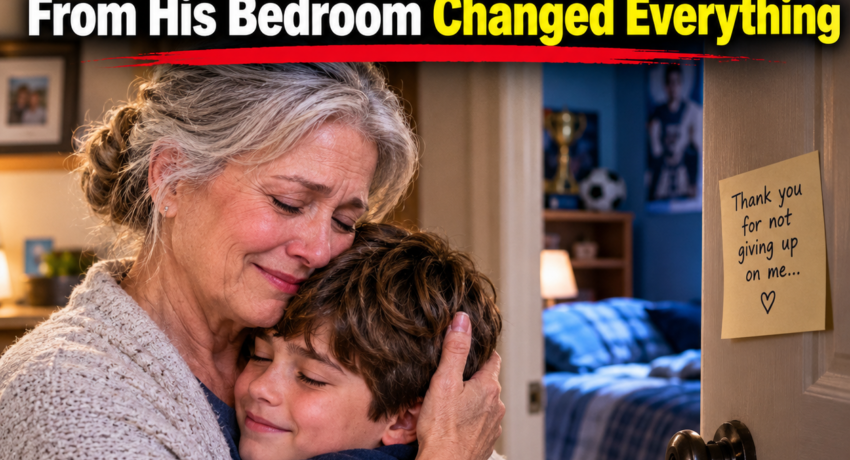
“Dad.”
I stopped breathing.
For twelve years, I had assumed that word would never belong to me.
I had watched friends become fathers.
Then grandfathers.
I had made peace with the empty bedrooms in my house and the fact that no child would ever come running toward me with scraped knees, school papers, questions, or bedtime stories.
At sixty-two, I had adopted Noah because I thought he needed a home.
I hadn’t realized how much I needed him too.
Fourteen families had looked at the challenges surrounding this quiet little boy and decided they couldn’t continue.
I had never blamed them.
I didn’t know their circumstances.
But now Noah was looking at me as though he’d just handed me the most precious thing he possessed.
His trust.
His voice.
That one word.
My eyes burned.
I walked back to the bed and knelt beside him.
“Yeah,” I managed.
My voice cracked so badly that I almost laughed.
Instead, I smiled.
“I’m right here.”
Noah smiled too.
A real smile this time.
Not the quick, uncertain smile I’d seen over burned grilled cheese.
This one stayed.
I pulled the blanket gently around his shoulders and stood.
When I reached the doorway, I looked back.
Noah was still watching me.
“Good night, son.”
His eyelids slowly closed.
And for the first time since he had entered my home three months earlier, Noah fell asleep before I left the room.
Part 7 — What “Dad” Really Meant
People might hear this story and think Noah speaking was the miracle.
I understand why.
After nearly three years without words, hearing him call me Dad felt like the world had shifted beneath my feet.
But over time, I came to understand something.
The word itself wasn’t the miracle.
Trust was.
Noah had lived for years believing safety could vanish.
He had learned to watch doors.
To study footsteps.
To keep lights on.
To check locks again and again.
He had learned that adults could leave, disappoint him, frighten him, or fail to protect him.
Then somehow, little by little, he had begun to believe that I might be different.
Not because I gave a grand speech.
Not because I forced him to tell me his story.
Not because I convinced him there was nothing to fear.
I couldn’t make that promise.
The world isn’t always safe.
What I could promise was much simpler.
If he was afraid, he wouldn’t be afraid alone.
If he needed the light on, the light would stay on.
If he needed me home in twenty minutes, I would be home in twenty minutes.
If someone came to the door who made him afraid, I would stand between them.
And if he needed three years—or ten years—to find all the words trapped inside him, I would wait.
I once believed becoming a father meant teaching a child how to face the world.
Noah taught me something different.
Sometimes fatherhood is sitting quietly beside a frightened child without demanding that he explain his fear.
Sometimes it’s burning lunch just to discover the sound of his almost-laughter.
Sometimes it’s checking a door so he doesn’t have to.
Sometimes it’s leaving the hallway light on night after night.
And sometimes, after months of expecting nothing in return, you hear one small word from a darkened bedroom—
“Dad.”
—and suddenly understand that an empty house can become a home long after you thought that chapter of your life had closed.
I was sixty-two when Noah came into my life.
People thought I was giving an unwanted child a second chance.
Maybe I was.
But they never understood the other half of the story.
Noah gave one to me too.