Part 1 — The Receipts He Never Meant Me to Find
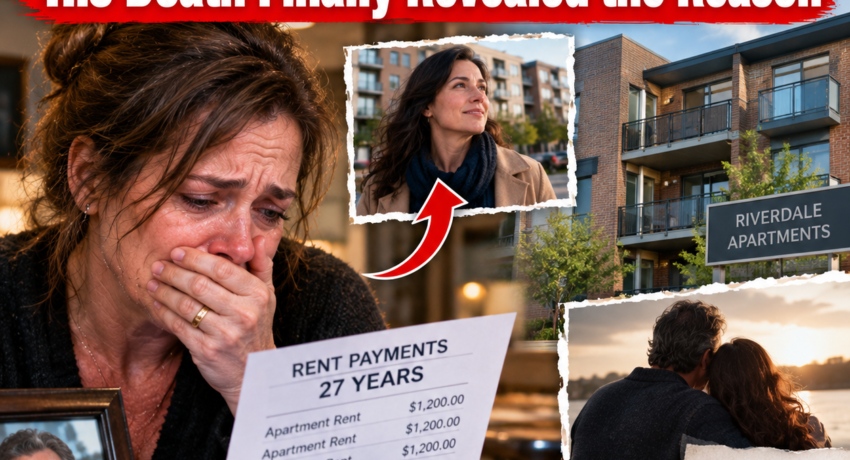
A month after my husband died, I discovered that for twenty-seven years, he had secretly paid another woman’s rent.
At first, I thought I was looking at some kind of mistake.
Michael had been gone for only four weeks, and I was still moving through each day like someone walking underwater. His coffee mug remained in the kitchen cabinet because I couldn’t bring myself to move it. His jacket still hung by the door. Every room seemed to hold some small reminder that he had once been there.
I had spent nearly forty years believing I knew the man I had married.
Then I opened one drawer in his office and realized I might not have known him at all.
I was sorting through tax records, insurance documents, and old financial statements when I noticed a thick folder pushed flat beneath several stacks of paper.
It didn’t have a label.
That alone made me curious.
Michael labeled everything.
I almost put it aside. I had already spent hours going through paperwork, and grief had made even simple tasks exhausting.
But something about the folder bothered me.
It hadn’t simply been stored.
It had been hidden.
So I opened it.
Inside were rent receipts.
Dozens of them.
Then hundreds.
Each one listed the same address.
Each payment had come from Michael’s personal account.
And every receipt was connected to the same woman.
Margaret.
My hands began to shake.
The oldest receipt was twenty-seven years old.
Twenty-seven years.
I went through the stack again, certain I had misunderstood.
Monthly payments.
Year after year.
Never missing for long.
Michael had been supporting another woman for nearly three decades, and I had never heard a single word about it.
My first thought was the one almost any wife would have had.
Had there been someone else?
Had he lived an entire second life behind my back?
Had all the late nights, business trips, and unexplained withdrawals meant something I had been too trusting to see?
That night, I barely slept.
Every memory of our marriage suddenly felt suspicious.
Every unexplained absence became a question.
Every old argument seemed to hide another meaning.
By sunrise, I could no longer sit still.
I put the oldest receipt on the passenger seat, entered the address into my phone, and started driving.
The house was three hours away.
For the entire journey, I rehearsed what I would say.
Who are you?
What were you to my husband?
Why was he paying your rent?
When I finally reached the address, the house looked almost disappointingly ordinary.
Small.
Quiet.
A little weathered.
There was no glamorous secret life waiting behind an iron gate. No mansion. No sign of hidden luxury.
I climbed the steps and knocked.
A few moments later, the door opened.
An elderly woman stood before me.
She was thin, with silver-gray hair twisted loosely behind her head.
For several seconds, I simply stared.
Then something inside me went cold.
I knew that face.
Age had softened it, but I remembered the high cheekbones.
The dark eyes.
The slight tilt of her head when she looked at someone.
My breath caught.
“No,” I whispered.
The woman frowned.
I stepped backward.
“Margaret?”
Her expression changed.
“Yes.”
My knees almost gave way.
“That’s impossible.”
She gripped the edge of the door.
“What do you mean?”
I stared at her as though I were looking at someone who had climbed out of a grave.
“Michael told me you died almost thirty years ago.”
For a moment, she said nothing.
Then she gave a quiet, humorless laugh.
“Did he?”
“He said you were dead.”
Her eyes hardened.
“Of course he did.”
A chill moved through me.
“What does that mean?”
Margaret studied me for several seconds.
Then she said something that shattered the last bit of certainty I had carried with me.
“Michael lied to you.”
She paused.
“And from the look on your face, I’m guessing this isn’t the first lie you’re about to discover.”
Part 2 — The Woman Who Was Supposed to Be Dead
I had met Margaret only a handful of times when we were young.
She was Daniel’s older sister.
Daniel had been Michael’s closest friend since childhood.
The two men had eventually started a business together.
Years later, that business collapsed.
Or at least, that was the story I had been told.
Michael had always said Daniel had made reckless financial decisions and destroyed everything they had built.
He had spoken about it with such sadness that I never questioned him.
Then Daniel died a few years afterward.
Michael told me Margaret had died too.
Now she was standing directly in front of me.
Alive.
Very much alive.
“Why would he tell me you were dead?” I asked.
Margaret stepped back from the doorway.
“You should come inside.”
I didn’t move.
Not yet.
I held the receipt up.
“First tell me why my husband paid your rent for twenty-seven years.”
Her eyes dropped to the paper.
When she looked at me again, there was something almost weary in her expression.
“You think we were having an affair.”
“I don’t know what to think anymore.”
“We weren’t.”
“Then what was this?”
Margaret’s mouth tightened.
“This wasn’t about me.”
She looked away for a moment.
“It was about Daniel.”
The name landed differently now.
“What about him?”
Her voice dropped.
“What Michael did to my brother.”
I stared at her.
Michael had spent decades grieving Daniel.
He had kept an old photograph of the two of them in his office.
He had once called Daniel the closest thing he’d ever had to a brother.
“What are you talking about?”
Margaret stepped farther into the house.
“If you want the truth, come inside.”
This time, I followed.
Her home was modest but carefully maintained. The furniture was old, though everything was spotless. On a small table in the living room sat a metal box with its lid already open.
Margaret sat beside it.
“You may want to sit down,” she told me.
I remained standing.
She reached into the box and removed several bundles of yellowed documents.
“Michael and Daniel built their company together,” she began. “Equal partners. Equal responsibility.”
“I know.”
“No. You know Michael’s version.”
She spread several papers across the table.
“When the company began collapsing, there was still money that could have been recovered. Not enough to save everything, but enough to soften the damage.”
She pushed one document toward me.
“Michael moved it.”
I looked down.
My stomach tightened.
“He transferred the recoverable funds into accounts Daniel couldn’t access.”
I shook my head.
“No.”
“He did.”
“Michael told me Daniel lost the money.”
“Michael needed you to believe that.”
She placed another page in front of me.
Then another.
Bank transfers.
Dates.
Account numbers.
Letters.
My head began to spin.
“Why would he do something like this?”
Margaret looked directly into my eyes.
“Because he was afraid.”
“Afraid of what?”
“Of losing everything.”
Her expression softened slightly.
“You were young. You had small children. Michael saw the company collapsing and panicked. So instead of falling together with Daniel, he protected what he could for himself.”
“For us,” I whispered.
“Yes.”
The word hurt more than I expected.
“For you.”
I looked down at the papers.
“He saved his own family,” Margaret continued, “and left my brother standing alone in front of every creditor, every debt, and every accusation.”
I could barely breathe.
“That isn’t what happened.”
“It is.”
“He said Daniel destroyed the business.”
“Because if Daniel was the villain, Michael could remain the hero in your eyes.”
Margaret picked up a faded letter.
“This is from Daniel.”
I recognized the handwriting from birthday cards and Christmas notes.
My fingers trembled as I read.
Daniel had begged Michael to honor their agreement.
To share responsibility.
To stop hiding.
Michael had never replied.
I sat down.
For the first time since entering the house, my legs could no longer hold me.
Margaret’s voice grew quieter.
“Daniel lost his home. His reputation was destroyed. His health failed. But the worst part wasn’t the money.”
She swallowed.
“It was knowing his best friend had abandoned him when he needed him most.”
I closed my eyes.
Memories returned with brutal clarity.
Michael coming home late.
Michael telling me Daniel had become irresponsible.
Michael saying he couldn’t save someone who refused to help himself.
Had every word been a lie?
“Daniel died a few years later,” Margaret said. “And he died believing the man he trusted most had sacrificed him to save himself.”
I looked at her.
“Why didn’t you tell me?”
Her expression hardened again.
“I tried.”
Part 3 — Twenty-Seven Years of Silence
“After Daniel died, I went to Michael,” Margaret said. “I told him I was going to tell you everything.”
My heart pounded.
“What did he say?”
“He begged me not to.”
She leaned back in her chair.
“He said the truth would destroy you. He said his children would hate him. He said he had made one terrible decision because he was scared, and he couldn’t lose his family because of it.”
“And then?”
“I left town.”
The answer came so simply that it took me a moment to understand.
Michael had told me Margaret was dead because he needed to make sure I never went looking for her.
He had erased a living woman from our lives with a sentence.
But one question remained.
“Why did he start paying your rent?”
Margaret gave a faint smile.
“At first? Guilt.”
I said nothing.
“I was struggling financially. Michael knew it. He offered to cover my rent.”
“For twenty-seven years?”
“Not originally.”
She folded her hands.
“For the first few years, he paid willingly. Maybe he convinced himself it was compensation. Maybe it helped him sleep.”
“But eventually?”
“He tried to stop.”
There was something unsettling in the calmness of her voice.
“What did you do?”
“I reminded him that I still had the documents.”
I stared at her.
She didn’t look away.
“I told him that if the payments ended, you would learn what really happened to Daniel.”
The air seemed to disappear from the room.
“You blackmailed him.”
Margaret’s expression turned cold.
“You can call it whatever makes you comfortable.”
“What else would I call it?”
“I call it payment.”
“For twenty-seven years?”
“Your family benefited from what Michael did.”
She reached into the metal box again and removed a folded sheet of paper.
Then she pushed it across the table toward me.
I unfolded it.
Another rent invoice.
Next month’s.
I looked at her in disbelief.
“Michael is dead.”
“I know.”
“He was buried four weeks ago.”
“The obligation didn’t disappear when he died.”
For a moment, I thought I had misunderstood.
“You expect me to continue paying?”
“I expect your family to settle what it owes.”
I stared at her.
“You’ve been receiving money for twenty-seven years.”
“And your family has been living with the benefit of Michael’s betrayal for even longer.”
“The house, your children’s education, the vacations, the security. Don’t pretend none of it came from what Michael protected.”
Something shifted inside me.
Until that moment, I had seen Margaret only as a woman who had been terribly wronged.
Now I saw something else too.
She was enjoying the power.
“If I refuse?”
She looked at me calmly.
“I’ll tell your children who their father really was.”
My chest tightened.
“They adored him.”
“I know.”
“And you would destroy their memory of him?”
“Michael made his choices.”
She leaned closer.
“Now you can make yours.”
I left her house carrying the invoice.
On the drive home, I couldn’t decide whom I was angrier with.
Margaret?
Michael?
Myself?
For almost forty years, I had believed I was married to a good man who had suffered a terrible betrayal by his closest friend.
Now I knew the truth was almost exactly the opposite.
Yet beneath my anger was another realization.
Margaret believed she knew what I would do.
She believed I would pay.
Why wouldn’t I?
Michael had paid for decades.
All she had to do was threaten the one thing he feared losing.
His family’s love.
By the time I reached home, Margaret’s words had carved themselves into my mind.
Pay me, or your children learn the truth.
For several hours, I considered doing exactly what Michael had done.
Then I returned to his office.
And I began searching.
Not for another lie from Michael.
For something Margaret hadn’t told me.
Part 4 — The Truth Behind the Truth
I opened every drawer.
I pulled folders from cabinets.
I searched through bank statements, handwritten ledgers, old correspondence, and financial records so fragile that some nearly came apart in my hands.
Hours passed.
Then I found it.
A gap.
Three months during which no rent payments had been made to Margaret.
I checked the dates again.
Nothing.
Then, written beside one entry in Michael’s handwriting, were words that made the entire arrangement brutally clear.
Margaret had threatened to tell the children.
Payments resumed.
I sat alone in Michael’s chair and stared at the note.
So Margaret had told the truth.
Michael had betrayed Daniel.
Michael had lied to me.
Michael had spent decades trying to bury what he had done.
But Margaret had also built something from that guilt.
I started calculating.
Month after month.
Year after year.
Twenty-seven years of rent.
When I finally compared the total with the amount Michael had originally protected during the business collapse, I stopped.
Margaret had already received far more.
Several times more.
Her pain had been real.
Her anger had been justified.
Her brother had deserved better.
But at some point, punishment had turned into profit.
Justice had turned into control.
And Michael had allowed it because he was terrified of the truth.
That was when I finally understood.
Margaret’s real power wasn’t the documents.
It wasn’t the receipts.
It wasn’t even what Michael had done.
Her power was our fear of anyone knowing.
As long as the truth remained hidden, she could threaten us with it forever.
Michael had spent twenty-seven years buying silence.
If I paid her now, I would simply inherit his prison.
One month would become a year.
A year would become ten.
And someday, after I was gone, Margaret—or someone holding those same documents—might knock on one of my children’s doors.
No.
I would not leave them that inheritance.
Not fear.
Not shame.
Not another secret.
The following evening, I called all three of my children.
“Can you come over?” I asked. “All of you.”
They arrived worried.
They assumed I needed help sorting through Michael’s estate.
Instead, I placed the hidden folder on the dining room table.
For several seconds, I couldn’t speak.
These were my children.
They were still grieving their father.
They had spent their entire lives believing he was honorable.
What I was about to tell them would hurt.
But silence had already caused enough damage.
“I found something among your father’s papers,” I finally said. “And I’m going to tell you the truth, even though I wish I didn’t have to.”
Then I told them everything.
Daniel.
The failing business.
The hidden transfers.
The lie.
Margaret.
Twenty-seven years of payments.
When I finished, the room was completely silent.
My son David stood abruptly.
“No.”
His voice was sharp.
“That can’t be right.”
“I saw the records.”
“Dad wouldn’t do that.”
“I wish that were true.”
“He was trying to protect us!”
David was angry now.
“We were little. The company was failing. What was he supposed to do? Let all of us lose everything?”
“I understand why he was afraid.”
“Then why are you judging him?”
“I’m not judging the frightened young father who made one desperate choice.”
My voice trembled.
“I’m grieving the man who spent the next forty years refusing to tell the truth about it.”
David said nothing.
“He let Daniel carry all the blame,” I continued. “He told me Daniel destroyed the company. Daniel died believing his best friend had abandoned him.”
Across the table, my daughter Rachel was crying.
I looked at them.
“Your father even told me Margaret was dead so I would never find her.”
David slowly sat down again.
The anger drained from his face.
“What happens now?”
I took a breath.
“Margaret has been using the truth to keep your father paying her rent for twenty-seven years.”
Rachel looked up.
“What?”
“And now she expects me to continue.”
They stared at me.
“She said that if I stop paying, she’ll tell all of you what your father did.”
No one spoke.
Then I said the words I had finally understood.
“That is why I am telling you myself.”
David lowered his head.
“And now?” he asked.
“Now she has nothing left to threaten us with.”
Part 5 — The Secret Lost Its Power
David rubbed both hands over his face.
“You could’ve just paid her.”
His voice was softer now.
“It would’ve been easier.”
“For how long?”
He looked at me.
“A month?” I asked. “A year? Ten years?”
No answer.
“And when I’m gone? What happens then? Does she come to you? To Rachel? Does this become something our family keeps paying for forever because everyone is too afraid to say what happened?”
Rachel reached across the table and took my hand.
“You did the right thing, Mom.”
Her voice broke.
“It hurts. But I’d rather hear it from you.”
I squeezed her fingers.
Something inside me loosened.
Not the grief.
That remained.
Not the betrayal.
That would take much longer.
But the fear was gone.
Michael had hidden the truth because he was terrified that his children would stop loving him.
Perhaps he had underestimated them.
Perhaps he had underestimated love itself.
Learning the worst thing someone has done doesn’t erase every good thing they ever did.
It simply makes the picture honest.
My children would have to decide how they remembered their father.
But at least no stranger would get to control them with information I had been too frightened to share.
Margaret didn’t know that yet.
The following morning, I drove back to her house.
The journey felt entirely different.
The first time, I had driven there terrified of what I might discover.
This time, I already knew the worst.
There was freedom in that.
I knocked.
Margaret opened the door.
When she saw me, a small, satisfied smile appeared.
“I wondered how long it would take you to accept reality.”
I said nothing.
“The rent is due soon,” she added. “You can leave the payment with me.”
“I’m not paying you.”
The smile disappeared.
“What?”
“There won’t be another payment.”
Her expression hardened.
“Think carefully.”
“I have.”
“I have every document I need.”
“I know.”
“I can call your children today.”
“You can.”
That seemed to surprise her.
She reached for her phone.
“Do you really want them to know their father built their comfortable lives on my brother’s ruin?”
“Margaret, Michael was not innocent.”
She froze slightly.
“He betrayed Daniel. He hid money. He lied about what happened. And then he lied to me for decades.”
Her eyes narrowed.
“But you did something too.”
Her mouth tightened.
“Don’t compare me to him.”
“I’m not.”
I stepped closer.
“What happened to Daniel was terrible. You had every right to be angry. You had every right to expose Michael.”
“You know nothing about what Daniel suffered.”
“You’re right.”
I nodded.
“I didn’t live through it.”
Then I looked directly at her.
“But twenty-seven years of rent did not bring your brother back.”
Her face changed.
“I went through Michael’s records. I calculated every payment.”
She said nothing.
“You have received several times more money than the amount Michael originally protected.”
Margaret’s jaw tightened.
“This stopped being repayment years ago.”
“How dare you—”
“You turned his guilt into your income.”
Her face flushed.
“You lived comfortably because of what he stole from Daniel!”
“Then you should have told the truth twenty-seven years ago.”
She reached for her phone.
“Fine. I’ll tell them now.”
I watched her unlock the screen.
“I’ll tell your children exactly what their precious father did.”
“You can’t hurt us with that anymore.”
She gave a bitter smile.
“We’ll see.”
“They already know.”
Her finger stopped above the screen.
For the first time since I had met her, Margaret looked uncertain.
“What?”
“I told them.”
The phone lowered slightly.
“All three of them.”
She stared at me.
“I told them about Daniel. About the money. About Michael lying. About you. About the payments.”
Margaret’s face seemed to empty of expression.
“You… told them yourself?”
“Yes.”
Silence stretched between us.
Twenty-seven years of power disappeared in a few seconds.
I stepped back.
“You have no secret left to sell, Margaret.”
She didn’t answer.
“There will be no payment next month.”
Still nothing.
“Or the month after that.”
I looked at her one final time.
“And when I’m gone, you will not pass this fear to my children.”
For years, Michael had believed silence protected his family.
Instead, silence had trapped him.
I would not make the same mistake.
“Goodbye, Margaret.”
Then I turned away.
Part 6 — What Truth Left Behind
I drove home beneath a pale afternoon sky.
For the first time since Michael’s death, I wasn’t thinking about the man I had believed him to be.
I was thinking about who he actually was.
A loving father.
A husband who had shared almost forty years of my life.
A frightened young man who had made a terrible decision.
A friend who had betrayed someone who trusted him.
A man who regretted what he had done but never found the courage to confess it.
All those things could be true at the same time.
That was perhaps the hardest lesson of all.
People are rarely only the best thing they’ve ever done.
And they are rarely only the worst.
I didn’t know whether I would ever completely forgive Michael.
Maybe forgiveness wasn’t even the most important thing.
What mattered was that his secret would end with me.
I would not rewrite history to make him a monster.
But I would not preserve a lie to make him a saint either.
When I pulled into the driveway, I saw my children sitting together on the front porch.
David stood first.
Rachel was beside him.
My youngest came down the steps.
For a moment, none of us spoke.
Then Rachel opened her arms.
I walked toward them.
We were still grieving.
We were still hurt.
There would be difficult conversations ahead.
There would be questions none of us could ask Michael now.
But for the first time, we were grieving the real man rather than the perfect memory he had carefully left behind.
And somehow, that felt healthier.
Lighter.
More honest.
Michael’s lies had shaped almost forty years of my life.
They had destroyed one friendship.
They had trapped him in fear.
They had given Margaret twenty-seven years of control.
But they would not decide what happened next.
The secret was over.
The payments were over.
And so was the fear.
Sometimes telling the truth doesn’t repair what happened in the past.
Sometimes it cannot restore what was lost.
But it can stop the damage from traveling into the future.
And for my children and me, that was where healing finally began.