Part 1 — The Man I Never Truly Forgot
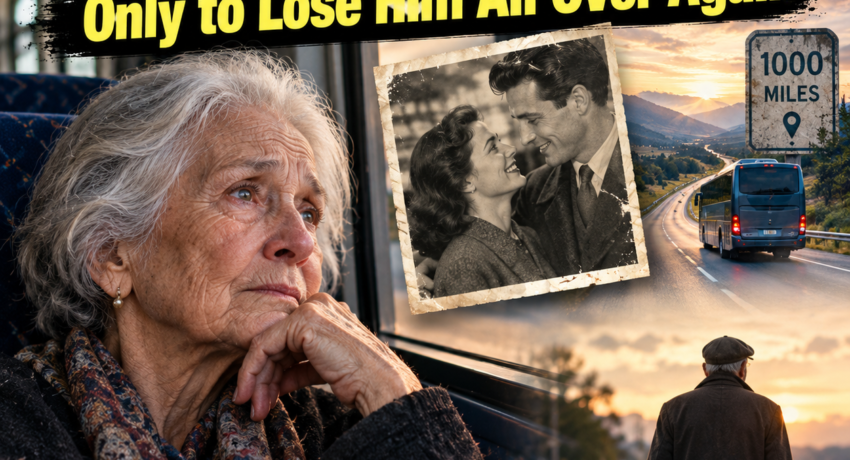
At seventy-nine years old, I drove more than a thousand miles for a man I had not seen in half a century.
By the following morning, he had vanished.
And when I went looking for him, I found something inside his house that made my hands tremble—a fifty-year-old photograph of the two of us, with my face circled in red ink.
But to understand why that photograph terrified me, you have to understand who Thomas had once been to me.
I was twenty-nine when we met.
Back then, I believed I was old enough to recognize the difference between a passing attraction and something that might actually matter.
I had dated charming men before.
I knew how easily a handsome smile could make a woman overlook common sense.
I also knew that charm rarely lasted once real life entered the picture.
Then Thomas walked into my life.
A mutual friend introduced us after one of his taekwondo competitions.
Thomas had just finished competing, and he still carried himself with the alert confidence of a man who expected someone to challenge him at any moment.
He was athletic, self-assured, and annoyingly handsome.
But what I noticed first were his dimples.
Ridiculous little dimples that appeared every time he smiled.
I caught myself staring.
He noticed.
Naturally, he smiled even wider.
I immediately decided I disliked him for it.
Our mutual friend introduced us, exchanged a few jokes, and eventually wandered away to talk with other people.
Thomas and I were left alone.
There was no reason for us to keep talking.
I assumed we would exchange a few polite sentences, perhaps have a drink, and then go our separate ways.
Instead, we talked for six hours.
Six.
The competition hall slowly emptied around us.
Workers began stacking chairs.
People said goodbye.
Lights were switched off in sections of the building.
Still, Thomas and I kept talking.
Eventually, we moved somewhere quieter.
And then we talked some more.
He told me about competitions, injuries, training, and the strange pressure of having people constantly expect him to prove himself.
I told him about my family, my hopes, the life I imagined building, and the mistakes I was absolutely certain I would never make again.
What surprised me most was the way he listened.
Thomas had the sort of confidence that usually came with a love of hearing one’s own voice.
But he wasn’t like that.
When I spoke, he paid attention.
Real attention.
If I mentioned something casually, he remembered it an hour later.
If I avoided answering a question, he noticed.
If I became serious, his expression softened and he leaned closer.
By the time I went home, I knew something had happened.
I just wasn’t ready to give it a name.
That night, I couldn’t sleep.
I kept replaying pieces of our conversation.
His laugh.
His eyes.
Those stupid dimples.
The way he paused before answering difficult questions, as if my opinion genuinely mattered to him.
I reminded myself that I was twenty-nine, not nineteen.
I was supposed to know better than to build a future around one extraordinary evening.
Still, when morning came, I desperately wanted to see him again.
And for several wonderful weeks, I did.
Thomas slipped into my life with astonishing ease.
Soon, even when he wasn’t beside me, I found myself collecting things to tell him later.
A funny conversation I’d overheard.
A strange sign on the highway.
A ridiculous thought that no one else would understand.
I had begun imagining him as part of my future before I had even admitted to myself how deeply I cared.
Then, without warning, Thomas disappeared.
No argument.
No goodbye.
No explanation.
Nothing.
At first, I was frightened.
I thought perhaps he had been injured.
Then I wondered whether I had done something wrong.
I replayed every conversation.
Every glance.
Every sentence.
I examined our final days together as though somewhere inside them was a clue I had failed to notice.
There wasn’t.
Eventually, fear became embarrassment.
Embarrassment turned into anger.
And over time, anger settled into something quieter.
A question.
One simple, painful question that followed me through fifty years of my life.
Why?
Part 2 — Fifty Years Later
Life does not stop because your heart has been broken.
It moves forward whether you are ready or not.
Mine certainly did.
I changed homes.
Changed routines.
Changed priorities.
People came into my life, stayed for a while, and sometimes left again.
I aged.
I learned.
I became calmer in some ways and less willing to tolerate nonsense in others.
By seventy-nine, I was almost unrecognizable from the woman Thomas had known.
Yet somewhere in the back of my mind, he remained unfinished.
Not constantly.
I didn’t spend fifty years sitting beside a window waiting for him.
But every so often, something would bring him back.
A martial arts competition on television.
The sound of a man’s laugh across a crowded restaurant.
A pair of dimples.
And suddenly, for one second, I would be twenty-nine again.
Then, at seventy-nine, I found him.
Thomas was eighty-four.
The first time I saw his face after fifty years, I simply stared.
His dark hair had turned silver.
The powerful athlete’s body had softened with age.
He moved more carefully.
His shoulders no longer carried the same restless energy.
But when he smiled, the years seemed to fold in on themselves.
The dimples were still there.
I felt something inside me shift.
It was strange seeing him aged.
Almost comforting.
Time had touched him just as surely as it had touched me.
But seeing him again did not make the unanswered questions disappear.
If anything, it made them louder.
Thomas looked at me for a long moment.
There were emotions in his face I couldn’t read.
Surprise.
Regret.
Affection.
Perhaps fear.
Then he smiled.
And somehow, that smile was enough to make me do something absolutely unreasonable.
I drove more than one thousand miles to see him.
At seventy-nine.
Alone.
Anyone who has attempted a long road trip at my age will understand that romance is not the only thing capable of taking your breath away.
Sometimes it’s your lower back.
My knees complained whenever I stopped for gas.
My shoulders became stiff.
I drank entirely too much coffee.
And approximately every hundred miles, I held an argument with myself.
This is ridiculous.
Turn around.
You’re too old for this.
What exactly are you expecting?
An apology?
A romance?
A miracle?
Every time, I kept driving.
I told myself I didn’t expect us to fall in love again.
I wasn’t some foolish young woman chasing a fantasy.
I only wanted answers.
At least, that was the story I told myself.
When I finally arrived, something between us felt unexpectedly easy.
That evening, Thomas and I walked through the city until almost midnight.
Neither of us moved quickly anymore.
We made jokes about sore knees.
We stopped more frequently than either of us cared to admit.
Thomas teased me about getting old.
I reminded him that he was five years older than I was.
For the first time in decades, the past didn’t feel painful.
It felt close.
At a tiny bar, Thomas ordered his favorite drink.
Gin with quince syrup.
I stared at the glass.
“You’re serious?”
“Completely.”
“That sounds terrible.”
He looked offended.
“You’ve clearly lost your appreciation for sophistication.”
“I never had any.”
He laughed.
Then his expression suddenly changed.
Thomas raised his glass.
His eyes met mine.
“To second chances.”
My smile faded slightly.
There were fifty years sitting inside those three words.
Fifty years of silence.
Fifty years of questions.
I could have asked him everything right then.
Why did you leave?
Did you ever think about me?
Did I mean anything to you?
But I didn’t.
Maybe I was afraid of the answers.
Maybe I wanted one evening where the past couldn’t hurt us.
So I raised my glass.
“To second chances.”
That night, for a little while, I felt twenty-nine again.
Then morning came.
And Thomas disappeared.
Again.
Part 3 — I Refused to Lose Him Twice
I called him that morning.
No answer.
I waited.
Perhaps he was sleeping.
I called again.
Nothing.
By noon, his phone had been switched off.
A familiar feeling settled into my stomach.
At first, I fought it.
Don’t be ridiculous, Cassie.
You’re not twenty-nine anymore.
People have dead phone batteries.
People get busy.
People go places without explaining every movement.
But as the hours passed, an old wound began opening inside me.
By evening, anger had replaced worry.
I knew exactly what this felt like.
Fifty years earlier, Thomas had disappeared from my life, and I had allowed silence to become the ending.
I had cried.
I had wondered.
I had blamed myself.
Eventually, I had moved on without ever knowing the truth.
I wasn’t doing that again.
I was seventy-nine years old.
Whatever time remained in my life was too precious to waste on another fifty years of unanswered questions.
So I got into my car.
And I drove straight to Thomas’s house.
His car was parked outside.
That stopped me.
If Thomas had intentionally left, why hadn’t he taken his car?
Suddenly, my anger became unease.
I walked to the house.
The front door was unlocked.
That frightened me even more.
“Thomas?”
No answer.
I stepped inside.
The silence was unnatural.
Not peaceful.
Empty.
His drinking glass was still beside the kitchen sink.
Nothing appeared damaged.
Nothing was obviously missing.
I moved farther into the room, trying to convince myself there was a completely reasonable explanation.
Then I saw the photograph.
It was lying on the kitchen table.
Old.
Faded around the edges.
The moment I picked it up, my breath caught.
It was Thomas and me.
The photograph had been taken the night we first met.
I remembered my clothes.
His smile.
The strange electricity I had felt standing beside him.
For several seconds, the kitchen disappeared.
I was twenty-nine again.
Then I noticed the red ink.
Someone had drawn a circle around my face.
Not lightly.
Not accidentally.
A thick, deliberate red circle.
My hands began shaking.
I stared at it.
Why would Thomas keep something like this?
And who had marked me?
“Thomas?”
Still nothing.
I went upstairs.
His bedroom was empty.
The bed appeared recently slept in.
Nothing looked disturbed.
But beside it sat an open suitcase.
Partially packed.
My heart pounded.
Was he leaving?
Had he planned to disappear again?
Had something interrupted him?
Then I heard it.
The front door slammed downstairs.
Footsteps entered the house.
They stopped at the bottom of the staircase.
I froze.
My mind returned instantly to the unlocked door.
The abandoned house.
The strange photograph.
The red circle around my younger face.
Then a voice called upward.
“Cassie?”
I knew that voice.
I rushed into the hallway.
“Thomas?”
He stood at the bottom of the stairs, breathing heavily.
For a second, he looked astonished to see me.
Then something darker crossed his face.
Fear.
“What are you doing here?” he asked.
I gripped the railing.
“You disappeared.”
“I didn’t disappear.”
“Your phone was off. You didn’t answer me. And there’s a suitcase in your bedroom.”
Thomas closed his eyes briefly.
I walked downstairs.
“What is happening?”
He looked exhausted.
Not simply physically tired.
It was as though something he had been carrying for decades had finally become too heavy.
“You shouldn’t have come here,” he said quietly.
I stared at him.
Those words hurt more than I expected.
“That’s what you’re going to say to me?”
“Cassie—”
“No.”
My voice was sharper now.
“I drove more than a thousand miles to see you. Last night you raised your glass and toasted second chances. Then this morning, you vanished.”
Thomas glanced toward the kitchen.
I followed his eyes.
The photograph remained on the table.
The color drained from his face.
“You found it.”
I picked it up.
“Why is my face circled in red?”
Thomas slowly lowered himself into a chair.
For several seconds, he said nothing.
I remained standing.
I had already waited half a century.
I was finished waiting.
Finally, he looked at me.
“My brother did that.”
I frowned.
“Daniel?”
Thomas nodded.
I vaguely remembered the name.
He had mentioned his brother once or twice when we were young.
“What did Daniel have to do with me?”
Thomas stared at the photograph.
“More than you ever knew.”
Part 4 — The Truth About Fifty Years Ago
Thomas motioned toward the chair across from him.
“Sit down.”
I did.
He folded his hands together on the table.
When he finally spoke, his voice sounded different.
Older.
Smaller.
“When I met you, Cassie, my life was already complicated.”
“What does that mean?”
“My family controlled almost everything.”
I waited.
“My father controlled my training, my competition schedule, my money, the people around me—everything. Once I stopped competing, I was expected to join the family business.”
Thomas paused.
“There was also a woman he expected me to marry.”
I felt something cold move through my chest.
“You never told me.”
“I know.”
“Why?”
“Because I was ashamed.”
“Of being engaged?”
“No. Of being afraid of my own family.”
He turned toward the window.
“My father wasn’t a man people said no to easily.”
I looked again at the photograph.
“When did they find out about me?”
“Almost immediately.”
“How?”
“Daniel followed me.”
My stomach tightened.
Thomas continued.
“He took photographs. He reported everything to my father.”
I looked down at the faded image.
Suddenly, it felt sinister.
That photograph had not been taken by some friend capturing a happy memory.
Someone had been watching us.
“Then what happened?”
“My father told me to stop seeing you.”
“And you did.”
“No.”
Thomas answered so quickly that I looked up.
“I told him I wouldn’t.”
That surprised me.
He held my gaze.
“I was planning to leave.”
“Leave your family?”
“Everything.”
He gave a quiet, bitter laugh.
“I had this ridiculous plan. I was going to pack a suitcase, walk away from the business, the money, the expectations—everything.”
He looked at me.
“And I was going to ask you to come with me.”
For a moment, I couldn’t speak.
All those years, I had believed I had been insignificant.
A temporary amusement.
A woman he had simply tired of.
“But you never asked me,” I whispered.
“No.”
“Why?”
“Daniel came to see me first.”
Thomas’s hands tightened.
“He told me my father had people watching you.”
I stared at him.
“What?”
“He said if I refused to end things, they would make your life difficult.”
“How?”
“Your job. Your family. Your reputation. Anything they could reach.”
I shook my head.
“Thomas, that’s insane.”
“I know.”
“And you believed him?”
“Not at first.”
He swallowed.
“Then Daniel showed me photographs.”
My skin went cold.
“Photographs of what?”
“You leaving work.”
Thomas’s voice grew quieter.
“You driving home.”
“You meeting friends.”
“You shopping.”
“You living your ordinary life while people you didn’t know were watching you.”
I stared at him.
The room suddenly seemed smaller.
Thomas’s eyes filled with tears.
“I was thirty-four years old. I thought I was strong.”
He gave a broken laugh.
“I competed. I fought. I stood in front of crowds. I thought fear was something I understood.”
His voice cracked.
“Then someone threatened you.”
He looked down.
“And I panicked.”
The anger inside me began rising again.
“So you disappeared.”
He nodded.
“I thought if I walked away, they would lose interest in you.”
“You could have told me.”
“I know.”
“You could have warned me.”
“I know.”
“You could have trusted me enough to let me decide whether I was willing to take that risk.”
Thomas flinched.
“I know.”
My voice shook.
“You let me spend fifty years thinking I meant nothing to you.”
His face changed.
That sentence hurt him.
Good.
Some small part of me wanted it to.
“I know,” he whispered.
I stood and walked away from the table.
For decades, I had imagined this conversation.
Sometimes, in my imagination, I slapped him.
Sometimes, I screamed.
In kinder versions, I immediately understood everything and forgave him.
Reality was nothing like that.
I was furious with him.
I pitied him.
I loved the man he had once been.
I resented the man sitting in front of me.
And beneath all of it was something I had never expected.
Relief.
I had mattered.
I wished that knowledge hadn’t mattered so much.
But it did.
Part 5 — Why He Disappeared Again
I turned back toward Thomas.
“That explains fifty years ago.”
He looked at me.
“But it doesn’t explain today.”
His shoulders sank.
“The suitcase?”
“The suitcase. Your phone. Your disappearance. All of it.”
Thomas took a long breath.
“Daniel called me this morning.”
For a moment, I simply stared.
“Daniel is still alive?”
“He’s eighty-seven.”
“And what could he possibly want now?”
Thomas’s jaw tightened.
“He heard you were here.”
A chill moved through me.
“How?”
“I don’t know.”
“You expect me to believe your brother is still interfering with your life when you’re eighty-four years old?”
Thomas gave a tired smile.
“Some families never learn when their authority expires.”
“What did he say?”
“That seeing you again was a mistake.”
I almost laughed.
“After fifty years?”
“He still believes the past belongs to him.”
I picked up the photograph again.
“And the circle around my face?”
“Daniel drew it.”
“When?”
“Years ago.”
“Why have you kept this horrible thing?”
Thomas looked at me.
“Because I hated what it represented.”
He paused.
“And because it was the only photograph I had of us.”
My anger weakened for one dangerous second.
I looked at the younger versions of ourselves.
Two people who had no idea how little time they would be given.
“Where were you today?” I asked.
“At Daniel’s house.”
“You went to see him?”
“Yes.”
“Why?”
Thomas’s expression changed.
The uncertainty was gone.
“I went to tell him he doesn’t get another fifty years.”
I slowly sat down.
Thomas reached toward my hand, then stopped before touching me.
“I turned my phone off because I didn’t want him calling while I drove.”
I stared at him.
“You could have told me where you were going.”
“I should have.”
“You did exactly what you did before.”
“I know.”
“You made a decision by yourself because you thought you knew what was best.”
Thomas nodded.
“You’re right.”
I hadn’t expected that.
No excuse.
No self-defense.
No speech about protecting me.
For the first time, he seemed willing to admit that good intentions did not erase the damage he had caused.
“I was a coward at thirty-four,” he said.
“I spent decades telling myself I disappeared because I was protecting you.”
He looked down.
“Maybe part of that was true.”
His fingers tightened together.
“But another part of me was protecting myself. Leaving you was easier than fighting them.”
The honesty hurt.
But I respected it.
I looked toward the staircase.
“And the suitcase?”
Thomas followed my gaze.
“I was packing.”
My chest tightened.
“To leave?”
“Yes.”
Something inside me dropped.
I almost laughed at myself.
Of course.
Perhaps fifty years hadn’t changed anything after all.
Then Thomas continued.
“I was hoping to leave with you.”
I stared at him.
“What?”
He smiled carefully.
Those dimples appeared.
At eighty-four.
Just as ridiculous as ever.
“I thought maybe we could go somewhere.”
“Thomas—”
“I don’t mean run away like we’re twenty-nine.”
A small laugh escaped me despite everything.
“Good, because I refuse to spend the night sleeping in a car at my age.”
He laughed.
Then his expression softened.
“I don’t know how much time we have, Cassie.”
Neither did I.
At our age, pretending otherwise would have been foolish.
“But whatever time I have,” he continued, “I don’t want to spend it afraid of Daniel. Or my father, even though he’s long gone. Or anything else.”
He looked at me.
“I don’t want fear choosing for me anymore.”
Part 6 — No More Disappearing
At seventy-nine, I knew something I had not understood at twenty-nine.
Love does not erase consequences.
Regret does not automatically deserve forgiveness.
And missing someone does not mean you should immediately rebuild your life around them.
Fifty years had happened.
We couldn’t pretend they hadn’t.
Thomas had hurt me.
Whatever his reasons, he had made a choice that affected my life without allowing me to have a voice in it.
I wasn’t going to romanticize that.
But I also knew something else.
Forgiveness did not require forgetting.
A second chance did not mean pretending the first chance had never been lost.
So I didn’t promise Thomas forever.
I didn’t tell him everything was forgiven.
I didn’t suddenly become a young woman dreaming about running away with him.
Instead, I held out my hand.
“First thing.”
He looked at it.
“What?”
“Turn your phone back on.”
For a second, Thomas stared at me.
Then he laughed.
A real laugh.
The same laugh I remembered from fifty years ago.
“Fair enough.”
“And another thing.”
“Anything.”
“No more disappearing.”
His smile faded.
He looked directly into my eyes.
“Never again.”
I let him take my hand.
His fingers were older now.
So were mine.
There were wrinkles where there had once been smooth skin.
Our hands no longer looked like the hands of two people beginning a love story.
Maybe that was what made the moment so precious.
We weren’t beginning with endless time ahead of us.
We were beginning with the understanding that time was limited.
For most of my life, I had believed Thomas disappeared because he hadn’t loved me enough to stay.
The truth was more complicated.
He had loved me.
But he had also been afraid.
And love mixed with fear can still leave terrible wounds.
Perhaps I had been afraid too.
Afraid to look for him.
Afraid to reopen the past.
Afraid that the truth would confirm my worst suspicion—that I had meant nothing.
Fear had already taken fifty years from us.
I was not willing to give it another day.
That evening, Thomas and I went upstairs together.
The suitcase still sat open beside the bed.
He looked at me.
“So what do I do with this?”
I smiled.
“We unpack it.”
He raised an eyebrow.
“I thought perhaps we were leaving.”
“Eventually.”
I picked up one of his shirts.
“But you’re not running anywhere tonight.”
Thomas took the shirt from me.
“No.”
He folded it slowly and placed it back in the drawer.
We unpacked the suitcase piece by piece.
There was something strangely symbolic about it.
Fifty years earlier, Thomas had planned to pack a bag and ask me to leave with him.
He never got the chance.
Now, half a century later, we stood beside another suitcase.
Only this time, neither of us was running.
When the last item had been put away, Thomas closed the empty case.
Then he looked at me.
“Cassie?”
“Yes?”
“I’m sorry.”
There are apologies that come too quickly.
Apologies meant to end uncomfortable conversations.
Apologies offered because someone wants forgiveness more than they want accountability.
This wasn’t one of them.
Thomas wasn’t asking me to erase what had happened.
He wasn’t asking me to tell him that disappearing had been justified.
He was simply acknowledging the weight of what he had done.
I nodded.
“I know.”
We stood quietly for a while.
Then Thomas smiled.
The dimples appeared again.
And I shook my head.
“What?”
“Nothing.”
“You’re staring.”
“I’m wondering how those ridiculous dimples survived eighty-four years.”
He laughed.
“Perhaps you drove a thousand miles for the dimples.”
“Don’t flatter yourself.”
“Too late.”
I laughed too.
That night, there were still questions between us.
There were still wounds that one evening could never heal.
There was no magical promise that the years ahead would be easy.
But there was honesty.
There was choice.
And for the first time, there was no silence.
I had spent fifty years believing our story ended when Thomas stopped choosing me.
Now I understood that the truth had been far more complicated.
He had been afraid.
He had allowed other people to control his decisions.
And he had spent decades living with the consequences.
I couldn’t give us back the years we had lost.
Neither could he.
But maybe second chances aren’t about recovering the past.
Maybe they are about refusing to waste the present.
At twenty-nine, I had waited for Thomas to choose me.
At seventy-nine, I finally understood that I had a choice too.
I could walk away.
I could remain angry.
I could protect myself from the possibility of another heartbreak.
Or I could stay—not because the past had been erased, but because the truth had finally been spoken.
So I stayed.
That evening, we unpacked the suitcase.
Thomas turned his phone back on.
And for the first time since I was twenty-nine years old, the man I had never truly stopped loving did something wonderfully ordinary.
He stayed.