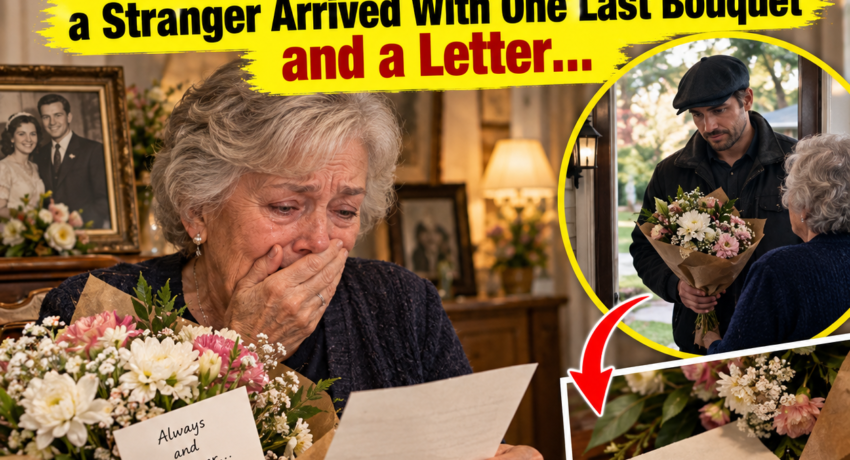
For 57 years, my grandfather put fresh flowers in my grandmother’s kitchen every Saturday before she woke up. He never missed a week. Six days after we buried him, a man in a gray coat knocked on her door with a bouquet and an envelope. “Thomas asked me to deliver this,” he said. The letter gave us an address and told us to go right away.
Part 1: The 2,964th Saturday
My grandfather brought my grandmother flowers 2,964 times.
I know the number because I counted. It was the night after his funeral. I sat at their kitchen table in Cambridge, Ohio, with a calculator from his junk drawer. Fifty-seven years times fifty-two Saturdays. I needed a number to hold onto, because nothing else felt solid.
Thomas Bennett never missed a week. Not when the steel plant laid him off in 1982. Not when he had his knee replaced. Not during the blizzard of ’78, when he walked eleven blocks in snow up to his shins and came home holding a handful of grocery-store carnations wrapped in a bread bag.
He always did it the same way. He got up before dawn and slipped out of the house. When Grandma Eleanor came downstairs in her blue robe, the flowers were already in the green glass vase by the sink.
Some weeks it was daisies. Some weeks tulips, or peonies in June. In October it was always something the color of pumpkins.
She never asked where he got them, and he never said. It was their little game.
“A woman should have one mystery in her life,” he told me once, winking over his coffee. “I figured I’d be hers.”
I was nine when he said that. I thought it was the most romantic thing I’d ever heard.
I was thirty-six when he died, and I still did.
He died on a Sunday afternoon in the hospital bed we’d set up in the living room, the one the hospice nurse called “the good bed” because it faced the window. Grandma held his hand the whole time. In the last hour, she leaned down and said something in his ear that none of us heard.
His lips moved. I’m almost sure he said, “Saturday.”
I thought it was confusion. The morphine. A dying man’s mind going back to his habits.
I was wrong about that, and about a lot of other things.
Six days later, on the first Saturday of my grandmother’s life without flowers, someone knocked on the front door at 8:05 in the morning.
When I opened it, a stranger was standing on the porch holding a bouquet tied with a narrow lavender ribbon.
It was the same lavender ribbon that had been on every bouquet my grandfather ever brought home.
Part 2: The Things He Left Behind
I should explain why I was there that week, because it matters.
I’m a pediatric nurse in Columbus, about an hour and a half west. My mother, Carol, lives in Phoenix and flew in for the funeral. She flew back on Wednesday because she “couldn’t take any more time off,” which is how my mother handles grief. She schedules it.
I took ten days of PTO I’d been saving for a trip that wasn’t going to happen anymore.
Four months earlier, I had moved out of the house I shared with my husband, Ryan. I found out he’d been hiding $14,300 in credit card debt for two years. He had separate statements and a separate email account. He’d smile across the dinner table and tell me everything was fine.
I could have forgiven the money. What I couldn’t get past was every ordinary Tuesday he looked me in the eye and kept it from me.
So when I say my grandparents’ marriage was my proof that real love existed, I mean it. When I looked at my own life and saw only wreckage, I looked at them. Fifty-seven years. No secrets. Flowers every Saturday.
That week, Grandma and I worked through the house one room at a time. She wasn’t ready to give anything away. She just wanted to touch his things.
“Leave the flannel shirts,” she said on Monday. “Box the ties. He hated ties.”
On Tuesday I cleaned out his desk in the den.
That’s where I found the first thing that didn’t fit.
In the bottom drawer, under a stack of old tax returns, was a thick bundle of receipts held with a rubber band. They were all from the same place:
Harlan’s Flowers — 214 N. Columbus St., Lancaster, Ohio.
There were hundreds of them, going back to the mid-1990s. Every one was dated on a Saturday and stamped between 6:00 and 6:30 a.m.
I stared at them. Lancaster is more than an hour from Cambridge. There was a flower shop six minutes from my grandparents’ house. There was a Kroger with a full floral department.
Why would an old man drive over two hours round-trip, before sunrise, every single week, for flowers?
I didn’t show Grandma. I told myself it was because she was tired.
The truth was that the first thought in my head was an ugly one, and I didn’t want her to see it on my face.
On Wednesday I found the second thing. It was a small brass key taped to the underside of the desk drawer. I checked every lock in the house and nothing fit it.
On Thursday Grandma sat at the kitchen table with the empty green vase in front of her. She ran her thumb along the rim.
“You know he couldn’t tie a bow?” she said suddenly. “His hands. The arthritis. Forty years he couldn’t tie his own shoes without cursing. But the flowers always had that perfect little ribbon.”
“Maybe the store tied it,” I said.
“Maybe,” she said. She kept looking at the vase.
Then she said something I’d never heard her say.
“I used to wonder, sometimes, where he really went.”
Part 3: The Man in the Gray Coat
The man on the porch that Saturday was maybe thirty-five. He had a gray wool coat and a neatly trimmed beard, and there was a white van at the curb with the engine still running.
He looked past me into the house like he was bracing for something.
“Good morning,” he said. His voice was careful and rehearsed. “I’m here for Thomas. He asked me to deliver this to his wife after he passed.”
My hands started shaking. I couldn’t have told you why. It was only flowers. But there was that lavender ribbon.
Behind me, I heard Grandma’s slippers moving fast across the hardwood, faster than I’d seen her move in years.
“Who is it?” she said. Then she saw the flowers, and she stopped.
The man held out the bouquet. White roses, yellow freesia, and a single sprig of something purple. Tucked into the stems was a cream-colored envelope with her name on the front.
Ellie.
Only one person in the world ever called her that.
“Who are you?” I asked.
He opened his mouth, closed it, and shook his head once. “I’m sorry. I promised I’d just deliver it. It’s not my part to explain.”
“Your part?”
But he was already walking down the steps. The van pulled away before I could get my shoes on.
Grandma didn’t wait. She sat on the bench in the front hall, the one where Grandpa used to lace his boots, and tore the envelope open with her finger.
It was his handwriting. I’d know it anywhere. Blocky capital letters, because his cursive had gone shaky years ago.
She read it out loud. Her voice was thin but steady.
“Ellie,
If you are reading this, then I ran out of Saturdays before I ran out of courage. I’m sorry I didn’t tell you this earlier.
There is something I hid from you for most of our life together. I did it because I loved you, but I’ve come to understand that isn’t always a good enough reason. You deserve to know the truth, and I should have been braver.
Please go to this address today. Don’t wait. She has waited long enough.
Take Claire with you. You shouldn’t make this drive alone.
I loved you every single day. Even the days I kept this from you. Especially those.
— Tom”
Below it was an address. Lancaster, Ohio.
I felt something cold settle in my chest.
She has waited long enough.
Grandma folded the letter in half, then in half again. Her hands were trembling so badly the paper rattled.
“Grandma,” I said carefully, “we don’t have to go today. We can think about this.”
She looked up at me. Her eyes were very clear.
“Get your keys,” she said. “And get my good coat. The navy one.”
Part 4: An Hour on Route 22
The drive took seventy-one minutes. I know because I watched the clock on the dashboard the whole way, like it could tell me something.
Grandma held the bouquet in her lap. She didn’t say a word for the first twenty miles.
I said plenty of things in my head.
Receipts from Lancaster every Saturday since 1995. A key to a lock we can’t find. “She has waited long enough.”
I’d been a nurse for twelve years. I’d sat with enough families in enough hospital rooms to know that when a man says “I hid something for most of our life,” there’s usually a woman on the other end of it. Sometimes there are children.
I thought about Ryan and his separate email account. I thought about every man who ever smiled and said everything was fine.
My hands tightened on the steering wheel.
“You’re angry,” Grandma said.
“I’m not.”
“Claire Marie. You’re doing seventy-eight in a fifty-five.”
I slowed down. “I just don’t want you to get hurt.”
“I’m seventy-seven years old and I buried my husband six days ago,” she said quietly. “I’m not sure what’s left to hurt.”
Somewhere around Thornville, she opened the letter again and read it silently. Then she said, almost to herself, “He said she.”
“I know.”
“Not they. Not him. She.”
I didn’t answer. There was nothing to say that wouldn’t make it worse.
At 9:32 a.m., the GPS told me to turn onto a narrow street lined with maple trees just starting to go orange. The address was a small yellow house with white shutters and a porch swing. There were flower boxes under every window, full of mums and trailing ivy, and they were immaculate.
The white van from that morning was parked in the driveway.
I turned off the engine. Neither of us moved.
“We can still go home,” I said.
Grandma unbuckled her seat belt. “Your grandfather drove to this town for thirty years. I think I can walk up one set of steps.”
I held her elbow up the porch. My stomach was in knots. She knocked twice, the way she always knocked on my apartment door, two short taps like she was apologizing for interrupting.
The door opened.
A woman stood there. She was around sixty, with silver hair cut to her chin and a green cardigan with a smear of soil on the cuff. She had reading glasses pushed up on her head.
When she saw my grandmother, she went completely still. One hand came up and gripped the doorframe.
For a long moment, nobody breathed.
Then the woman said, in a voice that shook on every word:
“I know who you are. I’ve been waiting for you for a very long time.”
She stepped back and opened the door wider.
“You need to know something Thomas was hiding from you. Please. Come in.”
Part 5: “Thomas Was My…”
The house smelled like coffee and eucalyptus. There were flowers everywhere: in mason jars, in teacups, drying upside down from a string across the kitchen window.
The man in the gray coat was standing in the kitchen doorway. He gave us a small, awkward nod.
“This is my son, Daniel,” the woman said. “I’m Margaret. Margaret Harlan.”
Harlan. The name on the receipts.
Margaret gestured toward a floral couch. My grandmother sat at the very edge of it, clutching the bouquet like a shield. I stayed standing.
Margaret sat across from us in a wooden rocking chair. She didn’t rock. She kept her hands pressed flat on her knees.
“What did Thomas hide from me?” Grandma asked. Her voice trembled, but she held Margaret’s eyes.
Margaret took a deep breath.
“Thomas was my…”
She stopped and pressed her lips together. I watched her try to find the word and fail.
“He was my friend,” she said finally. “For thirty-one years. He came into my shop every Saturday morning at six o’clock. I opened early just for him. He’d drink a cup of terrible coffee from my machine and tell me about his week. And then he’d take the flowers home.”
“To me,” Grandma whispered.
“To you.”
I couldn’t hold it in anymore.
“Friend,” I said. My voice came out sharper than I meant. “A married man drives an hour each way to see a woman every Saturday before dawn for thirty years, and hides it from his wife, and you’re calling that a friend?”
“Claire,” Grandma said.
“No. I’m sorry, but no.” I turned to Margaret. “If you had some kind of relationship with my grandfather, just say it. She deserves that much. Don’t dress it up.”
Daniel took a step forward. Margaret raised one hand, and he stopped.
She didn’t look offended. She looked tired, the way I’ve seen parents look at 3 a.m. in the pediatric ICU.
“It’s not what you think,” she said. “But I understand why you think it.”
She got up and crossed to a bookshelf. She came back with a wooden box, about the size of a shoebox, with a small brass lock on the front.
I knew before she set it on the coffee table.
“He said you might find the key,” she said to me. “He said you were the type who’d find it.”
I pulled the brass key out of my pocket. I’d carried it all week without knowing why.
It turned easily.
Inside were dozens of envelopes, all addressed to Margaret in his blocky handwriting. Under them was a stack of photographs. Me at my high school graduation. My mother’s wedding. Grandma in the garden at Cambridge, laughing with dirt on her nose. A newspaper clipping of their fiftieth anniversary.
Grandma made a small sound. “Why would he give you pictures of us?”
Then my eyes caught on something tucked into the lid of the box. It was a tiny plastic hospital bracelet, yellowed with age, the kind they put on newborns.
I picked it up. The typed letters had faded but were still readable:
BABY GIRL WHITAKER — 10/14/66 — ST. ANNE’S, PITTSBURGH PA
Whitaker.
My grandmother’s maiden name was Whitaker.
And every October 14th, for as long as I could remember, she pressed one flower between the pages of her Bible and wouldn’t say why.
I looked up. Grandma was staring at the bracelet in my hand.
All the color had gone out of her face.
Part 6: The Girl in the Lavender Blanket
“I was seventeen,” my grandmother said.
She said it to the bracelet, not to any of us.
“My parents sent me to a home in Pittsburgh. St. Anne’s. They told everyone at church I was visiting an aunt. I had her on a Friday. They let me hold her for eleven minutes.” She swallowed. “I wrapped her in a lavender blanket my grandmother had knitted. It was the only thing I had to give her. Then a nurse took her, and I signed the papers, and I went home and finished my junior year like nothing had happened.”
The room was so quiet I could hear the kitchen clock.
“I told Tom the night before our wedding,” she went on. “I told him because I thought he deserved the chance to leave. He didn’t. He just held me. And I made him promise…” Her voice cracked for the first time. “I made him promise he would never look for her. I told him if he ever did, I’d know I didn’t deserve to have been her mother.”
Margaret was crying silently now. She didn’t wipe the tears away.
“He kept that promise for twenty-six years,” Margaret said. “Until 1995.”
Grandma’s head came up. “My surgery.”
“He told me you almost didn’t wake up from the anesthesia,” Margaret said. “And that when you did, the first thing you said wasn’t his name. It was ‘Is my girl okay?’ He said you didn’t remember saying it. But he couldn’t forget it.”
Now I understood. It hit me all at once, the way the truth sometimes does in a hospital room when the lab results finally come back.
My grandfather hadn’t been having an affair. He’d been finding my grandmother’s daughter.
Margaret explained it slowly, like she’d practiced. Ohio had just opened a voluntary adoption registry. Thomas filed a request. Margaret had filed one, too, two years before. She’d been adopted by a couple in Lancaster, the Harlans, who owned a flower shop. She took it over when they retired.
“When he first walked into my shop, I was furious,” she said. “Not at him. At her.” She looked at my grandmother. “I was twenty-nine. I’d spent my whole life wondering why I wasn’t worth keeping. And this sweet old man shows up and says, ‘She was a scared kid, and she’s never stopped loving you.’ I didn’t believe him. I told him if he wanted to be in my life, he had to buy something and leave.”
“So he bought flowers,” I said softly.
“So he bought flowers.” She laughed through her tears. “And he came back the next Saturday. And the next. He never pushed. He just told me about her. About you. About Carol. He showed me pictures. After about a year, I started tying the bouquets myself.”
She reached into her cardigan pocket and pulled out a small spool of narrow lavender ribbon.
“I still have the blanket,” she said. “It’s upstairs. The adoption agency sent it with me. This is the closest color I could find.”
My grandmother put her hand over her mouth.
Every bouquet since 1995. That perfect little bow Grandpa’s arthritic hands could never have tied. The orange flowers every October. The extra stem each year on the fourteenth, which Grandma had always pressed without knowing where it came from.
For thirty-one years, every Saturday, my grandmother had been receiving flowers arranged by her daughter’s hands.
“Why didn’t he tell me?” Grandma whispered. “Thirty years, Margaret. Why?”
“Because at first I asked him not to,” Margaret said. “I wasn’t ready. And by the time I was, about eight years ago, he was terrified. He’d broken the one promise you ever asked of him. He thought you’d never forgive him. He thought you might…” She stopped.
“Might what?”
“Might think you didn’t deserve either of us.”
Grandma closed her eyes.
“He kept saying next Saturday,” Margaret said. “Next Saturday, he’d bring you with him. Next Saturday, he’d tell you. Then he got sick. Last spring, he sat in my shop and cried, and he said, ‘I’m a coward, Maggie. Promise me that if I run out of time, you won’t let her run out of time, too.’ So we wrote the letter together. Daniel agreed to deliver it.”
My grandmother opened her eyes. She looked at Margaret for a long time. It was the way she looked at a recipe card in someone else’s handwriting, trying to understand it.
“Did you hate me?” she asked.
Margaret didn’t soften it. “For a long time. Yes.”
Grandma nodded slowly, like she’d expected that. Like she felt she’d earned it.
“And now?”
Margaret set the ribbon on the coffee table between them.
“Now I’d like to know you,” she said. “If you’ll let me. But I need you to know that I’m sixty years old. I’m not the baby in the blanket. I have a life, and a son, and a shop, and I won’t be anybody’s secret again. If you want me in your life, it has to be out loud.”
My grandmother sat very still for almost a full minute.
Then she stood up, crossed the small space between them, and held out the bouquet with the lavender ribbon.
“I think these are yours,” she said. “You made them.”
Part 7: Out Loud
We stayed until almost four o’clock that afternoon.
Margaret brought down the blanket. It was faded now to the color of weak tea, but the stitching still held. Grandma didn’t cry when she saw it. She just unfolded it very carefully across her knees and smoothed it flat with both palms, over and over, the way you’d soothe a child with a fever.
Daniel made grilled cheese sandwiches. Nobody was hungry, and everybody ate.
I sat on the porch swing for a while and read some of Grandpa’s letters to Margaret. They weren’t love letters. They were grocery lists of a life. Carol’s getting married in May. Claire got into nursing school — first one in the family to go to college. Ellie’s tomatoes came in so fast this year we’re giving them to the mailman.
In one from 2019, he’d written:
I think about telling her every single week. Then I see her face when she comes downstairs and finds the flowers, and I think, one more Saturday. What kind of man keeps a secret out of love for this long? I’m starting to think it isn’t love anymore. It’s just fear wearing love’s coat.
I read that line three times.
I thought about Ryan.
Then I thought about the difference between him and my grandfather. Ryan hid something to protect himself. My grandfather hid something to protect her, and then kept hiding it because he was afraid. Both were wrong. But they weren’t the same kind of wrong.
I didn’t know what to do with that yet. I put it away for later.
The hardest part came that night, when I called my mother.
I put her on speaker at Grandma’s kitchen table. Grandma told her everything herself. I could have done it, but she said, “No. I’ve let other people carry this long enough.”
When she finished, my mother was silent for so long I thought the call had dropped.
“So I have a sister,” Mom finally said. Her voice was flat. “A sister you never told me about. And Dad knew for thirty years. And now she wants to come to the memorial?”
The memorial was the following Saturday. We were scattering Grandpa’s ashes in the garden, like he’d asked.
“I’d like her to come,” Grandma said.
“Mom, you can’t.” My mother’s voice broke. “You can’t just rewrite my entire childhood in one phone call and expect me to stand next to some stranger at my father’s memorial like it’s normal. If she’s there, I’m not coming.”
Grandma looked at me. She didn’t say it, but I understood. She was about to give in. She’d spent sixty years choosing the quiet option, the one that didn’t upset anyone.
So I made the choice for myself.
“Mom,” I said, “I’m the one who invited her. I asked Margaret to come this afternoon, before we even left Lancaster.”
It was true. I’d done it on the porch while Grandma was upstairs with the blanket.
“Claire.”
“I’m sorry. I know that’s hard. But Grandpa spent thirty years keeping her hidden because he was afraid of exactly this phone call. I’m not going to make her wait at the edge of the yard like she’s something to be ashamed of. If you need to not come, I’ll understand. I’ll save you a chair either way.”
My mother hung up without saying goodbye.
She didn’t answer my texts for eleven days. She didn’t answer when I sent her the photo of Margaret’s shop, or the photo of the blanket. On the ninth day she didn’t answer when I told her I’d called Ryan, just to talk. We were going to see a counselor, with one condition: every account, every statement, every password, out on the table. No more secrets wearing love’s coat.
On the morning of the memorial, a rental car pulled into Grandma’s driveway at 9:40 a.m.
My mother got out. She stood by the car door for a long time, looking at Margaret, who was standing by the garden gate with Daniel.
Then she walked straight across the lawn to her.
I held my breath.
My mother stopped a few feet away. “Dad used to tell me he had a friend in Lancaster who gave him a deal on flowers,” she said. “I always thought he was just being cheap.”
Margaret let out a startled laugh.
My mother’s chin trembled. “I’m really angry,” she said. “Not at you. I just need you to know I’m really angry, and it might take me a while.”
“That’s fair,” Margaret said. “It took me about twenty years.”
My mother nodded. And then, stiffly, awkwardly, like two people who’d never done it before, which they hadn’t, they hugged.
Part 8: The Door Opens
It’s March now, five months later.
I’m writing this at my grandmother’s kitchen table on a Saturday morning, because this is where I spend most of my Saturdays these days.
Grandma still lives in the house in Cambridge. She’s slower on the stairs, and she talks to Grandpa sometimes when she thinks no one is listening. She tells him about the weather. She tells him she’s still mad at him. She tells him she understands.
“Both things can be true,” she told me once. “I can be furious he didn’t trust me, and grateful he broke his promise. Fifty-seven years teaches you that almost everything worth having comes with both.”
Margaret drives over every other Saturday. They’re careful with each other. They don’t call each other “Mom” or “sweetheart.” Margaret calls her Eleanor. Grandma calls her Maggie, the way Grandpa did.
Some days are hard. In December, Margaret asked why Grandma never tried to find her, even after the registry opened, and Grandma didn’t have a good answer. Margaret left early that day. She came back two Saturdays later with a poinsettia and said, “I’m still here. I just needed a minute.”
They’re building something slowly, one Saturday at a time. It’s not a fairy tale. It’s better, because it’s real.
My mother flew in for Christmas and stayed four extra days. She and Margaret sat on the back steps and compared notes on their father and their mother. They found they were the same man and the same woman, loved from two different sides of a locked box.
Ryan and I are still in counseling. I don’t know how it ends. I know that for the first time in two years, I’m not afraid to ask him a question.
And the flowers?
They still come.
Every Saturday at 8:05 a.m., there’s a knock on the front door. Sometimes it’s Daniel with the white van. Sometimes it’s Margaret herself, with soil on her cuffs.
The bouquets are always different. Tulips in spring. Peonies in June. Something orange in October.
And there’s always a narrow lavender ribbon, tied in a perfect bow.
The only thing that’s changed is the knock. For fifty-seven years, my grandfather crept in quietly while she slept, so she’d never know where the flowers came from.
Now my grandmother is already awake. She’s already in her blue robe, already standing in the front hall when the knock comes.
She’s the one who opens the door.
My grandfather kept one secret for thirty-one years, and he kept it out of love until it became fear. Do you think he did the right thing by breaking his promise to find her, or should he have told my grandmother the truth the very first Saturday?