Part 1 — The Promise I Made at Seventeen
At seventeen, I believed love meant standing beside someone when everyone else walked away.
Fifteen years later, I learned that love without the truth can become a prison you never realize you entered.
I met the man who would become my husband during high school.
He was my first serious boyfriend, my first real love, and the first person outside my family who made me feel completely understood.
There was nothing dramatic about the beginning of our relationship.
No grand declarations.
No cinematic first kiss in the rain.
We simply liked being together.
He could make me laugh when I was stressed. I knew when something was bothering him before he said a word. We spent hours talking about college, careers, marriage, and the kind of life we imagined building one day.
We were seniors.
Seventeen years old.
Young enough to believe that if two people loved each other deeply, everything else would eventually work itself out.
Then, one snowy night a week before Christmas, my phone rang.
I was sitting cross-legged on my bedroom floor wrapping presents when I heard his mother crying on the other end.
Her words came in broken pieces.
There had been an accident.
A truck.
An ambulance.
He couldn’t feel his legs.
By the time I reached the hospital, the entire place seemed unreal.
The fluorescent lights were too bright. The air smelled like disinfectant. Nurses moved quickly in and out of his room while machines blinked beside the bed.
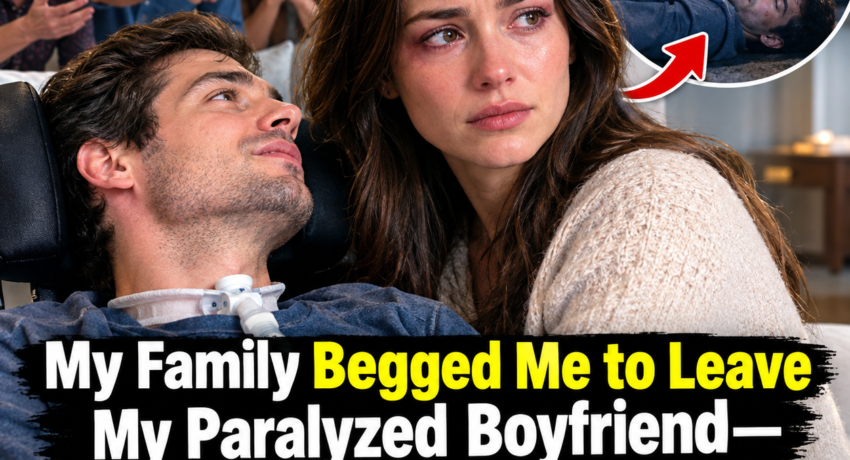
He was wearing a neck brace.
His face was bruised.
But he was awake.
The moment he saw me, his eyes filled with tears.
I rushed to his side and wrapped my fingers around his hand.
“I’m here,” I whispered.
He tried to speak.
I squeezed his hand harder.
“You don’t have to say anything. I’m not going anywhere.”
I meant every word.
A doctor eventually asked his parents and me to step into the hallway.
He spoke carefully, but there was no gentle way to deliver the news.
My boyfriend had suffered a severe spinal cord injury.
The paralysis from his waist down was expected to be permanent.
His mother collapsed into a chair.
His father stood completely still, staring at the floor.
And I remember thinking only one thing:
His entire future has just changed.
It never occurred to me that mine was about to change too.
Part 2 — “Him or Us”
When I returned home that night, my parents were waiting in the kitchen.
They were wealthy, successful people who had spent my entire childhood planning my future almost as carefully as they planned their investments.
There was a college fund.
A prestigious university they hoped I would attend.
Talk of law school afterward.
Internships.
Connections.
A career.
They believed they had given me every advantage a child could need.
That night, though, they weren’t interested in asking how my boyfriend was doing.
My mother pointed toward a chair.
“Sit down.”
I did.
“He can’t walk,” I told them. “The doctors don’t think he ever will.”
My mother’s expression tightened.
I continued before she could speak.
“I’m going back to the hospital tomorrow. His family is going to need help and—”
“No.”
I stared at her.
“What?”
“This needs to stop now.”
For a moment, I genuinely didn’t understand what she meant.
She folded her hands on the table.
“You are seventeen years old. You have your entire future ahead of you. You cannot build your life around someone who will need this level of care forever.”
Anger rushed through me.
“Someone?”
“He is my boyfriend.”
My father leaned toward me.
“Nobody is saying he’s a bad person.”
“That sounds exactly like what you’re about to say.”
“We’re saying you are too young to understand the consequences of what you’re promising.”
I pushed my chair back.
“So because he can’t walk anymore, I’m supposed to stop loving him?”
My mother sighed.
“Love is not enough.”
“It is to me.”
“Love doesn’t pay medical bills. It doesn’t transfer someone from a bed into a wheelchair. It doesn’t deal with insurance companies or accessibility or years of physical limitations.”
I felt tears burning behind my eyes.
“You think I don’t know his life has changed?”
“We think you have no idea how much yours will change with it.”
My father tried a softer approach.
“You can still care about him. You can still visit. But you don’t need to make this your future.”
I stared at him.
“What exactly are you telling me to do?”
Neither of them answered immediately.
So I said it for them.
“You want me to leave him.”
My mother’s silence was answer enough.
I started crying.
“I loved him yesterday. Why should today be different?”
“Because yesterday you weren’t facing reality.”
I stood.
“No. Yesterday you liked him because you thought he fit into the future you planned for me.”
My father stood too.
“Enough.”
“No. You think I should replace him because he’s inconvenient now.”
My mother’s face hardened.
“If you choose to stay with him, that is your decision.”
Something about her tone frightened me.
Then she continued.
“But we will not finance that decision.”
I stared at her.
“What does that mean?”
“Your college fund. Your living expenses. Tuition. Everything.”
I honestly thought she was bluffing.
“You’d cut me off because I refuse to abandon someone after an accident?”
“We won’t pay for you to throw away your future.”
The argument lasted for hours.
I cried.
I screamed.
I begged them to understand that the boy lying in that hospital bed was still the same person I had loved before the crash.
They wouldn’t move.
Finally, my mother looked directly at me.
“Him or us.”
The room became completely silent.
My voice shook when I answered.
“Him.”
Part 3 — The Life I Walked Away From
The following morning, my father removed my access to the college fund.
Then he placed a folder containing my personal documents on the table.
Birth certificate.
School records.
Identification.
“If you’re old enough to make adult decisions,” he said, “then you’re old enough to live with them.”
I stayed in the house for two more days.
Those were the longest two days of my life.
Nobody shouted anymore.
That would almost have been easier.
Instead, we passed each other in hallways like strangers.
My mother barely looked at me.
My father spoke only when necessary.
Eventually, I packed a duffel bag.
A few outfits.
Books.
Toiletries.
Whatever seemed important to a seventeen-year-old leaving home without knowing when—or whether—she would return.
Before walking out, I stood in the middle of my bedroom.
My entire childhood was still there.
Photographs.
School trophies.
The desk where I’d filled out college applications.
The closet containing the dress my mother and I had bought for graduation.
For one moment, I almost unpacked everything.
Then I remembered the hospital.
His hand holding mine.
My promise.
I zipped the bag.
His parents lived in a modest house across town.
When his mother opened the front door and saw me standing there with luggage, she understood immediately.
She didn’t ask what happened.
She simply stepped aside.
“Come in, sweetheart.”
That kindness broke me.
I cried against her shoulder like a child.
And from that day forward, their home became mine too.
I traded the university I had dreamed about for community college.
I worked wherever I could.
Coffee shops.
Retail stores.
Weekend shifts.
Evenings.
Anything that helped cover expenses.
Meanwhile, I learned more about caregiving before I turned eighteen than most people learn in decades.
Transfers from bed to wheelchair.
Medication schedules.
Catheter care.
Insurance appeals.
Accessibility equipment.
Physical therapy appointments.
How to help without making the person you’re helping feel helpless.
It was exhausting.
But I never considered leaving.
Not once.
When prom approached, my boyfriend refused to go.
“Everybody is going to stare at me.”
“So?”
He looked at me like I was ridiculous.
“So I don’t want to spend the night being somebody’s tragedy.”
“You won’t.”
“They’ll stare at the chair.”
“Then let them hurt their necks.”
That finally made him laugh.
I refused to let the accident take everything from us.
So we went.
The gym was decorated with cheap lights and shiny streamers.
People did stare.
But some friends quickly moved chairs out of the way so he could get through.
Others joked with him exactly the way they had before the accident.
And then Jenna appeared.
Jenna was my best friend.
She looked beautiful that night.
She hugged me first, then bent slightly toward him with a grin.
“Well, look at you. Wheelchair or not, you cleaned up pretty well.”
He laughed.
So did I.
Later, during a slow song, I stood between his knees.
His hands rested at my waist while we moved gently beneath the lights.
I remember looking around that gym and feeling strangely proud.
My family had warned me that this life would destroy me.
Instead, I thought we were proving everyone wrong.
If we could survive what had already happened, what could possibly break us?
I had no idea that the answer was already standing inside that room.
Part 4 — Fifteen Years of Choosing Him
After graduation, we married in his parents’ backyard.
There were folding chairs borrowed from neighbors.
A simple cake from Costco.
A clearance dress that needed alterations.
Someone decorated a cheap white arch with artificial flowers.
It wasn’t elegant.
It was ours.
I kept glancing toward the street throughout the ceremony.
Some stubborn part of me believed my parents might appear at the last moment.
Maybe my mother would walk up crying.
Maybe my father would stand at the back and quietly watch.
Maybe becoming my husband would finally make them understand that I hadn’t been going through some teenage phase.
They never came.
When we exchanged vows and reached the words “in sickness and in health,” I nearly smiled.
We had already lived those vows before speaking them.
A few years later, we had a son.
The day he was born, I stared at his tiny face and thought about my parents.
I mailed a birth announcement to their office.
I included a photograph.
I waited.
A week passed.
Then another.
No letter came.
No phone call.
Nothing.
Eventually, I stopped checking the mailbox.
Years accumulated quietly.
Christmas after Christmas.
Birthday after birthday.
Anniversary after anniversary.
Sometimes I would scroll through my contacts and stop at my parents’ numbers.
I never deleted them.
I also never called.
Pride can look a lot like strength from the outside.
Inside, it often feels more like grief.
Still, we built a good life.
My husband completed his degree online and eventually found remote work in IT.
He was patient and surprisingly good at it.
He could spend forty minutes guiding someone through a computer problem without sounding irritated once.
We weren’t wealthy.
We worried about bills.
We argued about chores, fatigue, money, parenting, and whose turn it was to handle something neither of us wanted to handle.
In other words, we had a marriage.
An imperfect one.
But I believed it was real.
Sometimes, when life was especially difficult, I reminded myself of everything we had overcome.
The accident.
Rehabilitation.
Being cut off from my family.
Starting with almost nothing.
Parenthood.
Years of adapting.
I believed surviving all of that meant we had a bond stronger than most people would ever understand.
Then, fifteen years after the accident, I came home early from work.
And heard my mother’s voice in my kitchen.
Part 5 — The Woman I Hadn’t Heard in Fifteen Years
At first, I thought my mind had created the sound.
I stood inside the front door holding a bag of my husband’s favorite takeout.
Then I heard her again.
Louder this time.
Angry.
My mother.
Fifteen years had passed since I had heard that voice in person, but there are some sounds you never forget.
I walked toward the kitchen.
My heart was pounding so hard that I could hear it.
She was standing beside the table with a stack of papers in her hand.
My husband sat across from her.
His face was almost gray.
My mother slammed one of the pages onto the table.
“How could you do that to her?”
He said nothing.
“How could you let my daughter build fifteen years of her life around a lie?”
My hand tightened around the takeout bag.
“Mom?”
They both turned.
For one brief second, her expression softened.
I saw shock.
Pain.
Something that looked almost like relief.
Then she looked toward the chair.
“Sit down.”
It was exactly the same thing she had told me the night of the accident.
This time, however, her voice was trembling.
“You need to see this.”
My husband looked at me.
He was already crying.
“Please,” he whispered. “I’m sorry.”
I stared at him.
“Sorry for what?”
He couldn’t answer.
My mother handed me the papers.
The first page was a copy of an old police report.
The date stopped me immediately.
The night of the accident.
Then I saw the route listed.
And the address.
It wasn’t anywhere near his grandparents’ house.
I looked at another page.
Old messages.
Then another.
My eyes caught a familiar name.
Jenna.
My best friend.
My hands went cold.
There were exchanges between them from the weeks before the crash.
One message from my husband read:
Can’t stay long. Need to get home before she starts asking questions.
Jenna had answered:
Drive carefully. Love you.
For a moment, I genuinely couldn’t understand what I was seeing.
My brain kept searching for an explanation that would allow the life I knew to remain intact.
“There has to be some mistake.”
My mother spoke quietly.
“There isn’t.”
I looked at my husband.
“Tell me she’s wrong.”
His face collapsed.
He looked down.
And in that silence, my marriage changed forever.
Part 6 — What Really Happened That Night
My mother said the words he couldn’t.
“He wasn’t coming home from his grandparents’ house the night of the accident.”
I could barely breathe.
“He was leaving Jenna’s.”
I looked at him.
He was crying openly now.
“Is that true?”
He nodded.
Everything inside me seemed to become numb.
“How long?”
His voice was barely audible.
“A few months.”
I laughed once.
Not because anything was funny.
Because sometimes your body produces the wrong reaction when the truth is too enormous.
“A few months.”
“I was seventeen,” he said. “I was stupid.”
“So was I.”
He looked at me.
“But somehow I managed not to secretly date your best friend.”
“I know.”
“You told me you were going to your grandparents.”
“I know.”
“That night?”
He nodded.
“And Jenna?”
Another nod.
“You were leaving her house when you crashed.”
“Yes.”
The kitchen suddenly felt too small.
I stared at the papers again.
Fifteen years of my life seemed to rearrange themselves.
The hospital.
My parents’ ultimatum.
Leaving home.
Community college.
Jobs.
Marriage.
Our son.
Every sacrifice I had willingly made rested on one basic belief:
The boy I loved had been terribly injured through no fault of his own, and abandoning him afterward would have been unthinkable.
But that hadn’t been the whole story.
I looked at him.
“When did you decide to lie?”
“After I woke up.”
His voice broke.
“I knew the truth would come out if I told anyone where I’d been.”
“So you made up the story about your grandparents.”
He nodded.
“Why?”
He cried harder.
“I was terrified.”
“Of what?”
His eyes finally met mine.
“Losing you.”
I felt something cold move through me.
“You knew me.”
“Yes.”
“You knew I would stay if I believed you had simply been in an accident.”
He didn’t answer.
“You knew I would fight everyone for you.”
His face crumpled.
“Yes.”
“And you also knew that if I found out you’d been sleeping with Jenna…”
“I thought you’d leave.”
I stared at him.
“So you didn’t give me the chance.”
“I was seventeen.”
“And then you were eighteen.”
He flinched.
“Nineteen.”
I stepped closer.
“Twenty-five.”
He closed his eyes.
“Thirty.”
My voice began shaking.
“You had fifteen years.”
“I know.”
“No, you don’t get to keep saying that.”
I slammed the papers onto the table.
“You watched me lose my parents because of you.”
“I never asked you to—”
I cut him off.
“You knew the choice I was making wasn’t based on the truth.”
He fell silent.
“That is the part you don’t seem to understand.”
My eyes filled.
“You didn’t simply cheat on me when we were teenagers. You stole my ability to decide what I wanted to do after learning who you really were.”
“I loved you.”
“Then you should have trusted me with the truth.”
“I thought I would tell you later.”
“When?”
He looked helpless.
“I don’t know.”
“After the wedding?”
No answer.
“After our son was born?”
Nothing.
“After ten years?”
He covered his face.
“Every year made it harder.”
I shook my head.
“No. Every year made the lie easier for you to live with.”
Part 7 — My Mother’s Truth
Eventually, I turned toward my mother.
One question remained.
“How did you find out?”
She sat down slowly.
“I ran into Jenna.”
Hearing that name made my stomach tighten again.
“She told me she’d been having a difficult few years,” Mom continued. “She’d suffered several miscarriages.”
Her voice softened.
“She said she had started believing terrible things about herself. That maybe she was being punished for something she’d done when she was younger.”
I stared at her.
“So she confessed.”
“Yes.”
“Just like that?”
“Not immediately.”
Mom explained that once Jenna finally told her about the affair, she gave enough details for my mother to begin checking the old story.
Dates.
Locations.
Messages Jenna had kept.
The accident report.
Together, they proved what had happened.
Of course my mother had come armed with evidence.
She knew exactly what I would assume if she appeared after fifteen years accusing my husband of something.
I sat down because my legs no longer felt steady.
My mother looked at me.
“We failed you too.”
I almost laughed.
“This isn’t the moment.”
“I know, but I need you to hear it.”
She wiped her face.
“What your husband did was wrong. But what your father and I did afterward was wrong too.”
I looked at her.
“We thought we were protecting your future. When you chose differently, we punished you.”
My throat tightened.
“You abandoned me.”
“Yes.”
She didn’t soften it.
Didn’t defend herself.
That mattered.
“We told ourselves you would come back when life became difficult,” she continued. “Then too much time passed. Pride took over. Every year that we didn’t call made the next year harder.”
The similarity hit me immediately.
I looked from her to my husband.
Different betrayals.
The same excuse.
Too much time had passed.
My mother began crying.
“We missed your wedding.”
I said nothing.
“We missed the birth of our grandson.”
My eyes burned.
“His first birthday. His first Christmas. Everything.”
“You could have called.”
“I know.”
“You knew where I was.”
“Yes.”
“You weren’t protecting me.”
“No.”
She looked down.
“We were protecting our pride.”
For the first time in fifteen years, my mother wasn’t telling me what decision I should make.
She was simply admitting what hers had cost us.
But I could not forgive either of them in that kitchen.
There were too many truths arriving at once.
So I turned toward my husband.
“I need space.”
His face filled with panic.
“What does that mean?”
“It means I can’t look at you right now.”
“Please don’t leave.”
I stared at him.
Then I realized how strange those words sounded.
Fifteen years earlier, I had been the one standing with a bag and nowhere to go.
Now he was terrified of being left behind.
“Where am I supposed to go?” he asked.
A bitter laugh escaped me.
“I had to answer that question at seventeen.”
He stared at me.
“You’re an adult now.”
Part 8 — This Time, I Chose Myself
I walked into our bedroom and pulled out a suitcase.
The scene felt almost painfully familiar.
But everything about me was different.
At seventeen, I had packed because my parents had forced me to choose.
This time, nobody was choosing for me.
I packed clothes for myself.
Then clothes for our son.
His school things.
Documents.
His favorite stuffed dinosaur.
He was spending the afternoon at a friend’s house and had no idea that his parents’ marriage had just cracked open.
When I carried the suitcase back into the living room, my husband was waiting.
My mother stood nearby with tears streaming down her face.
He looked at the suitcase.
“Please.”
I set it beside the door.
“We have fifteen years together.”
“I know.”
“We have a child.”
“I know.”
“You can’t erase everything because of something I did when I was seventeen.”
I studied his face.
“That isn’t why I’m leaving.”
He looked confused.
“You made a terrible mistake at seventeen.”
I took a breath.
“Then you made another choice every day afterward.”
His face tightened.
“You could have told me after the accident.”
“I know.”
“Before we married.”
He looked down.
“Before we had a child.”
Nothing.
“Any ordinary Tuesday during the fifteen years that followed.”
Tears filled my eyes.
“You had thousands of chances to decide that I deserved the truth.”
“I was afraid.”
“And your fear mattered more to you than my right to know.”
He started crying again.
“I love you.”
For years, those words would have been enough to make me stay.
That day, they weren’t.
“I loved you too.”
His expression collapsed at the past tense.
“I loved you enough to lose my family.”
My voice broke.
“I worked jobs I hated. I changed my education plans. I learned how to build an entirely different life because I believed we were facing hardship together.”
“I know.”
“And the strange thing is, I don’t regret doing any of it.”
He stared at me.
“I don’t regret helping you. I don’t regret marrying you. I don’t regret our son.”
I wiped my face.
“What I regret is that you never respected me enough to let those decisions be mine.”
I picked up the suitcase.
He whispered, “Can we fix this?”
“I don’t know.”
That was the truth.
Not revenge.
Not cruelty.
Just truth.
And for once, truth was going to matter.
I walked out.
Part 9 — The Grandparents My Son Had Never Met
I picked up my son and told him we were going somewhere for a few days.
“Where?”
“Grandma and Grandpa’s.”
He stared at me.
“My grandparents?”
I had spoken about them occasionally over the years, carefully avoiding telling him too much about why they weren’t part of our lives.
He looked excited.
I nearly cried.
When we reached my childhood home, I sat in the driveway for several seconds before getting out.
The house looked smaller than I remembered.
My father opened the door.
He looked past me.
Then he saw my son.
His hand immediately gripped the doorframe.
My son’s face contained enough of me at that age that Dad didn’t need an introduction.
His eyes filled.
“Is this…”
“Yes.”
My mother appeared behind him.
The moment my son smiled politely and said, “Hi,” she broke down.
He looked at me, confused.
“Did I do something?”
“No, sweetheart.”
I put my hand on his shoulder.
“They’re just happy to meet you.”
That evening, after he went to sleep, my parents and I sat around the same kitchen table where they had once told me to choose between them and the boy I loved.
My father apologized first.
Not conditionally.
Not with excuses.
He apologized for cutting me off.
For believing money gave him control over my decisions.
For never contacting me.
For allowing pride to cost him fifteen years with his daughter and grandson.
My mother apologized too.
I listened.
When they finished, nobody spoke.
Finally, my father asked quietly, “Can you forgive us?”
I thought about it.
Then answered honestly.
“I don’t know yet.”
His face fell slightly.
I continued.
“But I’m willing to see what happens next.”
That was all I could give them.
It was more than we had possessed the day before.
Part 10 — What Came After
The divorce wasn’t quick.
It wasn’t clean.
There were lawyers.
Financial discussions.
Custody arrangements.
Schedules.
Long conversations that went nowhere.
Some days I hated my husband.
Other days I remembered a joke he’d told fifteen years earlier and started crying because grief doesn’t always understand what it’s supposed to miss.
I didn’t want our son to hate his father.
His father’s betrayal belonged to our marriage, not to their relationship.
So I gave him the simplest version of the truth.
“Your dad made a serious mistake,” I told him. “And then he hid it for a long time.”
He frowned.
“Do you still love him?”
Children always find the hardest question.
I thought carefully.
“A part of me probably always will.”
“Then why can’t you live together?”
“Because loving someone and trusting someone are different things.”
He was quiet.
Then I added,
“And sometimes adults have to change their relationship when trust gets broken.”
He accepted that better than I expected.
Children don’t always need every ugly detail.
They need to know they are safe.
They need to know they didn’t cause the problem.
And they need permission to keep loving both parents.
My own relationship with my parents has been slower.
There was no magical reunion.
Fifteen lost years don’t disappear because people cry in the same room.
Sometimes my mother says something that reminds me exactly why we used to fight.
Sometimes my father’s instinct is still to solve a problem with money instead of emotion.
Sometimes I become seventeen again in my head and want to walk out.
But then my son plays cards with my father.
Or my mother asks before offering advice.
Or one of them says, “We were wrong,” without adding a single excuse.
And the distance between us becomes slightly smaller.
I have my own apartment now.
Nothing luxurious.
But I chose it.
I have my job.
My son.
A life that belongs to me.
Some nights, after everything becomes quiet, I still mourn the marriage I believed I had.
That might be the strangest grief of all.
I’m not only grieving what happened.
I’m grieving something that never fully existed.
For years, I thought the greatest act of courage in my life had happened when I was seventeen and chose love over comfort.
Maybe it was courageous.
Maybe it was also reckless.
But I don’t regret loving a boy after his life changed.
His paralysis was never the betrayal.
Helping him was never the mistake.
My mistake was believing that sacrifice and trust were automatically the same thing.
They aren’t.
You can love someone enough to carry burdens beside them.
You can change your plans.
You can stay when life becomes difficult.
You can forgive imperfections.
But you cannot build a healthy life around a truth you’ve never been allowed to know.
Fifteen years ago, everyone wanted me to choose between love and family.
Now I understand there was always another choice.
Myself.
And this time, I finally made it.
Because choosing love can require courage.
But choosing truth is what finally sets you free.