Part 1 — The Man Outside the Window
The first time I saw Jamie, we were eighteen and still young enough to believe promises could survive anything.
The second time I saw him, ten years had passed.
He was hanging twelve stories above the street with a squeegee in one hand while the people around me laughed at him.
I was sitting in the most important meeting of my career.
Our boardroom occupied the corner of the twelfth floor, surrounded by glass from ceiling to floor. From that height, the city looked polished and expensive—the kind of view people used as proof that they had finally made it somewhere.
That morning, I should have been thinking about numbers.
Margins.
Operational forecasts.
The massive corporate acquisition our firm had spent months preparing for.
Instead, I was trying to stop my hands from shaking beneath the conference table.
Rumors had been circulating for weeks.
A major company was considering taking control of our firm. No one below senior leadership seemed to know exactly who the buyer was, but everybody understood the stakes.
If the deal went through, some people would rise.
Others might disappear.
I had worked for years to earn my position as one of the youngest senior consultants in the company, and that meeting could determine whether I moved even higher.
Our regional director was halfway through a presentation when laughter broke out near the windows.
At first, I ignored it.
Then Brent, our lead analyst, stood and wandered toward the glass.
He had the irritating ability to act amused even when everyone else was terrified.
He looked outside and smirked.
“Well, there’s motivation to stay in school.”
Several people laughed.
Someone else said, “Come on. Somebody has to wash the windows.”
More laughter.
I gave a small, automatic smile.
Not because I thought it was funny.
Because that was what I had trained myself to do in rooms filled with people more powerful than me.
Smile.
Don’t create friction.
Survive the meeting.
Then I finally looked outside.
A man in a blue work shirt stood on a narrow suspended platform.
A safety harness crossed his chest. Soap covered part of the glass in front of him.
He moved the squeegee downward, wiped one corner with his glove, and lifted his face.
Our eyes met.
My breath stopped.
The conference room disappeared.
So did the skyline.
So did the ten years separating the woman I had become from the girl I used to be.
I knew those eyes.
Older now.
More tired around the edges.
But unmistakable.
Jamie.
For several seconds, neither of us moved.
Then his expression softened.
And he smiled.
The exact same crooked, gentle smile I had spent a decade trying not to remember.
My eyes filled before I could stop them.
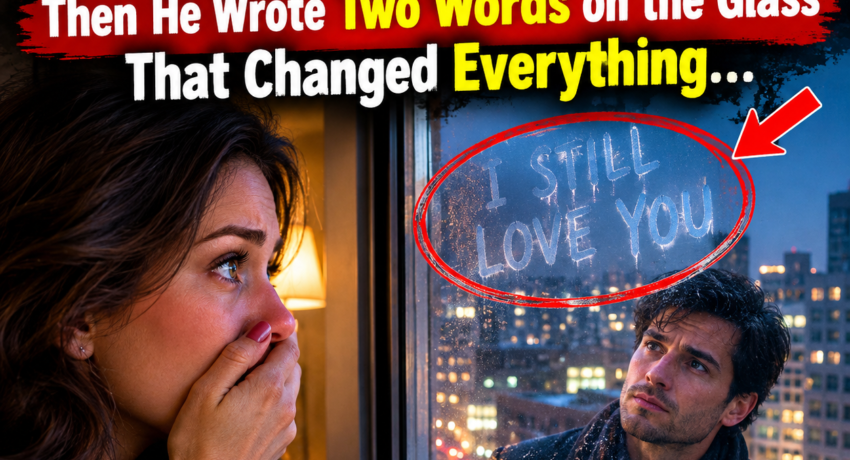
Jamie dipped one finger into the white foam covering the glass.
Slowly, carefully, he wrote:
J + A
My hand flew to my mouth.
Behind me, people were still laughing.
They had no idea that the man they were mocking had once given up his entire future so I could have mine.
And suddenly, I wasn’t sitting in a boardroom anymore.
I was eighteen again.
Part 2 — Before Everything Fell Apart
I grew up believing that good grades were the closest thing my family had to financial security.
My father left when I was nine.
After that, my mother worked two jobs to keep us afloat.
We lived in a small apartment where the heating system rattled through winter and every unexpected expense meant something else had to wait.
New shoes.
A dentist appointment.
A school trip.
Sometimes even groceries.
My mother never complained in front of me.
That somehow made it worse.
I understood early that college wasn’t simply something I wanted.
It was my way out.
So while other teenagers spent Friday nights at football games, I usually sat beneath fluorescent library lights.
I skipped parties.
Joined academic clubs.
Applied for every scholarship I could find.
One bad semester could have changed everything, and I knew it.
Jamie used to make fun of me for taking it all so seriously.
One afternoon, he walked beside me after school while I held a chemistry book open in front of my face.
“You know,” he said, “I’m starting to think you’re dating that textbook.”
I kept reading.
“It understands me.”
“That hurts.”
“You’ll recover.”
“You didn’t even notice me this morning.”
“I had a chemistry quiz.”
Jamie placed a hand over his chest.
“So I rank below the periodic table.”
I finally looked at him.
“Somewhere below oxygen, yes.”
“That’s cold, Amanda.”
I laughed.
Then he took my hand.
Jamie could do that—make the pressure inside me loosen without even trying.
He didn’t come from money either.
In fact, his life was harder than mine in some ways.
His father had vanished when he was young. His mother cleaned motel rooms during the day and waited tables in the evenings.
Jamie worked after school to help her.
His sneakers were usually worn out.
His truck made frightening noises whenever it started.
Teachers liked him, but no one talked to him about prestigious universities.
Guidance counselors told him to be “practical.”
Trade school.
Construction.
Mechanic work.
Anything realistic.
I hated that word.
Realistic seemed to mean different things depending on how much money someone’s parents had.
Jamie never complained.
He would finish a shift and still show up at the library carrying coffee for me.
“You’re going to run the world someday,” he told me once.
I looked at him across the table.
“And you?”
He shrugged.
“I’ll find something.”
I wish I had understood how little he believed his own future mattered.
We didn’t fall in love dramatically.
There were no expensive restaurants.
No elaborate dates.
We shared fries and milkshakes.
We studied together.
We walked home holding hands.
He remembered the dates of exams I had forgotten I’d told him about.
I knew the birthdays of everyone in his family.
Sometimes we sat on the hood of his old truck and talked until the streetlights came on.
I felt safest there.
With him.
When I look back now, I think the version of myself I miss most is that eighteen-year-old girl who could sit beside Jamie and believe that being loved was enough.
Then senior year arrived.
And one stupid prank changed both of our lives.
Part 3 — The Fire and the Promise
A group of seniors decided it would be funny to set off homemade smoke devices near the science building after classes.
Jamie had nothing to do with it.
Neither did I.
But one of the devices landed close enough to the chemistry lab to ignite materials that had been improperly left out.
Within minutes, smoke poured through the windows.
Alarms screamed across campus.
Teachers rushed students outside.
Firefighters arrived quickly enough to keep the damage from spreading beyond the laboratory, but the room itself was badly destroyed.
The investigation began immediately.
Security cameras didn’t cover every part of the building.
Students contradicted one another.
Rumors became facts simply because enough people repeated them.
Then someone said they had seen me near the science wing.
That part was true.
Jamie and I had been studying nearby earlier that afternoon.
I had even gone into the lab before everything happened.
Suddenly, I was being questioned.
I remember sitting across from the principal while he folded his hands on his desk.
“Amanda,” he said, “if the investigation determines that you were involved…”
He never finished.
He didn’t need to.
I knew what could happen.
Suspension.
Possibly expulsion.
The loss of my scholarship.
No college.
No escape.
Everything my mother had sacrificed could disappear because I had been in the wrong place at the wrong time.
That night, I sat beside Jamie on the hood of his truck and cried until my chest hurt.
“I can’t lose this,” I told him.
“You won’t.”
“You can’t know that.”
“I do.”
“They already suspect me.”
“They don’t have proof.”
“What if they find my fingerprints?”
“You were supposed to be in the lab.”
“They might not care.”
He became strangely quiet.
I kept talking because I was too frightened to notice.
“If I lose that scholarship, my mom can’t pay tuition. There is no backup plan, Jamie.”
“I know.”
“I’ve worked for this my whole life.”
“I know.”
I wiped my face.
“How can you keep saying everything is going to be okay?”
He looked at me.
There was sadness in his expression I didn’t understand until the next morning.
“Because I’m not going to let them take your future.”
The following day, Jamie confessed.
He walked into the principal’s office and claimed responsibility for the prank.
He said things had gone further than he intended.
He refused to identify anyone else.
The second I heard, I ran to the office.
Jamie was sitting calmly in a chair.
“What did you do?”
He looked up.
“It’s okay.”
“No, it isn’t!”
“Amanda—”
“You weren’t involved!”
“I know.”
“Then tell them that!”
He slowly shook his head.
“If they keep digging, your name stays in this.”
“I didn’t do anything.”
“I know.”
“Then they’ll believe me.”
“Maybe.”
“Maybe?”
He looked directly at me.
“What if they don’t?”
My anger collapsed into fear.
“You cannot take responsibility for something you didn’t do.”
“I already did.”
“I’ll tell them the truth myself.”
“You can.”
His voice stayed gentle.
“But I’m not changing what I said.”
“Why?”
He looked at me as though the answer should have been obvious.
“Because you have a future.”
“So do you.”
He smiled sadly.
“Not the way you do.”
I started crying again.
“I don’t want you to do this.”
“I know.”
“You could ruin your life.”
“Maybe.”
“Jamie…”
He reached into his jacket.
For one ridiculous second, I thought he was taking out tissues.
Instead, he opened his hand.
A tiny silver ring rested in his palm.
It wasn’t expensive.
A small blue stone sat at its center.
“I was going to give you this after graduation.”
I stared at it.
“Jamie…”
“Relax. I’m not proposing.”
Despite everything, a broken laugh escaped me.
“We’re eighteen.”
“Exactly. I can’t even afford decent tires.”
He took my hand.
“This is a promise ring.”
My vision blurred again.
“What are we promising?”
“That this isn’t goodbye.”
He slipped the ring onto my finger.
“Wherever life sends us, somehow we’ll find each other again.”
I looked down.
Tiny letters were engraved inside.
J + A.
“Our initials,” he said.
“I know what initials are.”
He grinned.
For one second, we were just Jamie and Amanda again.
Then he pulled me against him.
“Promise me something.”
“What?”
“Go to college.”
“I can’t leave you.”
“You have to.”
“I love you.”
His arms tightened around me.
“I love you too.”
Those were the last peaceful words we shared before everything changed.
Because Jamie was eighteen and had no previous record, the case ultimately went through a young-offender rehabilitation program. Investigators concluded that the damage had resulted from reckless behavior rather than a deliberate attempt to burn the building.
He lost months of his life to detention and mandatory rehabilitation.
People said he had destroyed his future.
No one knew he had been protecting mine.
I wanted to visit him.
His mother stopped me.
Not because she hated me.
Because she understood her son.
“He’ll never forgive himself if you give up college because of him,” she told me.
“What am I supposed to do? Pretend none of this happened?”
She wiped tears from her face.
“No.”
“Then what?”
She took both of my hands.
“You become the woman he already believes you can be.”
A month later, I left for college.
And for a while, I wore Jamie’s ring every day.
Part 4 — Ten Years of Becoming Successful
The ring stayed on my finger through my first semester.
I wore it during lectures.
During exams.
During the nights when loneliness made the dorm room feel too quiet.
Then one winter afternoon, it vanished.
I searched everywhere.
My room.
The library.
Lecture halls.
The cafeteria.
Every pocket in every coat I owned.
Nothing.
I cried harder over that little silver ring than I had cried over almost anything since leaving home.
Because it didn’t feel like losing jewelry.
It felt like losing Jamie for a second time.
But life has an irritating habit of continuing even when you’re not ready.
I graduated.
Then went to graduate school.
Then landed my first consulting position.
My career grew faster than I expected.
One promotion became another.
I spent years moving between airports, conference rooms, hotels, reports, presentations, and client dinners.
People began using words about me that once would have sounded impossible.
Successful.
Ambitious.
Accomplished.
Confident.
I became the kind of woman my eighteen-year-old self had desperately wanted to be.
At least on paper.
What no one saw were the nights when I searched Jamie’s name online.
Or the weekends when I drove through our hometown hoping someone might know where he’d gone.
His old house had been sold.
The diner where his mother worked had shut down.
Someone told me she’d moved.
No one could tell me where.
Eventually I stopped asking.
Not because I stopped caring.
Because every dead end reopened the same wound.
Years passed.
The guilt remained.
Some days, it was barely noticeable.
Other nights, it sat beside me like another person.
What if Jamie hadn’t confessed?
What if I had fought harder?
What if I had stayed?
What if the future I had built had been purchased with his?
I never found an answer that made me feel better.
Then came the acquisition.
The biggest corporate event of my career.
And on the morning that everything was supposed to change professionally, the past appeared outside our boardroom window carrying a bucket and a squeegee.
Part 5 — J + A
The moment Jamie wrote our initials in soap, I forgot every rule I had taught myself about professionalism.
My chair scraped violently backward.
Several people turned toward me.
“Amanda?” our regional director said.
I didn’t answer.
Outside, the suspended platform had begun lowering.
Jamie held my gaze for one more second.
Then he disappeared beneath the window.
Panic tore through me.
No.
Not again.
I could not spend another ten years wondering where he had gone.
I grabbed my blazer.
“Where are you going?” Brent asked.
I headed toward the door.
Our regional director stood.
“Amanda, sit down.”
I kept walking.
“This meeting isn’t finished.”
“I’m sorry.”
His expression hardened.
“You walk out now, don’t expect that promotion.”
I stopped for less than a second.
Ten years earlier, Jamie had surrendered far more than a promotion for me.
I opened the door.
Behind me, someone muttered that I’d lost my mind.
Maybe I had.
The elevator was taking too long, so I ran toward the emergency stairs.
I started down.
Fast.
By the ninth floor, my breathing was ragged.
By the sixth, my legs burned.
By the third, my heels had become impossible.
I pulled them off and kept running barefoot, carrying one shoe in each hand.
People pressed themselves against the railing as I rushed past.
“Sorry.”
“Excuse me.”
“Please let me through.”
When I finally burst into the lobby, the security guard stared at me.
“Ma’am?”
I ignored him.
I pushed through the revolving doors and stumbled into the sunlight.
My eyes searched the sidewalk.
I expected to see ropes.
Cleaning equipment.
Maybe a service van.
Instead, I saw a black luxury sedan.
And beside it stood Jamie.
Except he no longer looked like a window washer.
The harness was gone.
So were the gloves and blue work shirt.
He wore a charcoal suit tailored so perfectly that for a moment I wondered whether I had run after the wrong man.
An expensive watch circled his wrist.
Polished shoes replaced the heavy work boots.
Standing beside him was Harold, the owner of our office building.
I knew Harold from company events.
He looked at Jamie, then at me.
And smiled.
Jamie adjusted one cuff.
“I wondered whether you’d come down.”
I stared at him.
“What is happening?”
His smile widened.
“Hello to you too.”
“Jamie?”
“It’s really me.”
I looked at Harold.
Then Jamie.
Then the car.
“I don’t understand any of this.”
Harold chuckled.
“I believe I’ll leave that explanation to him.”
Before walking back inside, he gave Jamie a knowing look.
“I think you got the answer you wanted.”
My confusion only deepened.
The second Harold disappeared, I turned back to Jamie.
“What answer?”
He laughed softly.
“You still ask questions exactly the same way.”
Then something inside me broke.
All the guilt, grief, longing, anger, and relief I had kept buried for years rose at once.
I crossed the distance between us and threw my arms around him.
Jamie caught me without hesitation.
The moment I felt him hold me, I started crying.
“I’m sorry.”
“Amanda…”
“I’m so sorry.”
He rested his cheek against my hair.
“I know.”
“I should’ve found you.”
“You tried.”
“Not enough.”
He pulled back.
“You went exactly where I wanted you to go.”
“I let you destroy your future for me.”
His expression changed.
“You didn’t let me do anything.”
“You took the blame.”
“I made that choice.”
“And it cost you everything.”
Jamie studied me for a second.
Then a small smile appeared.
“Did it?”
I blinked.
“What does that mean?”
He nodded toward a bench across the plaza.
“Come on.”
We sat.
For the first time in ten years, Jamie began telling me what happened after I left.
Part 6 — What Became of Jamie
“Detention was awful,” he said.
I lowered my eyes.
“Jamie…”
“I’m not telling you so you’ll feel guilty.”
“That ship sailed about nine years ago.”
He smiled faintly.
“When I got out, people treated me differently.”
I looked at him.
“Like what?”
“Like they’d always known what I was going to become.”
His expression grew thoughtful.
“The poor kid.”
“The one with the record.”
“The guy people shouldn’t expect much from.”
That hurt because I remembered exactly how adults had spoken to him even before the fire.
“And you believed them?”
“For a while.”
He leaned back.
“Then eventually I realized I had nothing left to prove to those people.”
“What did you do?”
“Worked.”
He smiled.
“A lot.”
“Where?”
“Construction crews. Landscaping. Maintenance. Cleaning companies. Repair work. Anywhere someone gave me a chance.”
My eyes drifted toward the building.
“So you really did wash windows.”
Jamie laughed.
“A ridiculous number of them.”
I shook my head.
“I can’t believe this.”
“Every job taught me something.”
“Such as?”
He looked toward the tower above us.
“I kept noticing how wasteful commercial buildings were.”
“Wasteful how?”
“Electricity. Heating. Cooling. Water. Old equipment running inefficiently. Systems nobody questioned because they’d always been there.”
I felt the old familiarity of his mind coming back to me.
Even as a teenager, Jamie noticed details everyone else ignored.
“So you started studying it?”
“Night classes.”
“Seriously?”
“Books too. Lots of books.”
“Jamie, you hated studying.”
“I hated people telling me what I was supposed to study.”
I laughed.
“That sounds more accurate.”
He continued.
“I saved money. Started experimenting with different systems. Eventually I designed a retrofit platform that could dramatically reduce energy use in older commercial buildings without forcing owners to rebuild everything.”
I stared at him.
“You designed it?”
“Yes.”
“By yourself?”
“Initially.”
“What happened?”
“One investor gave me a chance.”
He paused.
“Then someone else did.”
“And?”
“The company grew.”
“How much?”
His smile became suspicious.
I narrowed my eyes.
“Jamie.”
“What?”
“How much did it grow?”
He looked up at my office tower.
“A lot.”
Something in my stomach shifted.
Then he said it.
“The company acquiring yours is mine.”
I laughed.
Not because I thought he was joking.
Because my brain had run out of more appropriate reactions.
“No.”
“Yes.”
“The green-energy group?”
He nodded.
“You own it?”
“I founded it.”
I stared at the man beside me.
The boy everyone had once dismissed as having no future had built the company that now controlled the careers of everyone upstairs.
Then another realization struck me.
“The acquisition closed today.”
“Yes.”
“And you were outside our boardroom dressed as a window washer.”
“Yes.”
“So that wasn’t an accident.”
“No.”
“Jamie, why?”
His smile disappeared.
“Because financial statements tell me whether a company can make money.”
He looked toward the building.
“They don’t tell me what kind of people are running it.”
I slowly understood.
“You were testing them.”
“Observing them.”
“That’s the same thing.”
“Fair enough.”
“You do this often?”
“More than you’d think.”
He explained that before major acquisitions, he sometimes appeared around offices without introducing himself—working beside maintenance teams, delivery crews, or contractors.
“I want to see how people act when they think nobody important is watching,” he said.
My stomach tightened.
The laughter.
Brent’s comments.
My own forced smile.
“I smiled too.”
Jamie looked at me.
“For about two seconds.”
“I should have said something.”
“You were sitting in a room full of people who could affect your career.”
“That doesn’t make it right.”
“No.”
His honesty surprised me.
Then he added, “But what you did next told me more.”
“I ran out of a meeting.”
“You walked away from the biggest professional opportunity of your life because you thought a window washer mattered more.”
“Not a window washer.”
“You didn’t know that when you stood up.”
I went quiet.
He smiled.
“You saw me.”
The words hit harder than I expected.
Not my job.
Not my suit.
Not my title.
Me.
Before I could answer, the revolving doors opened.
Brent stepped outside with two senior executives behind him.
And none of them had any idea who Jamie was.
Part 7 — The People Who Laughed
Brent marched toward us.
“There you are.”
His eyes went directly to me.
Then Jamie.
He looked annoyed rather than curious.
“You created quite a disruption.”
Jamie stayed silent.
Brent turned to him.
“I don’t know what you said to one of our employees, but you’re interfering with a major corporate meeting.”
I opened my mouth.
Jamie lightly touched my arm.
He didn’t need help.
Before Brent could continue, Harold stepped through the revolving doors.
Brent’s posture changed instantly.
“Harold.”
Harold’s face was cold.
“Gentlemen.”
One of the executives adjusted his tie.
“We were wondering when the acquisition representatives would arrive.”
“They already have.”
Brent frowned.
Harold looked toward Jamie.
“Our chairman has completed his evaluation.”
“Chairman?”
Jamie stood.
“I can handle it from here.”
For a moment, Brent simply stared.
Harold gestured toward Jamie.
“As of this morning, your organization is officially part of the company founded and led by this man.”
Brent’s face emptied.
He looked at Jamie.
Then at the building.
Then back at Jamie.
“No.”
Jamie remained completely calm.
“Hello, Brent.”
“You’re…”
“The window washer?”
Brent swallowed.
Jamie nodded.
For once, Brent had no clever comment.
Jamie spoke evenly.
“Every acquisition includes a review of financial health, operations, and leadership.”
Brent tried to smile.
“Of course.”
“What spreadsheets don’t show is culture.”
His smile vanished.
“I spent this morning watching your team interact with people they believed had no influence over them.”
No one moved.
Jamie continued.
“Respect that appears only when the other person has status isn’t respect.”
Brent recovered enough to say, “It was a joke.”
“No.”
Jamie’s voice never became louder.
That somehow made it sharper.
“It showed me who you are when you believe the person in front of you can’t affect your life.”
Brent looked toward Harold.
“This is ridiculous.”
Harold said nothing.
Jamie did.
“The employees who openly mocked service staff won’t remain in leadership positions after the transition.”
Brent’s face turned red.
“You’re firing people over one comment?”
“I’m making decisions based on behavior I observed personally, along with the leadership review already completed.”
Security appeared near the entrance.
The other executives stopped arguing.
As Brent passed me, he stared as though I had somehow betrayed him.
“You knew who he was?”
I looked at Jamie.
Then answered with the first words that came into my mind.
“I never really stopped knowing him.”
Brent walked away.
The doors closed behind him.
And for a few seconds, the city seemed strangely quiet.
I looked at Jamie.
“You really searched for me?”
His expression softened.
“For years.”
“Then why didn’t you find me?”
“I went back to your apartment after I finished the program.”
“We’d moved.”
“I know that now.”
“You talked to people?”
“Everyone I could think of.”
“So did I.”
He nodded.
“I heard.”
I stared at him.
“You knew I looked?”
“Eventually.”
My eyes burned.
“I thought maybe you hated me.”
Jamie almost looked offended.
“I tried.”
That startled a laugh out of me.
“You tried to hate me?”
“Would’ve made life easier.”
“And?”
“I’m apparently terrible at it.”
I smiled through tears.
Then Jamie reached inside his jacket.
My heart started racing.
He removed a small velvet box.
I stopped breathing.
“Jamie…”
He opened it.
Inside lay a silver ring.
Small.
Simple.
With a blue stone in the center.
Almost identical to the ring I’d lost in college.
I covered my mouth.
“I lost mine.”
“I know.”
“I searched for days.”
“I know.”
“How could you know that?”
“Your mother told mine years later.”
I stared at the ring.
“I thought losing it meant I had lost the last thing connecting me to you.”
Jamie took it carefully from the box.
“So I had another one made.”
My eyes filled again.
“You carried this around?”
“For longer than I’m admitting.”
“Why?”
He looked at me as though he couldn’t believe I needed to ask.
“Because I made you a promise.”
Part 8 — The Promise We Finally Kept
Jamie took my left hand.
Ten years disappeared beneath the warmth of his fingers.
“I said we’d find each other again.”
My voice shook.
“And you actually believed that?”
“Every day?”
He smiled.
“No.”
I laughed.
“Good. At least you’re human.”
“There were years when I thought it wasn’t going to happen.”
“Me too.”
“But I never stopped hoping.”
My tears spilled over.
“I don’t deserve this.”
Jamie frowned slightly.
“Amanda, stop.”
“I mean it. You gave up so much for me.”
“This isn’t a reward.”
He held the ring between us.
“And what I did when we were eighteen doesn’t mean you owe me the rest of your life.”
I looked at him.
His expression was serious now.
“I don’t want gratitude.”
“What do you want?”
“You.”
One word.
After ten years, it was enough to make my heart feel eighteen again.
Jamie continued.
“Not because I saved you.”
“Jamie—”
“And not because I own the company you work for.”
I laughed weakly.
“That part is going to be complicated.”
“Extremely.”
He smiled.
“But that’s tomorrow’s problem.”
Then he lifted my hand.
“This is about whether the promise still means something to you.”
I stared at that tiny blue stone.
Then at him.
“It never stopped meaning something.”
He slid the ring onto my finger.
It fit perfectly.
I laughed through my tears.
“You remembered my ring size?”
“I remembered everything.”
For once, I didn’t care who was watching us.
Not coworkers.
Not strangers.
Not executives.
No one.
I wrapped my arms around him.
“I love you.”
Jamie’s arms closed around me.
“I never stopped.”
For a while, neither of us moved.
And there on a crowded city sidewalk, ten years after our lives had been pulled apart, we finally kept the promise two frightened eighteen-year-olds had made when neither of them knew what the future would look like.
Part 9 — Six Months Later
We didn’t pretend the missing decade hadn’t happened.
That mattered.
Jamie and I had changed.
We had wounds the younger versions of us never knew we would carry.
There were conversations that weren’t romantic.
About guilt.
About why he’d made the decision he made.
About why I had spent so many years believing his sacrifice was somehow my debt to repay.
About the ways success had changed both of us.
We learned each other again.
Slowly.
Properly.
I met the employees who had been with Jamie when his company was still operating from a rented warehouse.
He met colleagues of mine who knew nothing about the nervous scholarship student I had once been.
Our mothers cried the first time they saw us together.
Jamie’s mom held my face in both hands and whispered, “He always said you’d find your way back.”
Six months after the day outside the boardroom window, Jamie and I were married.
Nothing about the ceremony was extravagant.
We didn’t need it to be.
Our families filled the first rows.
Friends surrounded us.
My mother cried before I even reached the aisle.
Jamie’s mother cried harder.
Harold attended and claimed during the reception that his contribution to our romance had been “providing an excellent building with exceptionally clean windows.”
Jamie told him to stop taking credit.
I stayed with the company after the acquisition.
That decision took several serious conversations.
I never wanted anyone to believe my career suddenly depended on the man I married.
Jamie understood before I even explained.
“You earned your position before I walked onto that platform,” he told me.
“So don’t give anyone permission to pretend otherwise.”
I remained part of the transition team and continued moving forward on my own work.
Sometimes, during difficult meetings, I found myself looking through the windows.
The city stretched beneath me exactly as it had that morning.
But I saw it differently now.
For most of my life, I had believed success meant reaching a place where no one could look down on me again.
Jamie taught me something better.
People are not defined by the floor they work on.
Not by the clothes they wear.
Not by the title beneath their name.
Not by whether they are standing inside the boardroom or washing the glass outside it.
Character appears in the moments when we believe the person in front of us has nothing to offer.
And love?
Sometimes love doesn’t survive because two people never lose each other.
Sometimes it survives because even after years apart, after mistakes and guilt and distance, two people still recognize one another when their eyes finally meet again.
Every now and then, Jamie still writes J + A somewhere ridiculous.
In the steam on the bathroom mirror.
On the corner of a grocery list.
Once, embarrassingly, on a fogged restaurant window.
And every time, I look down at the small blue stone on my finger and remember the eighteen-year-old boy who told me we would find each other again.
For years, I thought he had sacrificed his entire future so I could have mine.
I was wrong.
Our lives simply took separate roads.
And somehow, after everything, those roads led us back to the same place.
To each other.