Five years after my daughter disappeared, a stranger left a baby on my porch, wrapped in the jacket I’d bought Jennifer when she was fifteen. I thought the note folded into the pocket would finally give me an answer. Instead, it opened a door into the life she’d built without me — and the truth her father had been sitting on the whole time.
PART 1 — The Porch
The doorbell only rang once. Quick. Sharp. The kind of ring that belongs to someone who doesn’t want to be seen waiting.
I almost didn’t answer it. It was just past six in the morning, I was still in my robe, my hair half-pinned, and my coffee had already gone lukewarm in my hand. But something about that single ring pulled me out of the kitchen and down the hall.
I opened the door and forgot how to breathe.
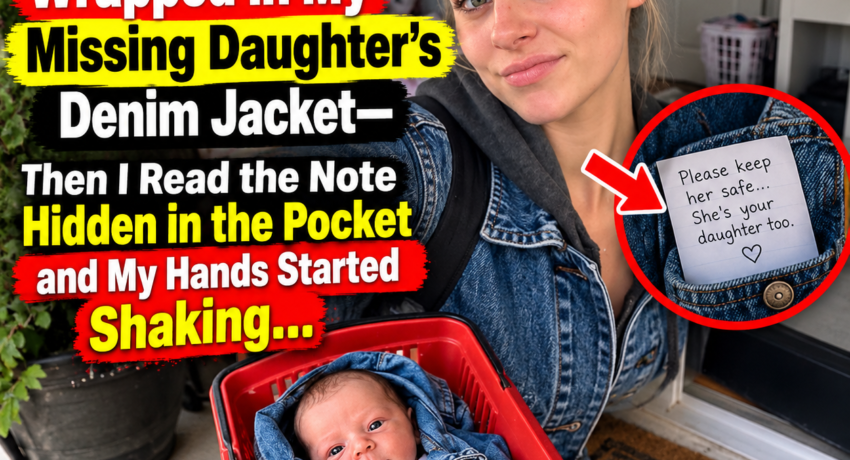
There was a baby on my porch.
Not a shadow. Not my mind playing a cruel trick before I’d had my coffee. A real baby, small and pink-cheeked, blinking up at the porch light like she was deciding whether it was worth crying about.
She was wrapped in a denim jacket.
My legs went soft underneath me.
I knew that jacket. I’d have known it in the dark, in a pile of a thousand others. I bought it for my daughter, Jennifer, the summer she turned fifteen, and she’d worn it until the cuffs frayed, rolling her eyes at me the whole time. “Mom, it’s not vintage if it still smells like somebody else’s perfume.” That was Jen. Sharp-tongued, soft underneath, gone before I understood what either of those things would come to mean.
The coffee mug slipped out of my hand. It hit the floorboards and rolled, forgotten, before it even finished spilling.
“Oh my God.”
The baby worked one fist free of the blanket. I dropped to my knees right there on the porch, touched her cheek with two fingers, then let my hand slide down to her chest, just to feel it rise and fall under my palm. Warm. Steady. Real.
“Okay,” I whispered, though I don’t think I was talking to her so much as to myself. “Okay, sweetheart. I’ve got you. I’ve got you now.”
I gathered up the basket, checked the street in both directions — empty, of course it was empty — and carried her inside.
Five years earlier, my daughter had vanished at sixteen, in the space of one bad night.
One minute she was slamming cabinet doors because her father had forbidden her from seeing a boy named Andy. The next, she was gone so completely it felt like the house itself had swallowed her.
The police searched. The neighbors walked the woods behind the school with flashlights. Her photograph sat taped to the register at the gas station, in the church bulletin, in the window of the grocery store, fading a little more with every passing season until somebody finally took it down.
Nothing ever came back. Not a lead. Not a sighting. Not one honest answer.
Paul blamed me first in private, and then, once he’d had enough time to build up his nerve, in front of other people.
“You should have known something was wrong,” he told me, exactly one week after she disappeared.
“I didn’t know she was leaving, Paul.”
“Yeah. You never know anything until it’s too late, Jodi.”
He said worse than that, plenty worse, in the weeks that followed — enough of it that some nights I lay awake and started to wonder if he was right.
By the third year, he’d moved into a rented house with a woman named Amber and left me alone in the one we’d built together, with Jennifer’s door shut tight at the end of the hall like a held breath. We were still married on paper. I just never found the energy to sign the rest of it away.
And now there was a baby on my kitchen table, wearing my daughter’s jacket like it was the only thing in the world that still belonged to her.
PART 2 — The Note
I set the basket down and made myself move before I could think too hard about it.
There was a diaper bag tucked under the blanket. Formula, two sleepers folded with more care than I expected, a stack of newborn wipes. Whoever had left her hadn’t panicked and run. This had been planned, thought through, arranged the way you arrange something you can’t bring yourself to keep but refuse to abandon carelessly.
The baby watched me the entire time, solemn as a tiny judge weighing evidence.
I reached out and touched the jacket again, just to be sure my hands weren’t lying to me. The left cuff was still frayed in the exact spot Jennifer used to chew when she was anxious, a habit I’d nagged her out of a hundred times and never once succeeded.
My fingers found the pocket before my brain caught up to what I was doing.
Paper.
My pulse was so loud in my own ears that the kitchen seemed to tilt. I unfolded the note slowly, smoothing the creases flat with both hands, because some part of me needed one more second before I let myself read it.
Jodi,
My name is Andy. I know this is a terrible way to do this, but I don’t know what else to do.
This is Hope. She’s Jennifer’s daughter. She’s mine too.
Jen always said that if anything ever happened to her, Hope should be with you. She kept this jacket all these years. She said it was the last piece of home she never gave up.
I’m sorry.
There are things you don’t know. Things Paul kept from you.
I’ll come back and explain everything.
Please take care of Hope.
— Andy
My hands started shaking so badly the paper rattled.
“No,” I whispered, to no one, to the kitchen, to the ghost of my sixteen-year-old daughter. “No, Jen. No.”
For five years I had let go of the hope that my daughter would ever walk back through that door. Now Hope was blinking up at me from my kitchen table, and I understood, in one nauseating instant, that the two things could not both be true — that she was gone, and that she had loved someone enough to build an entire secret life, a baby, a jacket kept like a relic, all without me knowing a single piece of it.
I pressed the note to my lips, closed my eyes for exactly as long as I could afford to, and then made myself move.
I called the pediatric clinic first and told them I was bringing in a baby who’d been left in my care.
Then I called Paul.
He picked up on the fourth ring. “What now, Jodi?”
“Get over here.”
“Jodi, I have work. I have a life.”
“And I have your granddaughter sitting on my kitchen table.”
Silence. Then, quieter: “What?”
“Come now, Paul.”
PART 3 — What Paul Knew
He showed up twenty minutes later, jaw already set for an argument. Amber stayed in the car, which told me she at least understood this wasn’t going to be a short visit.
Paul stepped into my kitchen already complaining about his morning. Then he saw the jacket.
All the color left his face at once, like someone had pulled a plug.
He stopped dead in the doorway. “Where did you get that?”
I lifted Hope into my arms before I answered him, because I wanted my hands full of something that mattered more than his reaction.
“That’s exactly what I want to know.”
His eyes dropped to the note still folded on the counter, then skittered away from it just as fast.
“You knew more than you ever told me, Paul.”
“Jodi—”
“Did you know she was alive? That she left to build a life with someone? That she was out there being loved by somebody, while I sat in this house thinking she might be dead in a ditch?”
“Jodi.”
“Did. You. Know.”
Hope let out a thin, hiccupping cry, and somehow that made the whole moment worse, sharper, like the baby herself was casting a vote.
Paul rubbed a hand down his jaw, the way he always did right before he said something he’d regret. “She called me. Once.”
The floor seemed to drop an inch under my feet.
“She what?”
Now he looked angry, but I’d been married to him long enough to know that anger was just what cornered looked like on him. “A few months after she left. Said she was with Andy. Said she was fine.”
“And you let me believe she was dead.”
“I told her if she came home, she came home alone,” he snapped, voice climbing. “She was sixteen, Jodi. Almost seventeen. Ready to throw her whole future away on some college dropout with no plan and no money. Was I supposed to cheer her on?”
“No,” I said, and I felt something in me go very still and very cold. “You’d rather be right than have her home. Even if being right cost us our daughter.”
Amber appeared in the doorway behind him. “Paul…”
I didn’t even look at her. “You don’t get a word in this kitchen.”
Paul stared at Hope like the baby might somehow throw him a rope. She didn’t. I grabbed the diaper bag off the counter with my free hand and picked up my keys.
“I’m taking her to the clinic,” I said. “And when I come back, I want you gone. I called you here to see if there was any shame left in you.”
“Jodi, wait—”
“I mean it. If you’re still standing in this kitchen when I get back, I will call the police and tell them you withheld information about a missing child’s mother for five years.”
That got both of them moving toward the car.
PART 4 — Back to Work
Dr. Evans looked Hope over carefully, weighed her, checked her color, and told me she was healthy — just a little underweight, nothing that a few good weeks wouldn’t fix. She asked me careful, gentle questions, the kind a doctor asks when she already suspects the answer is complicated. I gave her careful answers back. I showed her the note. The supplies. The jacket, still slung over my arm like I couldn’t put it down.
“Do you have family support?” she asked.
I almost laughed, and caught myself before it turned into something else.
“I’ve got coffee and my coworkers,” I said.
She gave me a small, sad smile, the kind that had clearly been given to other tired women in other exam rooms. “Sometimes that’s exactly how it starts.”
By noon I had temporary emergency paperwork from a social worker named Denise, and three missed calls from Paul that I deleted without listening to a single word of.
By two, I was back at the diner, because grief doesn’t pay a mortgage and neither does shock.
I brought Hope with me. Denise had told me plainly not to leave her with anyone I didn’t fully trust, and after this morning, that list had gotten very short, very fast.
My boss, Lena, spotted the baby carrier tucked behind the register and set her jaw. “You have exactly thirty seconds to tell me what in God’s name happened before I start guessing.”
I gave her the short version. It was still enough to make her press a hand flat against her chest like she needed to hold something in place.
“Jodi.”
“I know.”
The bell over the diner door rang around four in the afternoon, and I didn’t think anything of it until I looked up.
PART 5 — The Man in the Doorway
He was young — twenty-three, maybe twenty-four — but grief had aged him in that particular way that makes a person look both older and somehow unfinished, like a house with the scaffolding still up. He stood just inside the door, turning a baseball cap over and over in both hands.
His eyes found Hope first. Then me.
“Hi, Jodi,” he said.
Every nerve in my body answered before my voice caught up.
“Who’s asking?”
He looked wrecked, not dangerous — there’s a difference, and I’ve learned to tell it fast. “I loved your daughter,” he said.
The diner went quiet in that specific way busy rooms go quiet when somebody’s whole life visibly tips sideways in front of everyone.
Lena lifted the coffee pot out of my hand without a word, the way you’d take a weapon away from someone before they hurt themselves with it.
I pointed to the back booth. “Sit.”
He sat like a man reporting for sentencing.
I slid into the seat across from him. Hope stirred in the carrier beside me, a small, sleepy sound. “Start talking.”
His eyes filled so fast he had to look down at the table. “She wanted to come home. So many times.”
I gripped the edge of the table hard enough to feel it in my knuckles. “Then why didn’t she?”
“Because of your husband.” He said it without any heat at all, which somehow made it land harder than if he’d shouted it. “After that first call, she cried for hours. He told her that if she came back with me, she’d be throwing her whole life away. He said if she really loved you, she’d stay gone and let you move on.”
I closed my eyes.
“I told her maybe he was bluffing,” Andy went on. “She said he wasn’t. She knew her father.”
“What happened to my daughter, Andy?”
He broke then — one hand pressed hard over his mouth, his shoulders shaking once before he wrestled himself back under control.
“Hope was born three weeks ago,” he said. “Jennifer had a bleed after the delivery. They said they’d stopped it. They told us she was going to be okay.”
He stopped.
“She wasn’t.”
I couldn’t feel my own feet anymore.
“Before—” His voice cracked clean in half. “Before the end, she made me promise. If anything ever happened, Hope was to go to you. Only you.”
Behind me, Hope made a small, sleepy sound, and I reached back and touched her blanket with one finger without looking away from Andy’s face. When I finally did look at him, he was watching me with an exhausted, grateful kind of look that ached to see.
“What was she like?” I asked. “With you. Tell me.”
Something in his face softened for the first time since he’d walked in.
“She laughed with her whole face,” he said. “Like she couldn’t hold it back even when she tried. She talked about you all the time, especially when she was tired. ‘My mom hums when she bakes.’ ‘My mom can get any stain out of anything.’ ‘My mom always knows when I’m lying.’ She missed you every single day, Jodi. She just didn’t think she was allowed to come back and prove it.”
“Why did you leave her on my porch?” I asked, my voice barely above a whisper. “Why not walk up and hand her to me yourself?”
He looked over at the carrier like it might answer for him. “Because I hadn’t slept in four days. Because every time she cried, I heard Jennifer not breathing. Because I was terrified I’d drop her, or fail her, or hate myself for not being enough for either of them.”
He scrubbed both hands over his face.
“I rang the bell. Then I sat in my car across the street until I saw you pick her up. I didn’t leave until then. I needed to know she was safe before I let myself go.”
I broke.
I cried right there in that booth, and Andy cried with me, quieter, his head bowed and both hands pressed over his face like he could hold the grief in if he just pushed hard enough.
After a minute, I wiped my face with the back of my wrist and asked the only question that mattered. “Do you want to be in her life?”
His head came up fast. “Yes. God, yes. I’ll be there for her, every day, I swear it. I just — I need help, Jodi. We don’t have anyone else left.”
I nodded, slow. “All right. Then don’t you dare disappear on her.”
“I won’t,” he said. “I swear to you, I won’t.”
PART 6 — Face to Face
I drove home that evening with Andy’s truck trailing behind mine, and Paul was already waiting in the driveway when we pulled in.
He saw Andy climb out and pointed a finger like an accusation all by itself. “You.”
I shifted Hope higher against my shoulder, a wall between them without meaning to be one. “You don’t get a say here, Paul.”
He ignored me completely. “You ruined my daughter’s life! Where is she? Where’s Jennifer?”
Andy went pale, but he held his ground. “No. Jen loved me. Your pride ruined the rest of it, not me.”
Paul took a step toward him.
“Don’t,” I said, and something in my voice stopped him cold.
I looked him dead in the eye, the way I hadn’t let myself in five years of grieving a daughter he’d known all along was alive.
“You kept telling me she was gone. She wasn’t gone, Paul. She was just somewhere your pride couldn’t follow her.”
His mouth opened. Nothing came out of it.
I walked past him to the front door and pushed it open. “Jennifer trusted me with Hope. Not you. Go find Amber.”
He left. This time, he didn’t argue.
PART 7 — What’s Left
Inside, Andy stood in my kitchen looking like he didn’t know which surface he was allowed to touch, while I warmed a bottle at the stove. I handed it to him, and he took Hope into his arms like something he was still learning to trust himself with.
“I’ll make us some dinner while you get her settled,” I told him.
He looked up at me, eyes still wet, and didn’t say anything at all. He didn’t need to.
I stood at my own stove that night, in the same kitchen where I’d raised a daughter I’d thought I’d lost twice — once when she vanished, and once more when I found out how much of her life had gone on without me. My granddaughter was fed and quiet in the next room. Her father was still standing in my house instead of walking out of it.
Jennifer had come home, in the only way she still could.
She had sent me the piece of herself she loved most, wrapped in the one thing she never let go of, and trusted me to finish raising what she couldn’t.
I still hum when I bake. Hope will grow up knowing that about me, the way her mother once did. Some things, it turns out, a person doesn’t have to be in the room to pass down