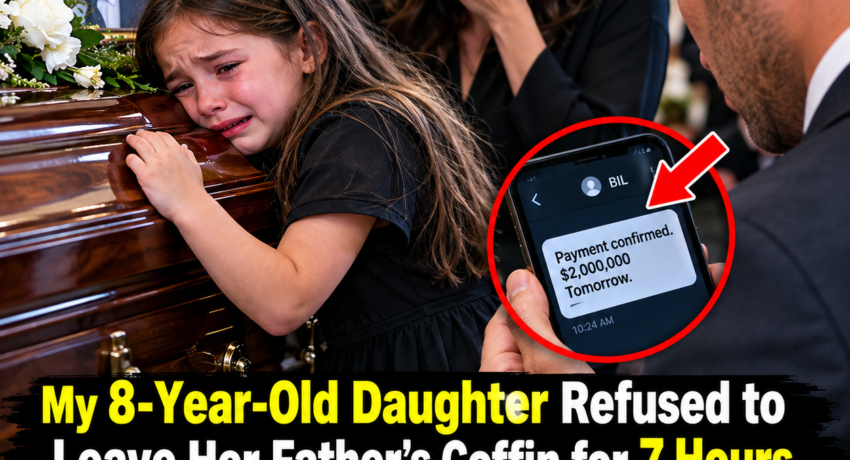
For 7 hours, my 8-year-old daughter refused to leave her father’s coffin while our entire family begged her to step away. Then she looked straight at me and whispered, “Mommy, Daddy isn’t d:ead.”
I didn’t argue or dismiss her.
I put my hand against his face and immediately called 911.
But before the paramedics arrived, I glanced at her uncle’s phone…
One message on that screen changed everything I thought I knew about my husband’s “de:ath.”
PART 1
My eight-year-old daughter leaned over her father’s casket and pressed her ear close to his chest while our entire family watched in shock. What she said next made even the doctor who had signed his d:eath certificate turn ghost-white.
“Mommy, Daddy isn’t d:ead.”
I felt the strength drain completely from my legs.
Up until that exact moment, Chloe had spent nearly seven hours sitting right beside Mark’s casket. She hadn’t cried. She hadn’t eaten. She had barely taken two sips of water.
The wake was being held at my mother-in-law’s house in suburban Chicago. Mark, my husband, had died—or so we were told—after suffering a sudden cardiac arrest at a small private clinic on the outskirts of the city.
He was thirty-nine years old
He was completely healthy.
And just two days earlier, he had told me something that kept ringing continuously in my head: “If anything strange happens at the company tomorrow, don’t sign a single thing for Marcus.”
Marcus was his older brother and business partner in a cold-chain logistics firm they had inherited from their father.
When I asked Mark what was going on, he had just shaken his head. “I want to verify it first.” Then he changed the subject.
On the afternoon of his alleged d:eath, Marcus had called me in a panic, claiming Mark had collapsed during a routine inspection inside one of their refrigerated warehouses. By the time I arrived at the clinic, Mark was already covered with a white sheet.
A Dr. Salgado explained that they had attempted resuscitation for nearly half an hour.
“I am so sorry, Mrs. Vance,” he had said softly. “He didn’t respond.”
I was too shattered by grief to ask intelligent questions. But that fog began to clear during the wake.
Chloe had asked for a chair so she could sit close to her father’s face. My mother-in-law, Teresa, let her stay. Several aunts whispered among themselves that the poor girl was simply in severe sh0ck.
But I knew my daughter.
When Chloe was frightened, she sobbed. When she didn’t understand something, she asked endless questions. That night, she was doing neither.
She was observing.
At 11:20 PM, I walked over to her. “Chloe, sweetheart, come with me for a minute.”
“No.”
“You need to rest.”
She stared closely at Mark’s face. “Daddy isn’t resting either.”
A cold shiver ran down my spine. “What do you mean?”
She didn’t answer.
Moments later, I noticed a detail that suddenly made me recall our final moments at the clinic. Mark hadn’t been prepared by a standard funeral home as would normally happen. Marcus had insisted on moving him quickly because, according to him, Mark had always stated he wanted zero invasive procedures post-mortem. Marcus had also personally chosen a tiny, independent funeral home owned by an acquaintance of his.
Suddenly, that decision no longer felt like a thoughtful family gesture.
I pulled out my phone and checked a photo I had taken at the clinic when they let me say goodbye. In the photo, Mark’s wrist watch read 4:13 PM.
I looked at the watch still sitting on his wrist inside the casket. It read 11:37 PM.
It was still ticking.
It didn’t mean he was alive, of course. But it meant that nobody had properly prepped or stripped his b0dy.
“Chloe,” I whispered, leaning down. “What did you see?”
My daughter brought her face inches from her father’s. “At first, I thought it was just my imagination.”
“What was?”
“His nose.”
My chest tightened. “Explain it to me, sweetie.”
“Sometimes it moves just a tiny bit right here.” She tapped beneath her nostrils.
Before I could respond, Marcus stepped up behind me. “Claire, enough. The girl needs to go to sleep.”
His tone sent a flare of irritation through me. It wasn’t grief. It was sharp, controlled impatience.
Then Chloe leaned over her father’s casket and pressed her ear close to his chest.
I rushed forward as my daughter kept her ear against Mark’s chest, listening carefully.
Marcus reached out aggressively to pull her back. “Get her away from there!”
I shoved his arm away. “Don’t touch her!”
Chloe looked up at me. She was pale, but her eyes were hyper-focused. “Mommy.”
“Yes, sweetie?”
“I felt two thumps.”
The entire room fell d:ead silent.
PART 2
I didn’t scream.
I didn’t have time to.
I pressed two fingers against the side of Mark’s neck, right below his jaw, the way I remembered from a CPR class I’d taken at Chloe’s school six years ago.
Nothing.
Then, faint. So faint I thought I imagined it.
A flutter.
“Someone call 911,” I said. My voice came out flat and strange, like it belonged to someone else.
Nobody moved.
“NOW,” I said, and this time it cracked the room open.
My sister-in-law grabbed her phone. Teresa started crying into her hands. Marcus stood frozen by the casket, his jaw tight, his eyes darting toward the front door instead of toward his brother.
That was the detail I would replay for weeks.
He looked at the door.
While I put my palm flat against Mark’s cold cheek, praying for something, anything, Marcus was already calculating an exit.
The paramedics were eleven minutes out. I know because I watched the clock on the mantel the entire time, the same mantel clock that had chimed at every family dinner for the last six years.
Eleven minutes felt like a lifetime.
To keep myself from falling apart, I made myself think backward instead of forward. Two days earlier. Tuesday afternoon. Mark had come home from the Joliet warehouse smelling like diesel and cold storage, and he hadn’t touched his dinner.
“Everything okay?” I’d asked.
“I found something in the inventory logs that doesn’t add up,” he said. “I want to go through it again before I say anything to Marcus.”
“Something like what?”
“I don’t know yet. Numbers that don’t match what’s actually sitting in the freezers.” He rubbed his eyes. “If anything strange happens at the company tomorrow, don’t sign a single thing for Marcus. Not a loan doc, not a transfer, nothing. Promise me.”
I’d promised, thinking it was ordinary sibling business friction. Brothers who inherited a company together always had friction.
I didn’t know it was a warning.
Chloe tugged my sleeve, pulling me back into the room, back into the wake, back into the eleven minutes.
“Mommy, is Daddy going to wake up?”
“I don’t know, baby. I need you to sit right here and hold his hand. Talk to him. Can you do that?”
She nodded and folded both of her small hands around his.
That’s when I saw it.
Marcus’s phone was sitting face-up on the side table beside the guest book, three feet from where he stood pacing. The screen lit up with an incoming text preview, the kind that flashes for a few seconds before locking again.
I wasn’t trying to look. I swear I wasn’t.
But my eyes caught the sender’s name first.
R. Salgado.
The doctor who had pronounced my husband d:ead six hours earlier was texting my husband’s brother while my daughter counted two heartbeats no one else believed were real.
I stepped closer, pretending to reach for a box of tissues on the same table.
The preview read only two lines before the screen went dark again.
He can’t wake up before Friday. If he does, everything falls apart.
PART 3
I read it twice.
Then a third time, silently, to make sure I hadn’t rearranged the words in my head out of shock.
He can’t wake up before Friday. If he does, everything falls apart.
Friday was three days away.
I didn’t touch the phone. I didn’t say a word. I just stood there with a tissue box in my hand that I didn’t need, watching Marcus pace a tight, nervous circle by the front window.
The paramedics came through the door at 11:34 PM.
Everything after that moved in pieces, like a film missing frames. A paramedic named Dana pressed a monitor to Mark’s chest and called out numbers I didn’t understand. Another one asked me questions I could barely answer.
“Ma’am, was he embalmed?”
“No. No, they hadn’t— we were told there wasn’t time before the wake.”
“Good. That’s good.”
I remember thinking it was strange that “good” was a word anyone could use that night.
They loaded him onto a gurney. His chest rose. Barely. But it rose.
I rode in the ambulance. Teresa stayed behind with Chloe, wrapping her in a blanket on the porch steps, both of them watching the lights disappear down the street.
Marcus did not get in the ambulance.
Marcus said he needed to “call the funeral home and cancel everything,” and he stepped out onto the driveway with his phone already pressed to his ear before the ambulance doors had even shut.
I watched him through the back window as we pulled away. He wasn’t calling the funeral home.
He was pacing in tight, fast circles, one hand raking through his hair, the other holding the phone so hard his knuckles looked bloodless under the porch light.
At the hospital, they rushed Mark straight into a trauma bay. A nurse pulled me aside and asked for his medical history, his medications, anything unusual in the past week.
“He’s never been sick a day in his life,” I said. “He runs 5Ks on Saturday mornings.”
She wrote something down and didn’t look up. “We’re running a full toxicology panel. Given the circumstances, given how he presented, we have to.”
“Toxicology? He had a heart attack.”
She hesitated just long enough for me to understand she wasn’t supposed to say more.
“The doctor will talk to you soon, ma’am.”
I sat in a hard plastic chair outside the trauma bay for two hours, holding my phone in both hands, staring at the words I hadn’t been able to unsee.
He can’t wake up before Friday. If he does, everything falls apart.
I thought about calling the police right then. I thought about it for a long time.
But I only had a photograph in my memory, not a screenshot. No proof. No name attached but a doctor’s initial. If I accused Marcus of something and I was wrong, I would destroy what was left of this family over a text message I half-read on a stranger’s screen.
So I did the only thing that felt controlled in a night that had nothing else that was controlled.
I opened my phone, opened a blank note, and wrote down exactly what I had seen, word for word, with the time stamp. 11:31 PM. R. Salgado. He can’t wake up before Friday.
If it meant nothing, I would delete it and never speak of it again.
If it meant something, I would need to remember it exactly.
At 2:47 AM, a doctor I hadn’t met yet walked out of the trauma bay, pulling off his gloves, and said the sentence that split my life into a before and an after.
“Mrs. Vance, your husband’s heart is beating on its own. But I need to ask you something, and I need you to think carefully before you answer.”
PART 4
“Has your husband had access to succinylcholine? Any medical background, any connection to an operating room, anesthesia, veterinary work, anything like that?”
I stared at him. “No. He runs a logistics company. Why?”
“Because his bloodwork is showing markers consistent with a paralytic agent, combined with a heavy dose of a beta-blocker that would have slowed his heart rate and breathing down to almost nothing. Enough to fool a routine exam. Enough, frankly, to fool most doctors without a full panel.”
The hallway tilted slightly.
“Are you telling me someone did this to him?”
“I’m telling you this wasn’t a natural cardiac event,” said the doctor. His name tag read Dr. Okafor. “I’m telling you we’re required to report this to the police, and I’m telling you your husband is very lucky that an eight-year-old girl didn’t listen to the adults in that room.”
I sat back down before my knees gave out.
Dr. Okafor crouched slightly so he was eye level with me. “He’s stable. He’s sedated, but stable. We caught it in time because the paralytic was starting to wear off on its own — that’s likely what your daughter felt. A pulse trying to come back. If this had gone one more day without intervention, I don’t think we’d be having this conversation.”
“Who would do this,” I said. It wasn’t really a question. It came out as a whisper.
“That’s not for me to say. But I’d hold onto anything unusual you’ve noticed. The police are going to want it.”
I called the front desk officer myself before I called anyone in the family.
A Detective Ruiz arrived within the hour, a heavyset man in a wrinkled gray jacket who listened to everything without interrupting, then asked me to repeat the exact wording of the text message three separate times.
“You didn’t take a photo of the screen,” he confirmed.
“That’s alright. A note with a timestamp made close to the event still holds weight. We’ll need Dr. Salgado’s phone records regardless. And we’ll want to talk to your brother-in-law.”
“Marcus,” I said.
“Marcus,” he repeated, writing it down.
By the time I got back to Teresa’s house that morning to change clothes and check on Chloe, Marcus’s car was already gone from the driveway.
Teresa met me at the door, her face swollen from crying, but for a different reason than the day before.
“He said he had to go handle something at the office,” she said. “Claire, what is going on? The hospital called and said Mark is alive. Alive. How is that even possible?”
“I don’t know everything yet,” I said carefully. “But I think Marcus does.”
Teresa’s hand flew to her mouth. “Don’t you dare say that about my son.”
“I’m not saying it to hurt you,” I said. “I’m saying it because there’s a message on his phone from the doctor, and it wasn’t about grief, Teresa. It was about timing.”
She didn’t answer. She just looked past me, out toward the empty driveway, the way you look at a door someone has already walked through.
PART 5
I didn’t go to the office that day. I went to the one person who could tell me what a phrase like “everything falls apart by Friday” might actually mean in dollars.
Her name was Priya Anand, and she had done the company’s outside bookkeeping for eleven years, ever since Mark and Marcus’s father was still alive to sign her checks himself.
I called her from the hospital parking lot.
“Priya, I need to ask you something, and I need you to be honest with me, even if it makes you uncomfortable.”
There was a long pause. “Is this about the audit?”
My stomach dropped. “What audit?”
“The lender’s audit. It was supposed to happen this coming Monday. Full inventory reconciliation on both warehouses, because of the size of the credit line Marcus took out in March.”
“What credit line?”
Another pause, longer this time. “Claire, I assumed you knew. Marcus took out a $1.8 million line of credit against the company’s cold storage inventory as collateral. Mark’s signature is on the application.”
“Mark didn’t sign that.”
“I only saw a signature page. I didn’t watch him sign it.”
I sat in my car with the engine off, my hands flat against the steering wheel, doing math I didn’t want to do.
“Priya, is there actually $1.8 million worth of inventory in those warehouses?”
The silence on the other end told me everything before she said a word.
“I flagged a discrepancy two weeks ago,” she finally said. “About four hundred thousand dollars’ worth of frozen product listed on the books that I couldn’t match to any shipping or storage record. I sent Mark an email about it. I never heard back.”
“He never mentioned an email. He told me two days before he collapsed that the numbers in the inventory logs didn’t match what he saw in the freezers with his own eyes.”
“Then he found it too,” Priya said quietly. “On his own.”
I thought about the key-man life insurance policy Mark had mentioned once, years ago, at a dinner where the topic had come up between him and his father. A policy the company held on each brother, worth three million dollars, meant to protect the business if one of them died.
“Priya. Was there a partner insurance policy on Mark?”
“Yes. Three point two million. Payable to the company upon proof of death.”
“And how fast does something like that pay out?”
“If the death certificate is filed and there’s no dispute, sometimes within a week.”
Three point two million dollars.
Enough to cover a $1.8 million fraud with room left over, if the death certificate was filed before Monday’s audit and nobody looked too closely at either number.
I thought about the watch still ticking at 11:37 PM. I thought about a tiny independent funeral home owned by a friend of Marcus’s. I thought about a doctor whose text said he can’t wake up before Friday.
Friday was the day the insurance claim would clear.
I closed my eyes in the parking lot and let it settle over me completely. This had never been about a heart attack.
It had been a deadline.
PART 6
I found Marcus at the Joliet warehouse late that afternoon, standing in the loading dock office with a stack of folders in front of him and a shredder running beside his desk.
He looked up when I opened the door, and for one second, before he composed his face, I saw something raw underneath the calm.
Fear.
“Claire. You shouldn’t be here.”
“Turn off the shredder, Marcus.”
He didn’t.
“I know about the credit line,” I said. “I know about the missing inventory. I know Mark found it two days before he ‘died.’ And I know Dr. Salgado texted you that he couldn’t wake up before Friday.”
The shredder kept grinding paper in the background, a dull mechanical sound that suddenly felt very loud.
“You’re upset,” Marcus said. “You’re not thinking clearly.”
“I’m thinking more clearly than I have in six years,” I said. “Tell me the truth. What did you do to your own brother?”
“I didn’t do anything to him.”
“Someone gave him a paralytic and a beta-blocker overdose designed to look like cardiac arrest. His doctor pronounced him d:ead with a straight face, knowing he wasn’t. Explain that to me like I’m an idiot, Marcus, because right now I genuinely don’t understand how a person does that to their own family.”
His jaw worked back and forth. “Ron owed me money. A lot of money, from a long time ago. I asked him for a favor.”
“A favor,” I repeated. “You call attempted murder a favor?”
“It wasn’t supposed to be like that.” His voice cracked, just slightly, the first honest sound I’d heard from him in two days. “It was supposed to be temporary. A sedation deep enough to trigger the policy paperwork, reversible with the antidote before anyone buried him. Ron was supposed to be there the whole time to manage it.”
“He wasn’t there. Nobody was there except an eight-year-old girl who wouldn’t stop listening to her father’s chest.”
Marcus flinched.
“You were going to let them put him in the ground,” I said. “Weren’t you.”
He didn’t answer that. He looked down at the folders on his desk instead, at years of numbers that no longer added up to anything he could explain.
“I was drowning, Claire. The warehouse expansion, the new trucks, a shipment that went bad and I covered it out of the company account instead of reporting it to the insurer, and then another one. I kept thinking I could fix it before Mark noticed. Then he noticed.”
“So instead of telling him the truth, you decided it was easier if he was d:ead.”
“I decided it was easier if the company survived,” Marcus said. “The policy would have covered the gap. Everyone would have been taken care of. You, Chloe, Mom. I would have made sure of that.”
“You don’t get to talk about taking care of my daughter,” I said. “Not after this.”
I stepped toward the desk and pulled the shredder’s power cord out of the wall.
“Detective Ruiz already has your name,” I said. “He’s going to want to hear this version of ‘taking care of us’ for himself.”
Marcus’s face went pale in a way I had never seen on him, not even at the funeral home two days earlier. He reached for his phone on the desk, and for one terrible second I thought he was calling a lawyer.
He was calling Dr. Salgado.
The call went straight to voicemail.
PART 7
Dr. Salgado turned himself in at the Cook County sheriff’s office two days later, before Detective Ruiz’s team even finished tracing his phone records.
I found this out because Ruiz called me directly, out of what I think was simple professional courtesy after everything I’d handed him.
“He came in on his own,” Ruiz said. “Lawyer present, but he talked. A lot, actually. I think he knew this was coming the moment your daughter opened her mouth at that wake.”
Ruiz met me at the hospital cafeteria that evening, since I hadn’t left the building in three days except to shower and check on Chloe, who was staying with my sister a few miles away.
“Dr. Salgado says the plan was never to kill your husband,” Ruiz told me. “According to him, Marcus needed a death certificate filed by Thursday to beat both the lender’s audit and a scheduled compliance review the state was doing on the cold storage facility. Salgado administered a combination he believed was reversible with a specific antidote, timed to be given roughly six hours later, once the death certificate had already been processed and the funeral arrangements were locked in.”
“Locked in,” I repeated. “Meaning buried.”
“Meaning past the point where an autopsy would be routine,” Ruiz said. “Once Mark was in the ground, any drug traces would have degraded enough over a few weeks that a full toxicology workup would’ve been far less conclusive, especially without embalming complicating the sample.”
I felt sick. “And the antidote?”
“Salgado says Marcus told him to hold off administering it. Said it needed to look completely convincing through the whole wake, in case any family members insisted on one more look, one more moment with the b0dy. Marcus was worried an early recovery would blow the timeline.”
“So he let it ride.”
“He let it ride,” Ruiz confirmed. “Salgado says he panicked once the paramedics were called, and by the time he thought about intervening himself, it was already out of his hands. He says—and I want to be honest with you, Mrs. Vance, since you’ve earned that—he says a part of him hoped it would just stop there and nobody would ask questions.”
I thought about the message. He can’t wake up before Friday. If he does, everything falls apart.
It hadn’t been a warning between two men managing a delicate medical procedure.
It had been two men managing a murder they were hoping to walk away from clean.
“There’s something else,” Ruiz said, sliding a folder across the table. “We pulled the inventory records Priya Anand flagged. It’s worse than four hundred thousand. Marcus had been inflating cold storage inventory for almost three years to keep the line of credit growing, using it to cover personal debt and to prop up a second business venture that failed in 2023. All told, we’re looking at just over two point one million in falsified assets.”
Two point one million dollars, built quietly, brick by brick, underneath a family business, underneath a marriage, underneath a little girl’s bedtime stories about her father and her uncle running trucks full of ice cream and frozen vegetables across three states.
“Does Mark know any of this yet?” I asked.
“He’s been asking for you,” Ruiz said. “He woke up an hour ago.”
PART 8
Mark’s voice was a rasp when I walked into his room, but his eyes found mine immediately and held on.
“Chloe,” he said, before anything else. “Is she okay?”
“She’s the reason you’re alive,” I said, and I had to stop for a second before I could keep talking. “She heard your heart when nobody else believed there was anything left to hear.”
He closed his eyes. A tear slid sideways into the pillow.
I told him everything, in pieces, over the next hour. The credit line. The falsified inventory. The insurance policy timed to Friday. Dr. Salgado’s confession. Marcus, standing at his desk with a shredder running, more afraid of being caught than sorry for what he’d done.
Mark didn’t interrupt once. When I finished, he stared at the ceiling for a long time.
“He’s still my brother,” he finally said.
“I know.”
“That doesn’t mean I’m protecting him,” Mark added quickly, reading something in my face. “I mean it’s going to hurt in a way that doesn’t have a clean edge to it. Not like it would if a stranger had done this.”
Three days later, the state’s attorney’s office called with an offer, one Teresa had clearly already heard about, because she showed up at our house that same afternoon, uninvited, her eyes red-rimmed and pleading.
“His lawyer is willing to have Marcus plead to the financial fraud charges,” she said, standing in our kitchen while I made Chloe a grilled cheese. “Full restitution, immediate repayment of the credit line, and in exchange, they’re asking the state to drop the attempted-murder charge down to reckless endangerment. He’d serve maybe eighteen months. Please, Claire. A trial would drag Chloe through all of this. It would drag Mark through it. Please just let this be over.”
I turned off the stove.
“Teresa, your son and his doctor planned to keep my husband unconscious in a locked coffin until it was financially convenient to bring him back, or not bring him back at all if things went wrong. That’s not reckless endangerment. That’s attempted murder with a deadline.”
“He’s family.”
“So is Mark,” I said. “So is Chloe. She’s eight years old, Teresa, and she is going to remember for the rest of her life that nobody in this family believed her except me. I am not going to also let her learn that the man who tried to k:ill her father got eighteen months because it was easier on everyone else.”
Teresa’s face crumpled. “What do you want from me?”
“I want you to understand that I’m not doing this to punish you,” I said. “I’m doing it because if we let this slide into something small and quiet, Marcus learns that the cost of almost k:illing his brother is a temporary inconvenience. I won’t teach my daughter that lesson.”
The state’s attorney called back that evening. I told her, on my own and without discussing it with anyone else first, that I would testify fully, that Mark would testify once he was strong enough, and that we would not support any plea deal that dropped the attempted-murder charge.
It cost us the $1.2 million civil settlement Marcus’s lawyer quietly offered the next morning, in exchange for our family declining to cooperate further with the criminal case.
I turned it down without calling Mark first. I knew what his answer would be anyway.
PART 9
The trial date was set for the following spring, but the fallout started long before anyone stepped into a courtroom.
Marcus was arrested two weeks after Mark woke up, charged with attempted murder, conspiracy, and financial fraud exceeding two million dollars. Dr. Salgado lost his medical license within the month and was charged as a co-conspirator, cooperating fully in exchange for a reduced sentence recommendation.
Teresa didn’t speak to me for almost four months.
She came to see Chloe twice during that time, quiet, careful visits where she sat on the porch and didn’t mention Marcus once. I let her. Chloe needed her grandmother, and punishing a child for the decisions of the adults around her had never been something I was willing to do.
Priya Anand helped us restructure the company from the ground up, working alongside a forensic accountant hired by the bonding insurance company. Heartland Cold Chain survived, barely, once the fraudulent inventory was written off and the credit line was renegotiated under new ownership terms.
New ownership meant me.
Mark, still recovering, still walking slower than he used to and tiring by early afternoon most days, signed the paperwork making us equal partners in the business his father had built, replacing the brother who had nearly buried him alive to save it.
“I never wanted to run half a cold storage company,” I told him one evening, sitting beside his recliner while he iced his knee.
“Neither did I, most days,” he said, and for the first time in weeks, he almost laughed. “But I’d rather run it with you than trust it to anyone else again.”
The locksmith came the same week Marcus was formally charged, changing every code and lock at both warehouses. It felt less like paranoia and more like closing a door that had been left open far too long.
Chloe went back to school in October. Her teacher called twice in the first month, worried about her being withdrawn, quiet during recess.
I picked her up early one Thursday and asked her, gently, what was on her mind.
“I keep thinking about how nobody believed me,” she said. “Except you.”
“I believe you,” I said, “because you were listening when the rest of us had already stopped. That’s not something to be sad about, sweetheart. That’s something to be proud of.”
She thought about that the whole drive home, her forehead pressed against the car window.
PART 10
Six months later, on a Tuesday evening in late spring, I walked into the living room to find Chloe curled up against Mark’s side on the couch, her ear resting flat against his chest, the same way it had been that night in the casket.
Only this time, his arm was wrapped around her shoulders, and the television was playing some cartoon neither of them was actually watching.
“What are you doing, bug?” Mark asked her, smiling down at the top of her head.
“Counting,” Chloe said.
“Counting what?”
“Your heartbeats. I like to check now. Just to make sure.”
Mark’s eyes met mine over her head, and neither of us said anything for a moment, because some things don’t need to be said out loud in front of an eight-year-old who has already carried more than her share of the weight.
Marcus’s trial is scheduled for next month. Dr. Salgado has already pled guilty and is cooperating as a witness for the prosecution. Teresa and I speak now, carefully, mostly about Chloe, sometimes about Mark’s recovery, never yet about her son.
I don’t know if that will ever fully heal. I’ve stopped expecting it to.
What I do know is that every night before bed, Chloe still climbs onto the couch, lays her ear against her father’s chest, and listens for a moment before she says goodnight.
One heartbeat. Steady. Real.
This time, everyone in the house believes her.