Part 1 — The Stranger Who Gave Me a Second Chance
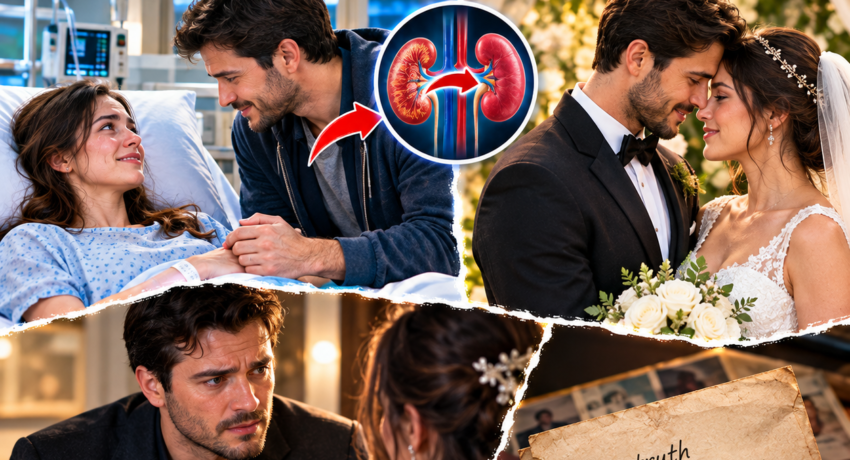
If someone had told me a year earlier that a complete stranger would give me one of his kidneys, I would have thought they were describing the plot of some overly dramatic movie.
If they’d added that I would eventually marry that stranger, I probably would have laughed.
But nothing could have prepared me for what happened minutes after our wedding ceremony.
Nathan had just become my husband when he reached for my hand, leaned toward me, and quietly said something that made the happiness drain from my body.
“There’s something I need to tell you now.”
That sentence changed everything.
But to understand why it hurt so much, you have to understand how we began.
A year earlier, my life had collapsed almost overnight.
I was thirty-one. I had never considered myself especially healthy, but I was healthy enough to take my body for granted. Hospitals belonged to other people. Dialysis was a word I had heard but never imagined would become part of my weekly routine.
Then my kidneys began failing.
There had been warning signs, but nothing that prepared me for how quickly my ordinary life disappeared.
Suddenly, I knew which nurses worked nights.
I knew what antiseptic smelled like at five in the morning.
I knew which chair in the dialysis center squeaked and which vending-machine coffee was least terrible.
My days revolved around blood tests, medication schedules, appointments, needles, waiting rooms, and doctors speaking carefully about possibilities.
The hardest part was the uncertainty.
No one could tell me when—or whether—I would receive a transplant.
My family was tested.
Mom held my hand while the transplant coordinator explained compatibility. Dad pretended to be optimistic. My brother kept making jokes, saying his kidney was probably “top shelf” and I should consider myself lucky.
I laughed because I knew he needed me to.
Then the results came back.
None of them matched.
I remember going home that evening and sitting on the edge of my bed without turning on the light.
For the first time, I allowed myself to think the thought I had been avoiding.
Maybe this was simply my life now.
Maybe there would be no rescue.
Two months later, my doctor walked into the dialysis unit carrying a file.
Something about his face immediately caught my attention.
“We may have a living donor,” he told me.
I stared at him.
“A living donor?”
He nodded.
“Who?”
He looked at the paperwork.
“His name is Nathan.”
I waited for recognition.
None came.
“Nathan who?”
My doctor explained that Nathan knew about my situation through a mutual acquaintance named Mara. They had worked together years before. Apparently, after hearing what had happened to me, Nathan had volunteered to be tested.
And he matched.
I almost laughed because the idea sounded absurd.
“A stranger wants to give me his kidney?”
“He has completed the preliminary screening.”
“But why?”
My doctor gave me the kind of careful expression doctors use when they have no answer.
“You can ask him yourself.”
Three days later, I did.
Nathan entered the hospital conference room carrying two takeaway cups.
“Coffee or tea?” he asked.
I stared at him.
“Coffee.”
He handed me one.
I didn’t drink it.
Instead, the question burst out of me.
“Why are you doing this?”
He sat down across from me.
“Well, hello to you too.”
I didn’t smile.
“I’m serious.”
His expression softened.
“Mara told me what was happening to you. I asked about getting tested.”
“There are thousands of people who need organs.”
“I know.”
“So why me?”
Nathan looked at his hands for a moment.
Then he shrugged slightly.
“Because I got tested. And when they told me I matched, it felt wrong to walk away just because helping you would be inconvenient.”
“That’s it?”
“That’s it.”
“You don’t even know me.”
“No,” he said. “I don’t.”
That answer somehow made his decision even harder to understand.
And yet, over the following weeks, Nathan never wavered.
There were more screenings.
More interviews.
More paperwork.
More opportunities for him to change his mind.
He didn’t.
On the morning of surgery, he found me crying behind the curtain beside my hospital bed.
I wiped my face quickly.
“You’re supposed to be the brave one,” he teased.
I glared at him.
“You’re the idiot giving an organ to someone you barely know.”
“One organ,” he corrected.
“Still stupid.”
He stepped closer.
“Then you owe me.”
I looked up.
“What?”
His expression became unexpectedly serious.
“Use it well.”
Those three words stayed with me.
Hours later, surgeons carried part of Nathan into another operating room and gave it to me.
The transplant worked.
My new kidney began functioning almost immediately.
And Nathan survived just fine.
In fact, he recovered quickly enough to become irritating.
He shuffled into my hospital room wearing ridiculous socks, carrying pudding he definitely hadn’t been given permission to bring.
“You look awful,” he announced.
“You donated a kidney, not your manners.”
“My manners were rejected during screening.”
I laughed and immediately grabbed my side.
“Don’t make me laugh!”
His eyes lit up.
“Finally. I have power.”
That should have been the end of our story.
A generous stranger saves someone’s life.
They recover.
They shake hands.
They move on.
Nathan, however, kept coming back.
And eventually, I realized I didn’t want him to stop.
Part 2 — When Gratitude Became Something More
After we were discharged, Nathan found increasingly ridiculous reasons to visit.
Sometimes he brought groceries.
Sometimes books.
Once, he showed up carrying a small fern.
I looked from him to the plant.
“What am I supposed to do with that?”
“Keep it alive.”
“You saved me and now you’re assigning homework?”
“Yes.”
“That’s cruel.”
“Think of it as rehabilitation.”
I nearly killed the fern within two weeks.
Nathan considered this personally offensive.
Our friendship developed in a strange order.
Most people learned ordinary things about each other before sharing anything important.
Nathan and I had started with surgery.
After that came favorite foods, childhood stories, bad television shows, annoying habits, embarrassing music tastes, and arguments about whether pineapple belonged on pizza.
We had already shared something enormous before learning the tiny details that normally create intimacy.
Maybe that was why everything moved so quickly.
One rainy evening, we found ourselves trapped beneath the awning outside my apartment building.
Neither of us had an umbrella.
Nathan glanced at me.
“You know you don’t have to keep thanking me.”
“I haven’t thanked you once today.”
“You don’t need words.”
“What does that mean?”
“Your face does it.”
I nudged him with my elbow.
“You’re unbearable.”
“Accurate, though.”
I smiled.
And somewhere inside me, something shifted.
That was the moment I understood the dangerous truth.
I no longer wanted Nathan around because I felt grateful.
I wanted him around because I missed him when he wasn’t there.
A month after my transplant, he arrived at my apartment after dark.
This time, he wasn’t carrying food.
No book.
No plant.
No sarcastic joke waiting behind his smile.
He stood in the hallway with his hands buried inside his coat pockets.
“Can I come in?”
Something in his voice frightened me.
I stepped aside.
He sat at my kitchen table, staring at the poor fern sitting near the window.
I tried to break the tension.
“It’s still alive.”
“Barely.”
“Nathan, what’s wrong?”
He took a breath.
“The doctors found something during one of my follow-up examinations.”
My stomach tightened.
“Because you donated?”
“No. It isn’t related to the transplant.”
I sat opposite him.
“Then what?”
He finally met my eyes.
“Cancer.”
For several seconds, I couldn’t speak.
“What kind?”
He told me.
I heard the words, but they barely registered.
What I understood was worse.
Aggressive.
Advanced.
Treatment might slow it down.
Treatment might give him time.
But his doctors didn’t believe they could cure it.
Then came the sentence that shattered whatever hope I was desperately trying to construct.
“They can’t tell me how long I have.”
I reached across the table.
He took my hand.
For the first time since meeting Nathan, he looked truly frightened.
“I don’t want whatever time I have left to be lonely,” he whispered.
“You won’t be alone.”
His mouth twisted into a sad smile.
“Careful saying things like that.”
“I mean it.”
“So do I.”
Then he stood.
He reached inside his coat.
And placed a small ring box beside the dying fern.
For several seconds, I simply stared at it.
“Nathan…”
“I know.”
“You cannot possibly know what I’m about to say.”
“I know this is fast.”
“Fast?”
My voice rose.
“You just told me you have terminal cancer and now you’re putting a ring on my table. This isn’t fast. This is insane.”
“Probably.”
He opened the box.
Inside was a simple silver ring.
Nothing extravagant.
Nothing theatrical.
That somehow made it worse.
It looked real.
“Marry me,” he said.
I stood and walked toward the sink because sitting felt impossible.
“You can’t tell me you’re dying and propose marriage in the same conversation.”
“I know.”
“Do you?”
He stood too.
“I know that I love you.”
I turned toward him.
“Do you actually want me as your wife? Or are you terrified of dying alone?”
Nathan flinched.
Then, quietly, he answered.
“Both things can be true.”
That frightened me more than a polished answer would have.
Because it sounded real.
I thought about the man who had entered my life before he knew anything about me.
The hospital pudding.
The books.
The fern.
The rain.
His hand holding mine while we laughed about things that didn’t matter.
My illness had already taught me that time had no respect for sensible plans.
So I asked him for one thing.
“If I say yes, I need a promise.”
“Anything.”
“No secrets.”
Nathan met my eyes.
“No secrets.”
“Don’t protect me from the truth.”
“I won’t.”
I believed him.
And I said yes.
Part 3 — A Wedding Built Around Uncertainty
We didn’t plan a large wedding.
There was no time for months of seating charts and floral consultations.
More importantly, neither of us wanted that.
We reserved a small garden room behind a local restaurant.
My parents came.
My brother complained dramatically about wearing a tie.
Mara cried before the ceremony began.
Nathan hadn’t started treatment yet.
We didn’t talk about death directly, but it hovered near every conversation.
We tried not to treat every dinner like a last dinner.
Every walk like a last walk.
Every morning like borrowed time.
On our wedding day, before everyone arrived, I held Nathan’s hands and asked one final question.
“Are we doing this because we’re frightened?”
He thought about it.
Then he squeezed my fingers.
“We’re doing it because we’re frightened,” he said, “and because I love you.”
That was enough for me.
The ceremony lasted barely twelve minutes.
I know because my brother secretly timed it.
When we finished signing the documents, he leaned toward me.
“Very efficient.”
I laughed.
Nathan laughed too.
For one perfect moment, everything felt wonderfully ordinary.
Then the officiant announced that we were husband and wife.
Everyone clapped.
I turned toward Nathan.
I expected joy.
Relief.
Maybe tears.
Instead, his expression changed.
His smile disappeared.
I immediately felt cold.
He reached for my hand.
Then he leaned close enough that only I could hear him.
“There’s something I can finally tell you.”
My fingers stiffened inside his.
“What?”
He looked toward the garden doors.
“I have a daughter.”
For a moment, I genuinely thought I had misunderstood him.
“A what?”
“A daughter. Her name is Sophie. She’s twelve.”
The celebration around me seemed to blur.
People were smiling.
Glasses were being raised.
Someone was laughing.
But all I could hear was the sound of my own heartbeat.
“You have a twelve-year-old daughter?”
“Yes.”
“And you’re telling me now?”
His face tightened.
“I wanted to tell you earlier.”
“But you didn’t.”
“No.”
My anger rose so quickly that I almost couldn’t breathe.
“You promised me there would be no secrets.”
“I know.”
“Where is she?”
“With her grandmother. She stays there during school weeks. I usually have her on weekends and for part of the summer. Her mother hasn’t been consistently involved since our divorce.”
Every answer created another question.
“Does Sophie know about me?”
Nathan hesitated.
That hesitation told me everything.
“Yes.”
The pain of that answer surprised me.
“So your daughter knew about the woman you were going to marry, but your future wife didn’t know your daughter existed?”
“She knows about the transplant. She knows about our relationship.”
“And?”
“She didn’t want to meet you.”
“Why?”
Nathan rubbed both hands over his face.
“She thinks you’re replacing her.”
I stared at him.
“Did you give her a reason to think that?”
“No.”
“Then why hide her?”
He looked exhausted.
“Every time I mentioned you, she became angry. Then the diagnosis happened. Everything started moving too fast. I kept waiting for the right moment, and the longer I waited, the harder it became to tell you.”
I stepped backward.
“You married me without telling me because you thought being married would somehow make this easier?”
Nathan looked away.
“I thought if Sophie understood that you weren’t temporary, maybe she’d accept—”
I stopped him.
“You used our marriage to force the situation.”
“No. I married you because I love you.”
“I believe you love me.”
That was perhaps the worst part.
“But you still took away my choice.”
He had no answer.
I looked down at my wedding ring.
An hour earlier, it had represented a promise.
Now it felt like proof that a promise had been made without all the facts.
I walked out through the side door.
Nathan followed me into the parking lot.
“Claire, please.”
I turned.
“Don’t.”
“Please don’t leave.”
“Then stay here.”
He stopped.
“What?”
“For once, don’t decide what happens next.”
I held out my hand.
“Give me Sophie’s grandmother’s address.”
His expression changed instantly.
“Sophie isn’t ready.”
My anger flared again.
“You have spent enough time deciding what everybody else is ready for.”
“She might hate you.”
“Then she gets to decide that.”
He stared at me.
After several seconds, he pulled out his phone.
Part 4 — The Girl Who Had Been Left Out
Sophie’s grandmother lived about twenty minutes away.
I drove there wearing my wedding dress.
The seatbelt pressed awkwardly across the fabric, and every time I stopped at a traffic light, people stared at me.
I probably looked like a runaway bride.
Maybe I was.
Just not for the reason anyone would have guessed.
An older woman answered the door.
Her eyes traveled over my dress.
“You must be Claire.”
“I’m guessing Nathan called.”
“He did.”
“Is Sophie here?”
“Yes.”
“Can I talk to her?”
She hesitated.
“She doesn’t want to see you.”
“I understand.”
The woman studied me.
Then she opened the door slightly wider.
“You can sit on the steps if you’d like.”
So I did.
I sat outside in my wedding dress while ten minutes passed.
Then fifteen.
I was beginning to think Sophie would never come out when the door finally opened behind me.
“This is really weird.”
I turned.
A twelve-year-old girl stood in the doorway with her arms folded.
She had Nathan’s eyes.
She also had the same expression he wore when he thought someone was being ridiculous.
“Yeah,” I said. “It probably is.”
She walked down one step.
Then she asked the question she had apparently been waiting to ask.
“Did you marry my dad because you felt sorry for him?”
I could have given her an easy answer.
I could have said absolutely not.
But after everything Nathan had done, the last thing Sophie needed was another adult simplifying the truth.
“His diagnosis affected the timing,” I admitted. “We might not have gotten married this quickly if he hadn’t been sick. But no, I didn’t marry him out of pity.”
She watched me carefully.
“Then why did he give you his kidney when he didn’t even know you?”
I started to answer.
Then stopped.
Because suddenly, I understood.
Sophie wasn’t truly angry with me.
She was scared.
Her anger was armor.
“You’re afraid he’s going to keep giving pieces of himself to everyone else until there’s nothing left for you.”
Her face shifted.
Only slightly.
But enough.
“Everybody thinks he’s wonderful,” she muttered.
“He is wonderful.”
She rolled her eyes.
“Exactly.”
I almost smiled.
“But you have a right to be angry with him.”
That got her attention.
She sat beside me.
“He does this all the time,” she said. “Not kidneys, obviously. But everything else.”
I stayed quiet.
“Neighbors call him. Friends call him. People from work call. If somebody needs help late at night, he’s already grabbing his keys. Everyone talks about how generous he is.”
She picked at a loose thread on her sleeve.
“Nobody talks about what it’s like waiting for him to come home.”
That sentence landed harder than anything Nathan had told me.
I’d loved his generosity.
Of course I had.
I had benefited from it in the most enormous way imaginable.
Because of Nathan, I was alive.
But Sophie had experienced the other side of that generosity.
Every person he rescued had taken a little of the time she wanted with her father.
I looked down at my wedding ring.
“He should have told me about you.”
“Obviously.”
“And he needs to stop deciding what love looks like for everybody else.”
Sophie gave a short laugh.
“Good luck with that.”
I smiled despite myself.
For the first time that day, I felt like I understood what I needed to do.
Part 5 — Giving the Truth Back to Everyone
By the time I returned to the restaurant, the reception had effectively ended.
But no one had left.
My parents stood beside the empty tables.
My brother’s tie hung loose around his neck.
Mara sat silently with both hands around a champagne glass she hadn’t touched.
Nathan was waiting near the garden doors.
Mom reached me first.
“Claire?”
She searched my face.
“What happened?”
Nathan opened his mouth.
I lifted one hand.
“No.”
He stopped.
I looked directly at him.
“Tell them.”
His face went pale.
“Claire…”
“You decided when I was allowed to know the truth. You don’t get to decide when everyone else hears it.”
The room became silent.
Nathan looked at my mother.
Then Dad.
Then my brother.
Finally, he spoke.
“I have a twelve-year-old daughter.”
Mom frowned.
“And Claire didn’t know until after the ceremony.”
The silence changed.
Mom stared at him.
At first, she looked confused.
Then the meaning settled in.
Her expression hardened.
“You allowed my daughter to make a legal commitment to you without telling her something that important?”
Nathan lowered his head.
“Yes.”
Dad stepped beside her.
“Why?”
For several seconds, Nathan didn’t answer.
Then something in him seemed to give way.
“I kept telling myself I was protecting Sophie.”
He swallowed.
“Then I told myself I was protecting Claire.”
His eyes moved toward me.
“But really, I was protecting myself. If I didn’t tell them everything, neither of them could say no.”
Nobody comforted him.
Not Mara.
Not my family.
Not me.
And that was exactly what Nathan needed.
I moved closer.
“If this marriage is going to continue, this has to stop.”
He looked at me.
“What has to stop?”
“You deciding what everyone needs and then calling it love.”
His eyes closed briefly.
When he opened them again, he looked older.
“Sophie says something similar.”
“Then maybe you should finally listen to her.”
Nathan nodded.
Then he turned toward my parents.
“I’m sorry.”
Mom folded her arms.
He continued.
“Not because Claire discovered the truth. I’m sorry because I took away her chance to decide for herself.”
My mother answered quietly.
“Then give that choice back.”
Nathan looked at me.
This time, he didn’t plead.
He didn’t explain.
He didn’t make another decision on my behalf.
He simply asked.
“Claire, do you want me to leave?”
For the first time all day, I felt the smallest piece of control return to me.
“No,” I said.
Relief flashed across his face.
I held up one finger.
“But you’re going to learn how to ask.”
Part 6 — Loving Someone Without Saving Them
Nothing magically became easy after that.
Our wedding didn’t end with forgiveness.
Our family didn’t transform overnight.
The months that followed were complicated, uncomfortable, and painfully real.
Sophie called me Claire.
Not Mom.
Not stepmom.
Just Claire.
And I never asked for more.
She stayed with us twice.
Then she refused to come over for nearly three weeks.
Nathan wanted to fix it.
I told him not to.
Eventually, Sophie returned when she was ready.
Nathan began changing too.
Slowly.
He protected his weekends with Sophie instead of filling them with errands for neighbors or favors for friends.
When medical appointments came up, he stopped deciding whether Sophie should attend.
He asked her.
Sometimes she said yes.
Sometimes she said no.
Both answers were allowed.
Nathan also had to learn that I didn’t need him managing every part of my recovery.
One morning, I noticed him reorganizing my medication.
“I can handle my own pills.”
“I know.”
I raised an eyebrow.
“Then practice knowing.”
He backed away from the counter.
That became our strange little lesson.
Nathan had always expressed love through doing.
Fixing.
Giving.
Protecting.
Solving.
But sometimes love required him to sit still.
Sometimes it meant asking rather than acting.
Sometimes it meant letting people struggle with a decision instead of making it for them.
His treatment wasn’t easy.
Some scans gave us reasons to hope.
Others left us sitting silently in the car afterward.
His doctors never withdrew the word terminal.
We never received the miracle sentence people hear in movies.
There was no moment when someone entered the room smiling and announced that everything had vanished.
We simply learned to live without certainty.
And Nathan began learning that uncertainty didn’t give him permission to control everyone around him.
I think that changed all three of us.
Part 7 — The World’s Most Complicated Family
That summer, the three of us returned to the garden where Nathan and I had gotten married.
The place looked completely different without wedding decorations.
No flowers arranged perfectly.
No champagne glasses.
No frightened bride discovering that her husband had a secret daughter.
Just three people sitting on a blanket in the sunshine.
Nathan had packed too much food.
Naturally.
Sophie arrived holding two wrapped boxes.
She handed the first one to me.
“For you.”
I opened it.
Inside was an inexpensive mug.
Printed across the front were the words:
WORLD’S MOST COMPLICATED STEPMOM
I burst out laughing.
Nathan leaned over to see it.
He laughed too.
Sophie immediately pointed at him.
“Don’t get smug. Yours is worse.”
She shoved the second package toward him.
Nathan opened it.
His mug said:
ASK YOUR FAMILY FIRST
He groaned.
I laughed harder.
Sophie stole a strawberry from his plate.
“Fair?” she asked.
Nathan looked at the mug again.
“Very fair.”
“Good.”
She ate the strawberry.
I leaned against Nathan’s shoulder.
For once, he wasn’t rescuing a stranger.
He wasn’t solving a neighbor’s emergency.
He wasn’t volunteering for something nobody had asked him to do.
He wasn’t secretly deciding what Sophie could handle.
He wasn’t rearranging my medication.
He wasn’t trying to save the world.
He simply sat there beside his daughter and his wife.
Nathan looked down at the ridiculous mug in his hand.
Then at Sophie.
Then at me.
And I realized something.
The kidney Nathan gave me had saved my life.
But loving him required something entirely different from gratitude.
It required honesty.
Boundaries.
Choice.
And the courage to remain beside someone without surrendering yourself to them.
Nathan had once believed love meant giving pieces of himself away.
I had once believed being grateful meant accepting everything he offered.
Sophie had spent years wondering whether everyone else would always receive the best parts of her father first.
None of us had completely figured it out.
Maybe families never do.
But that afternoon, with Sophie stealing food from Nathan’s plate and Nathan pretending to be offended, nobody needed saving.
Nobody needed fixing.
Nobody needed to make a decision for anyone else.
We were simply three imperfect people learning how to belong to one another without disappearing inside that love.
And for the first time since Nathan walked into my life carrying two cups of coffee and an impossible offer, that felt like enough.